


VA’s 2026 Change: Veteran Spouse Home Care Help for U.S. Families
If you are a veteran spouse or surviving spouse looking for help with in-home care, start with these four VA programs: Aid & Attendance, Survivors Pension, Homemaker/Home Health Aide services, and the Program of Comprehensive Assistance for Family Caregivers. Surviving spouses of wartime veterans often qualify for Survivors Pension paired with Aid & Attendance. Your fastest next step is to contact a VA social worker or start an application at va.gov.
Table of Contents
- VA home and community care options for spouses and survivors
- Eligibility rules that matter for spouses and survivors
- How to apply: forms, evidence, and the process
- What home care services cover and who delivers them
- Costs, rates, and the 2026 policy change families should know
- Working with a VA social worker and using decision aids
- A practical checklist and what to expect timeline-wise
- Why VA benefit navigation works best with a local partner
- How CareBuilders at Home supports veteran spouses and survivors
- Key VA pages and forms worth bookmarking
- Sources
- FAQ
VA home and community care options for spouses and survivors
VA-sponsored care for spouses and surviving spouses falls into two categories: monthly payments you can spend flexibly, and services the VA arranges and supervises directly. Knowing which is which helps you understand what to expect once you apply.
- Aid & Attendance and Housebound benefits add a monthly payment to a VA pension for veterans or survivors who need daily help or are largely confined to home.
- Survivors Pension, sometimes called Dependency and Indemnity Compensation depending on the situation, provides income support to surviving spouses of wartime veterans.
- Homemaker/Home Health Aide (H/HHA) services send trained aides into the home under a registered nurse’s supervision to help with bathing, dressing, and daily tasks.
- Respite care gives family caregivers scheduled breaks, in the home or at a facility, which is crucial for maintaining caregiver well-being and emotional support.
- Home Based Primary Care (HBPC) brings a VA medical team to homebound veterans with complex needs.
- PCAFC (the Program of Comprehensive Assistance for Family Caregivers) supports spouses who serve as a veteran’s primary caregiver with a stipend and guaranteed respite.
A living veteran’s spouse typically applies through the veteran’s own eligibility, while a surviving spouse applies in her or his own name once the veteran has passed. That distinction shapes which forms you file first.
Eligibility rules that matter for spouses and survivors
Eligibility hinges on service history, income, net worth, and medical need, and the rules differ depending on whether you are a spouse or a surviving spouse.
- Survivors Pension requires the deceased veteran to have served during a period of war and the survivor to meet income and net worth limits.
- Aid & Attendance requires documented help with daily activities such as bathing, dressing, or managing medication, or a housebound status confirmed by a medical provider.
- PCAFC requires the veteran to have a service-connected disability rating of 70% or higher and a documented need for at least six months of continuous, in-person personal care, after which a designated spouse caregiver can receive a monthly stipend and at least 30 days of annual respite.
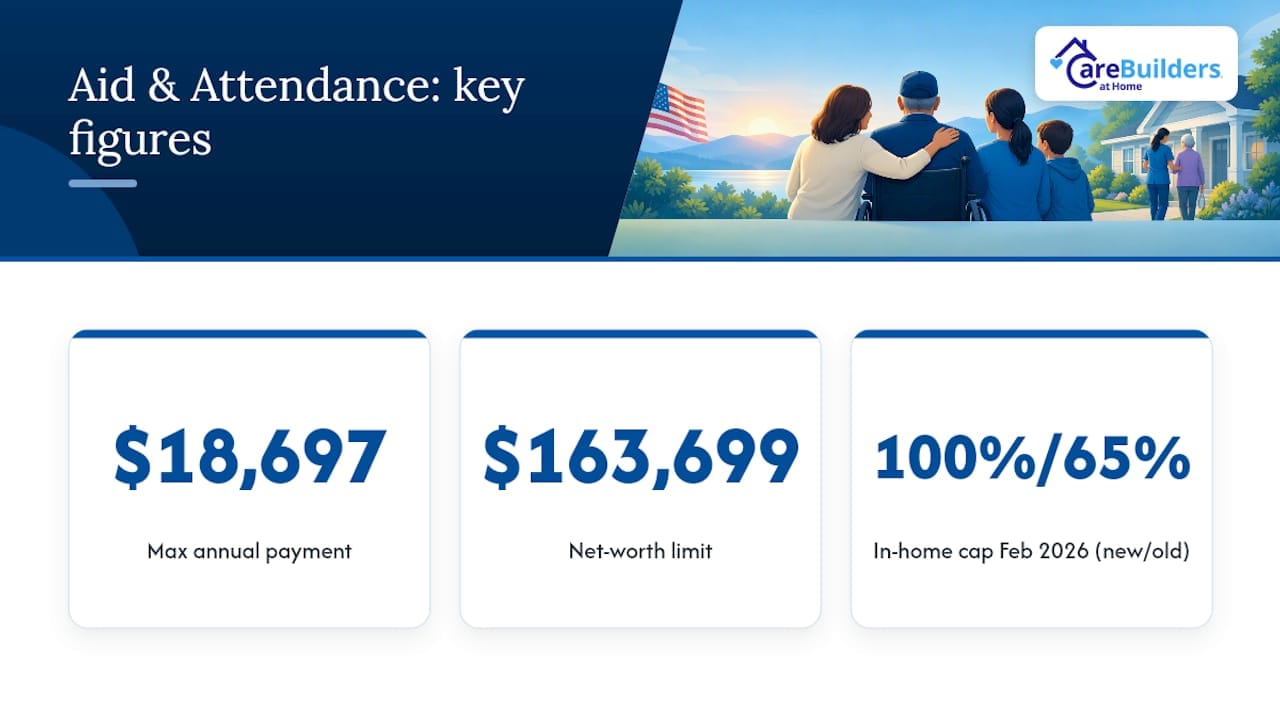
For Survivors Pension, the maximum annual pension rate for a surviving spouse with no children who qualifies for Aid & Attendance is $18,697, with a net worth limit of $163,699, for the period running December 1, 2025 through November 30, 2026. That figure sets the ceiling for what the VA will pay, not a guaranteed amount, since your countable income reduces it.
Copays, wait times, and which services are actually available can vary by VA regional office and by the veteran’s service-connected status, so treat these thresholds as a starting point for a conversation, not a final answer.
How to apply: forms, evidence, and the process
Three forms carry most of the weight in a home care application, and gathering the right evidence upfront saves weeks of back and forth.
- VA Form 21-2680 is the medical evidence form for Aid & Attendance or Housebound claims; a treating provider completes it, and the VA recommends pairing it with a detailed narrative letter describing specific functional loss.
- VA Form 10-10CG is the application for PCAFC, filed jointly by the veteran and the proposed spouse caregiver.
- VA Form 21-0779 is used for requesting nursing home or aid and attendance information when a veteran is in a care facility rather than at home.
Submit forms online at va.gov, by mail to the relevant pension management center, or in person at a VA regional office. Loop in a VA social worker or the Caregiver Support Program early, since they can flag missing documentation before it delays your claim.
Pro Tip: Ask your loved one’s doctor to write specifics like “requires hands-on help transferring from bed to chair” rather than a general note that they “need assistance,” since concrete examples move claims faster.
What home care services cover and who delivers them
Not all VA-funded home care looks the same, and the right fit depends on the level of medical need.
- Homemaker/Home Health Aide services are for veterans who need help with daily personal care; aides work under the supervision of a registered nurse, and hours are set after an interdisciplinary assessment rather than a fixed schedule.
- Home Based Primary Care goes further, sending a full medical team into the home for veterans with complex, ongoing conditions.
- PCAFC caregivers receive a monthly stipend and, in many cases, access to health coverage through CHAMPVA, since the spouse is doing the hands-on caregiving rather than an outside agency.
- Aid & Attendance funds are paid directly to the veteran or survivor and can be used flexibly, including to pay a private caregiver of the family’s choosing.
Costs, rates, and the 2026 policy change families should know
Money worries are often what push families to delay reaching out, so it helps to know the actual numbers before you assume care is out of reach.
Surviving spouses qualifying for Aid & Attendance can receive up to $18,697 a year, tax-free, under the net worth limit of $163,699 for the December 2025 through November 2026 period. That payment can offset a meaningful share of paid home care hours when spent directly on caregiving.
In February 2026, the VA raised the expenditure cap for in-home and community-based services to 100% of the cost of comparable care in a VA Community Living Center for veterans with certain complex conditions, up from the previous 65% cap. Ask your VA social worker directly whether this change affects your family’s authorized hours, since it can mean the VA now covers a larger share of home-based services than it did before.
Copays and exact coverage still vary by region and by the veteran’s disability rating, so confirm your specific numbers rather than assuming a flat rate applies everywhere.
Working with a VA social worker and using decision aids
VA social workers assess needs, coordinate referrals, and connect families to Homemaker/HHA, HBPC, and the Caregiver Support Program, which makes them the most efficient starting point rather than one option among several.
- Ask for a formal needs assessment before you apply for any specific benefit.
- Request a referral to the Caregiver Support Program if you are the primary caregiver.
- Use the Veteran Decision Aid for Care at Home and the Caregiver Self-Assessment to clarify what level of help actually fits your situation.
- Build formal respite into your plan from the start rather than waiting until you are exhausted to ask for it.
Pro Tip: Write down a short, specific list of what your spouse needs help with each day before your first call, since it gives the social worker something concrete to act on immediately.
A practical checklist and what to expect timeline-wise
- Contact a VA social worker or the Caregiver Support Line to request an assessment.
- Gather marriage certificate, death certificate if applicable, military discharge papers, and a detailed medical provider letter.
- Complete the relevant forms, such as VA Form 21-2680 for Aid & Attendance or VA Form 10-10CG for PCAFC.
- Submit through va.gov, by mail, or in person, and ask for a receipt or confirmation number.
- Request interim respite or Homemaker/HHA services while your full application is pending, since some services can start before a final decision.
Processing times vary by regional office and by how complete your paperwork is at submission. If your claim stalls, escalate through your local Caregiver Support Program team or the Caregiver Support Line rather than waiting silently.
Why VA benefit navigation works best with a local partner
Families rarely have the bandwidth to learn VA paperwork while also managing daily caregiving. A VA-approved local provider that already understands Aid & Attendance, PCAFC, and Homemaker/HHA referrals can shorten the learning curve considerably and catch documentation gaps before they cause a denial or delay.
That said, no outside partner replaces the VA social worker as your primary point of contact. The strongest results come from combining both: official VA channels for eligibility decisions, and a local care partner for the day-to-day logistics of getting help into the home quickly.
— cbahplano
How CareBuilders at Home supports veteran spouses and survivors
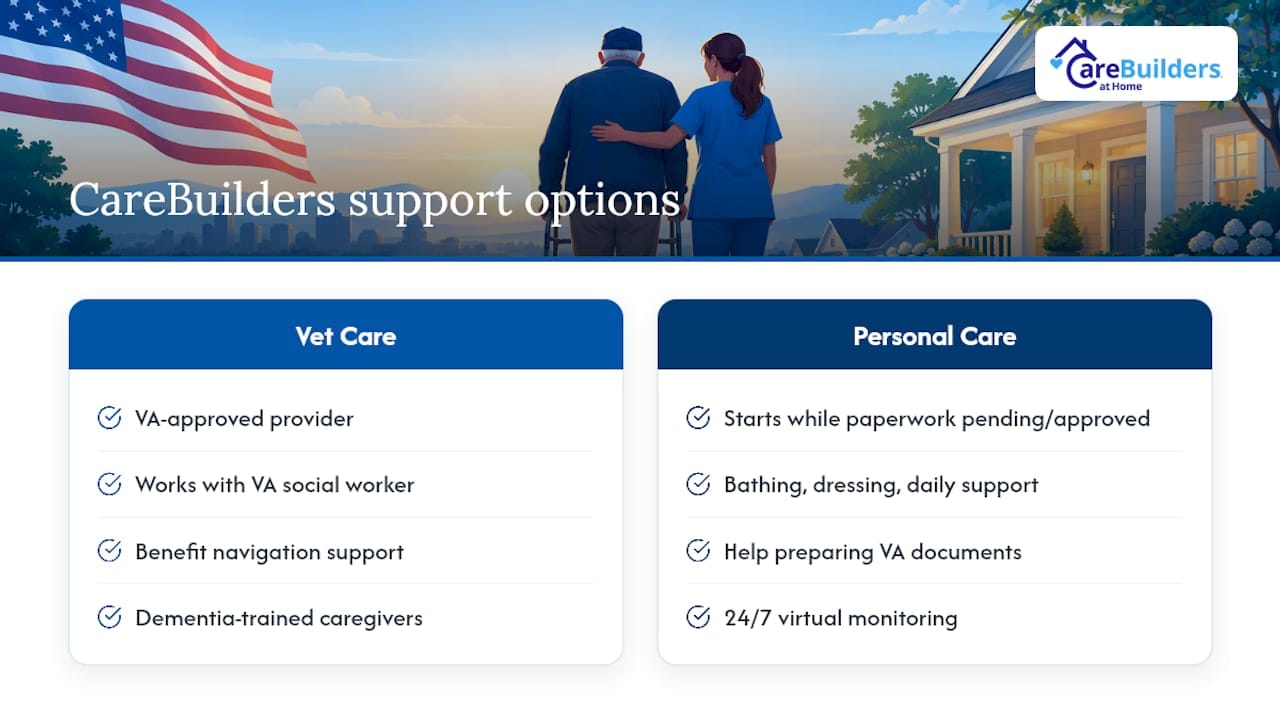
CareBuilders at Home is a VA-approved provider, which means they can work alongside your VA social worker while your Aid & Attendance, PCAFC, or Homemaker/HHA application moves through the system. Our Veterans Care Services include benefit navigation support, dementia-trained caregivers, and transitional care for veterans coming home after a hospital stay.
If your family needs help now, whether your VA paperwork is pending or already approved, our Personal Care Services team can start with bathing, dressing, and daily support while we help you prepare documents for VA submission. They also offer 24/7 virtual monitoring with fall detection as an added safety measure between caregiver visits.
Call our Plano office or visit Cbahplano to schedule a benefits navigation consult and an in-home care assessment.
Key VA pages and forms worth bookmarking
- Aid & Attendance and Housebound benefits: the primary page for eligibility and how to apply.
- Survivors Pension rates: current MAPR and net worth limits.
- PCAFC program page: stipend and respite details for spouse caregivers.
- Social work services: how to find your local VA social worker.
This article is general information, not a substitute for advice from a qualified doctor. Consult a qualified healthcare professional about your own circumstances before acting on anything here.
Sources
- Current Survivors Pension Benefit Rates | Veterans Affairs
- Aid And Attendance Benefits And Housebound Allowance | Veterans Affairs
- Program of Comprehensive Assistance for Family Caregivers (PCAFC) | Veterans Affairs
- VA increases in-home and community-based services expenditure cap for Veterans with complex conditions | VA News
- Social workers | Veterans Health Administration
FAQ
How much does the VA pay a spouse to be a caregiver?
Under PCAFC, a designated primary family caregiver, including a spouse, receives a monthly stipend along with at least 30 days of annual respite care. The exact stipend amount depends on the veteran’s location and level of need, so ask your VA social worker for a current calculation specific to your household.
Does the VA cover in-home care for a spouse?
The VA covers in-home care primarily for the veteran, not directly for a spouse’s own care, through programs like Homemaker/Home Health Aide services and Home Based Primary Care. A surviving spouse may separately qualify for Survivors Pension with Aid & Attendance, which pays a monthly benefit that can be used toward the surviving spouse’s own care needs.
What is the VA 10 year rule for spouse?
Definitions of this rule vary depending on which VA benefit you mean, and it is not a single standardized eligibility test across all programs. If you have heard this term used for a specific benefit, ask your VA social worker to clarify how it applies to your exact situation rather than relying on a general rule of thumb.
Can my spouse get free healthcare if I have VA?
Spousal healthcare access depends on the specific VA program: CHAMPVA can provide health coverage for the spouses of certain veterans, and spouse caregivers enrolled in PCAFC may also gain access to CHAMPVA coverage tied to their caregiver role. Eligibility rules differ by program, so confirm your specific case with a VA social worker before assuming coverage applies.