


How to Choose a Dementia-Trained In-Home Caregiver
TL;DR:
- Choosing a dementia-trained in-home caregiver involves verifying extensive training, hands-on behavioral experience, and ongoing education. Starting the search early helps build trust, ensures proper matching, and improves the senior’s quality of life.
Choosing a dementia-trained in-home caregiver is the process of selecting a qualified professional with the specialized skills, training, and experience needed to support a senior living with dementia safely and with dignity. The industry term for this role is “dementia specialist caregiver,” and the distinction from a general home aide matters enormously. Standards set by the Alzheimer’s Association and the National Council of Certified Dementia Practitioners (NCCDP) define what effective dementia care looks like. Families who understand those standards make better hiring decisions and protect their loved ones from preventable harm.
What qualifies as effective dementia training for in-home caregivers?
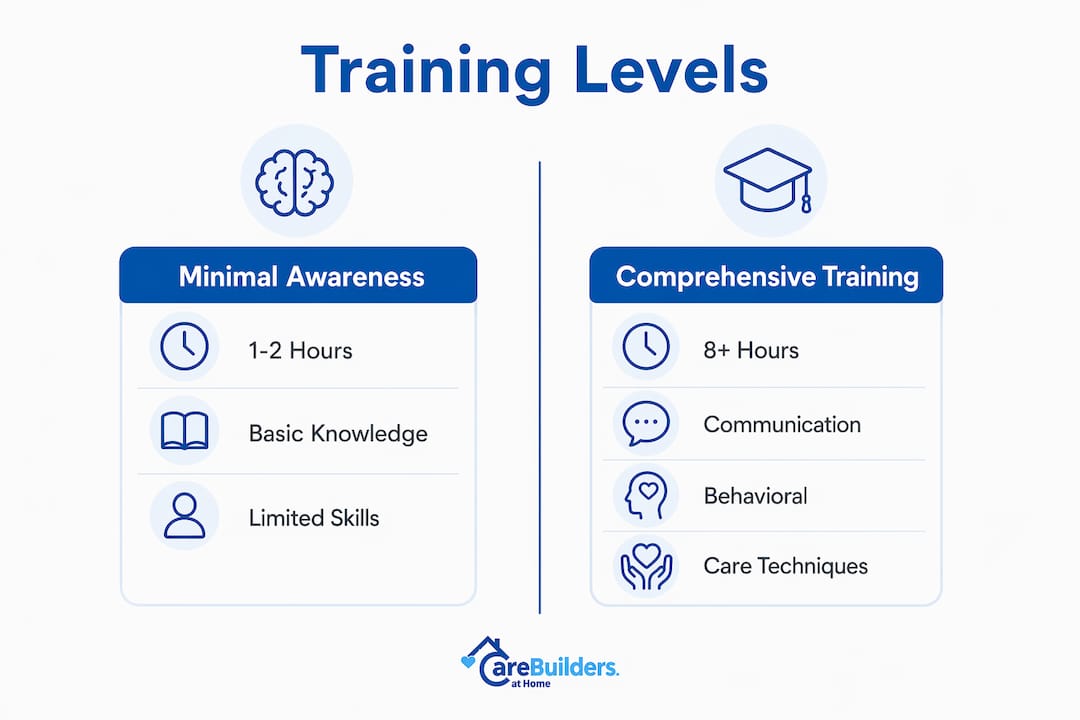
Effective dementia training goes far beyond a brief orientation session. Half of social care staff receive only 1–2 hours of dementia training, well below the 8-hour minimum that experts recommend for person-centered competence. That gap explains why so many families feel their loved one’s caregiver is unprepared for real behavioral challenges.
The 8-hour threshold is a floor, not a ceiling. Comprehensive dementia curricula typically run 13 hours and cover communication techniques, distress recognition, and person-centered care methods that reduce reliance on inappropriate medications. A caregiver who has completed a 13-hour program understands how to read nonverbal cues, de-escalate distress, and adapt routines to a senior’s changing abilities.
Certification adds another layer of accountability. The Certified Dementia Practitioner (CDP) credential, issued by the NCCDP, requires approved training, documented experience, and ongoing education. It signals that a caregiver has committed to evidence-based practice, not just completed a one-time course. Habilitation therapy, a person-centered approach that focuses on emotional well-being rather than cognitive deficits, is another framework worth asking about when you interview candidates.
The table below shows how training depth translates into real-world readiness.
| Training level | Hours | Key competencies covered |
|---|---|---|
| Minimal awareness | 1–2 hours | Basic dementia facts only |
| Foundational | 8 hours | Person-centered care, communication basics |
| Comprehensive | 13+ hours | Distress recognition, behavioral management, medication reduction |
| CDP certified | Ongoing | Evidence-based practice, continuing education requirement |
Pro Tip: Ask every caregiver candidate to name the specific curriculum they completed and how many hours it covered. A confident, detailed answer separates genuinely trained professionals from those who attended a brief orientation.
How do you evaluate dementia caregiver qualifications beyond certificates?
Certificates confirm that a caregiver sat through a program. They do not confirm that the caregiver can handle sundowning at 9:00 PM or redirect a senior who is trying to leave the house. Families should verify a caregiver’s hands-on experience with dementia-specific behaviors, not just their credentials.
Ask direct, scenario-based questions during the interview:
- “Describe a time a client became agitated in the late afternoon. What did you do?”
- “How have you handled a client who refused personal care?”
- “What is your approach when a senior with dementia insists on leaving the home?”
- “Have you supported someone through the later stages of dementia? What changed in your approach?”
These questions reveal whether a caregiver has real experience with wandering prevention, resistance to care, and sundowning. Generic answers like “I stay calm and patient” are not enough. You want specific strategies and concrete examples.
81% of care workers report wanting more dementia-specific training. That statistic tells you two things: most workers recognize their own gaps, and a caregiver who actively pursues additional education is a stronger candidate than one who considers their training complete.
Professional matching services that specialize in dementia care can simplify this process. They pre-screen candidates for documented experience and verified credentials, so you are not starting from zero. Relying solely on availability or a general caregiver registry is one of the most common mistakes families make. Availability is not a qualification.
Pro Tip: Request documentation of the caregiver’s dementia training curriculum, including the training model used (person-centered care, habilitation therapy) and the number of hours completed. This single step filters out the majority of underqualified candidates.
Why does starting dementia care early make such a difference?
Starting professional dementia care before a crisis arrives produces measurably better outcomes. Early engagement allows the senior to participate in building the caregiving relationship while they still have the cognitive capacity to adjust. Waiting until after a fall, a wandering incident, or a hospitalization forces a rushed match under emotional pressure.
The practical steps for early engagement follow a clear sequence:
- Identify the senior’s current diagnosis stage and primary behavioral challenges.
- Document their daily routine, preferences, and triggers in writing before the first caregiver meeting.
- Contact a matching service that specializes in dementia care and request vetted candidate profiles.
- Review profiles within the first 24 hours. Specialized matching services can deliver verified caregiver profiles that quickly for family review.
- Conduct scenario-based interviews with your top two or three candidates.
- Introduce the selected caregiver gradually, starting with shorter visits while the senior is still comfortable with new people.
The contrast between early and late engagement is stark.
| Factor | Early engagement | Late engagement |
|---|---|---|
| Senior’s adjustment | Gradual, participatory | Forced, often distressing |
| Caregiver match quality | Deliberate, needs-based | Rushed, availability-driven |
| Family stress level | Manageable | High, crisis-mode |
| Care continuity | Strong from the start | Frequent disruptions |
| Cost over time | Lower, stable | Higher due to reactive changes |
Detailing your loved one’s diagnosis stage, behavioral patterns, and daily schedule gives a matching service the information it needs to find the right fit. Vague requests produce generic matches. Specific requests produce caregivers who are genuinely prepared for your situation.
How does specialized dementia care improve quality of life?
Person-centered dementia care reduces anxiety, loneliness, and inappropriate medication use while improving a senior’s overall sense of well-being. The mechanism is straightforward: when a caregiver treats a person with dementia as an individual with preferences, history, and dignity, that person feels safer and less distressed.
Well-trained caregivers bring specific practices into daily interactions:
- Using a calm, unhurried tone during personal care routines to reduce resistance
- Orienting the senior gently to time and place without confrontation or correction
- Engaging the senior in familiar activities that reinforce identity and comfort
- Recognizing early signs of distress before they escalate into behavioral episodes
- Integrating psychosocial well-being screening alongside physical care tasks
These practices are not instinctive. They come from training. A caregiver without dementia-specific education tends to correct, redirect abruptly, or rush through tasks. Each of those responses increases agitation and erodes trust.
The benefits extend to families as well. When your loved one is calm, oriented, and treated with respect, your own anxiety decreases. Professional senior care improves outcomes not just for the senior but for every family member who has been carrying the weight of informal caregiving. Exploring brain health care fitness programs alongside in-home care can further support cognitive engagement and daily structure.
Dementia training is an ongoing process. Certifications reflect commitment to evidence-based care and the need for continual education. A caregiver who completed their training three years ago and has not updated their knowledge since is not the same as one who attends regular continuing education. Ask about both initial training and what the caregiver has learned in the past 12 months.
Key Takeaways
Choosing a dementia-trained in-home caregiver requires verifying training depth, assessing real-world behavioral experience, and starting the matching process before a crisis forces a rushed decision.
| Point | Details |
|---|---|
| Training hours matter | Effective dementia care requires at least 8 hours of training; comprehensive programs cover 13+ hours. |
| CDP certification signals commitment | The NCCDP’s Certified Dementia Practitioner credential requires ongoing education, not just a one-time course. |
| Scenario questions reveal real skills | Ask candidates how they handle sundowning, wandering, and resistance to care. |
| Early matching improves outcomes | Starting care before a crisis allows gradual adjustment and a needs-based caregiver match. |
| Person-centered care reduces medication use | Dignity-focused, psychosocially aware care lowers anxiety and inappropriate medication reliance. |
What I have learned about choosing a dementia caregiver
Working closely with families navigating dementia care, I have seen one pattern repeat itself: families focus on availability and overlook training depth. A caregiver who is warm and punctual but has only two hours of dementia training is not equipped for the behavioral complexity that comes with moderate to advanced dementia. Warmth matters. It is not sufficient on its own.
The credential question trips people up. Families see “dementia trained” on a profile and stop asking questions. That phrase can mean anything from a 45-minute online video to a full CDP certification with continuing education requirements. The only way to know is to ask for specifics: the curriculum name, the number of hours, and what ongoing training the caregiver has completed since their initial certification.
I also think families underestimate the value of personality fit alongside credentials. A caregiver who has excellent training but a rushed, task-focused style will still cause distress for a senior who needs slow, patient interaction. The best matches combine documented dementia education, verified behavioral experience, and a communication style that genuinely suits your loved one’s personality and current stage of the disease.
One more thing families rarely consider: the caregiver’s willingness to adapt as dementia progresses. The care needs at early stage are very different from those at late stage. A caregiver who commits to continuous professional development and updates their approach as the disease evolves is worth far more than one who treats the role as static. Ask directly: “How have you adjusted your care approach as a client’s dementia has advanced?” The answer tells you everything.
— cbahplano
Trusted dementia care support in Plano, Allen, and Collin County
CareBuilders at Home of Plano & Allen matches families with vetted, dementia-trained caregivers whose credentials and behavioral experience are verified before any profile reaches you. Care plans are built around your loved one’s specific diagnosis stage, daily routine, and behavioral challenges. As dementia progresses, the plan adapts. You are not left to renegotiate from scratch at every new stage. CareBuilders at Home of Plano & Allen also integrates virtual monitoring and fall detection technology, so your loved one is supported even between caregiver visits. Families in Plano, Allen, Richardson, Wylie, and surrounding Collin County can learn more about specialized in-home personal care and companion services for seniors tailored to dementia care needs.
FAQ
What is a dementia-trained in-home caregiver?
A dementia-trained in-home caregiver is a professional who has completed specialized education in dementia care, covering communication, behavioral management, and person-centered support. This role differs from a general home aide, who may have little to no dementia-specific training.
How many hours of dementia training should a caregiver have?
Experts recommend a minimum of 8 hours of dementia-specific training for person-centered competence, with comprehensive programs covering 13 or more hours. Half of social care staff currently receive only 1–2 hours, which falls well below that standard.
What is the CDP credential and why does it matter?
The Certified Dementia Practitioner (CDP) credential is issued by the NCCDP and requires approved training, documented experience, and ongoing continuing education. It is the clearest signal that a caregiver is committed to evidence-based dementia care rather than a one-time certification.
When should families start looking for a dementia caregiver?
Families should begin the search before a crisis such as a fall or wandering incident forces a rushed decision. Early engagement allows the senior to adjust gradually and gives families time to evaluate multiple vetted candidates based on specific care needs.
What questions should I ask when I hire a dementia specialist caregiver?
Ask candidates to describe how they have handled sundowning, wandering, and resistance to personal care in real situations. Also ask for the name and hour count of their dementia training curriculum and what continuing education they have completed in the past year.
Recommended
- CareBuilders at Home – Exceptional Senior and Veteran Care in Plano, Allen and Richardson
- CareBuilders at Home – Exceptional Senior and Veteran Care in Plano, Allen and Richardson
- CareBuilders at Home – Exceptional Senior and Veteran Care in Plano, Allen and Richardson
- Guide – CareBuilders at Home | Senior and Veteran Care in Plano, Allen & Richardson TX
One Response