


How to Refer Patients in In-Home Geriatric Care
TL;DR:
- Referring patients to in-home geriatric care connects elderly individuals with support that preserves their independence and safety.
- Early referrals based on functional decline or caregiver burnout lead to better health outcomes and ongoing quality of life.
Referring patients to in-home geriatric care is the process of connecting elderly patients with professional, home-based services that address their health, safety, and daily living needs. The industry term for this process is “home care referral,” and it applies across clinical and family caregiving settings alike. More than 75% of adults over age 50 prefer to age in place rather than move to a facility. That preference makes timely, well-coordinated referrals one of the most consequential decisions a physician or family member can make. Whether your patient has dementia, a chronic condition, or declining physical function, the right home care referral connects them with support that protects their independence and quality of life.
When should you refer patients for in-home geriatric care?
The clearest signal for a home care referral is a gap between what a patient can safely do and what their daily life requires. That gap shows up in several ways, and recognizing it early produces better outcomes than waiting for a crisis.
Clinical and functional indicators include:
- Difficulty with activities of daily living (ADLs) such as bathing, dressing, or preparing meals
- A recent fall or a documented fall risk identified during a clinical assessment
- Cognitive decline, including an Alzheimer’s or dementia diagnosis, where unsupervised time at home creates safety concerns
- Post-hospital discharge with wound care, medication management, or physical therapy needs
- Poorly controlled chronic conditions such as diabetes, heart failure, or COPD that require regular monitoring
Caregiver burnout is an equally valid trigger. Caregiver burnout manifesting in missed work or personal health decline justifies a referral even when the patient is not in acute crisis. Waiting until a family caregiver collapses often leads to emergency placements that serve no one well.
Proactive referrals outperform reactive ones. Starting referral conversations early before a crisis allows time for safety modifications, caregiver matching, and relationship building between the patient and their care team. Patients who receive home care before their needs to become severe tend to maintain independence longer.
Pro Tip: If a patient or family member mentions feeling “exhausted” or “unable to keep up,” treat that as a clinical signal. Caregiver fatigue is a documented referral indicator, not just a personal complaint.
What documentation do you need to make a referral?
The referral process is simpler than most healthcare professionals expect. A referral requires only basic patient identifiers: the patient’s name, contact information, primary diagnosis, and a brief description of care needs. Complex intake forms are rarely necessary at the initial stage. The home care agency builds the full care plan after conducting its own in-home assessment.
The core information to have ready includes:
- Full name, date of birth, and contact details for the patient and a family contact
- Primary diagnosis and any relevant secondary conditions (e.g., dementia, diabetes, post-stroke)
- A plain-language description of daily living challenges or safety concerns
- Current medications, if the referral involves medication reminders or skilled nursing support
- Insurance or funding source, such as Medicare, Medicaid, or VA benefits
For patients funded through Medicaid or the VA, a physician’s order may be required before services begin. Veterans in particular benefit from working with a VA-approved provider, since that designation unlocks specific benefit programs. CareBuilders at Home of Plano & Allen holds VA-approved status, which simplifies access for veteran patients and their families.
Home environment details matter more than most referrers realize. Noting whether a home has stairs, a walk-in shower, or a history of clutter helps the agency prepare the right caregiver and safety plan before the first visit.
How do you complete the referral process step by step?
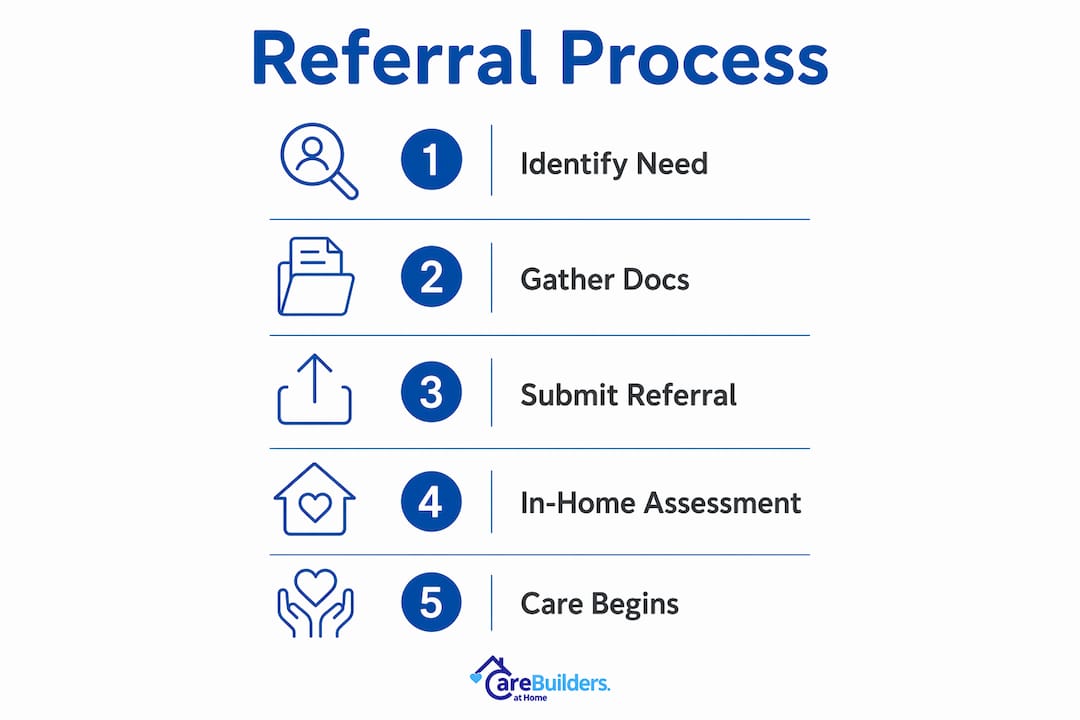
A well-executed referral follows a clear sequence. Skipping steps or leaving information gaps is the most common cause of delays.
- Identify the right agency. Choose a provider with documented experience in geriatric care, particularly for your patient’s primary condition. For dementia patients, confirm the agency offers specialized cognitive care training.
- Make initial contact. Most agencies accept referrals by phone, secure fax, or an online referral portal. Phone contact is fastest and allows you to ask questions in real time.
- Provide the basic patient information. Share the identifiers listed above. The agency will ask clarifying questions during the call.
- Confirm the assessment timeline. Professional home care agencies typically initiate in-home assessments within 24–48 hours of receiving a referral. Confirm this timeline and communicate it to the family.
- Coordinate between providers. Notify the patient’s primary care physician if you are a specialist or family member making the referral. Shared awareness prevents duplicate orders and conflicting instructions.
- Match caregiver skills to patient needs. Communicate specific preferences, such as language, gender, or experience with a particular condition. Good agencies treat this as standard practice, not a special request.
| Referral step | Typical timeline |
|---|---|
| Initial contact and information submission | Same day |
| In-home assessment scheduled | Within 24–48 hours |
| Care plan developed | Within 48–72 hours of assessment |
| Services begin | Within 3–5 days of referral in most cases |
The table above reflects standard timelines for non-emergency referrals. Urgent situations can often be accommodated faster. Always ask the agency about expedited options when a patient’s safety is at immediate risk.
How do you choose the right in-home geriatric care services?
Home care is not a single service. Matching the right service type to the patient’s actual needs is the most important quality decision in the referral process.
The main service categories include:
- Personal care: Assistance with bathing, dressing, grooming, and mobility. This is the most common service for patients with ADL limitations. Personal care services directly support a patient’s ability to remain at home safely.
- Companion care: Social engagement, light household tasks, and supervision. This service addresses isolation and psychosocial needs, which home-based care supports alongside functional autonomy and continuity of daily life.
- Specialized dementia care: Structured routines, cognitive engagement, and behavioral support from caregivers trained in Alzheimer’s and related conditions.
- Skilled nursing: Wound care, medication management, and chronic disease monitoring, typically ordered by a physician.
- Virtual caregiving: Remote monitoring technology that tracks movement, detects falls, and alerts caregivers or family members in real time.
When assessing a provider’s expertise, ask specifically about their training protocols for dementia and cognitive impairment. Case management led by nurses or social workers is often more important than physical caregiving tasks alone in determining quality of life outcomes. An agency that offers coordinated case management, not just task-based caregiving, delivers measurably better results.
Funding options vary by patient profile. Medicare covers skilled nursing and therapy services under specific conditions. Medicaid covers personal care for eligible patients. VA benefits apply to qualifying veterans. Private pay fills gaps where public funding does not reach.
Pro Tip: Ask every agency how they handle caregiver continuity. Frequent caregiver changes are especially disruptive for dementia patients, who rely on routine and familiar faces. A good agency will have a clear policy on this.
What are the most common challenges in the referral and care transition process?
Most referral problems trace back to incomplete information or unclear expectations, not to the complexity of the process itself.
- Incomplete referral information delays the assessment. Missing a diagnosis, a medication list, or a family contact number can push the timeline back by a full day or more.
- Unclear caregiver needs lead to poor matches. A referral that says “needs help at home” without specifying ADL limitations, cognitive status, or safety concerns forces the agency to start from scratch during the assessment.
- Family expectations that do not match service scope create friction early. Home care agencies provide support, not 24-hour medical supervision. Setting accurate expectations at the time of referral prevents disappointment.
- Delayed referrals reduce the range of options available. Being flexible and starting conversations early preserves patient independence and gives families more time to make thoughtful decisions.
- Failure to update the care plan as the patient’s condition changes. Home care is not static. A patient’s needs six months after a stroke differ significantly from their needs at discharge. Regular communication between the family, the agency, and the treating physician keeps the care plan aligned with reality.
The best outcomes come from treating the referral as the beginning of an ongoing relationship, not a one-time transaction. Agencies that offer structured care plan reviews and open communication channels make that continuity much easier to maintain.
Key Takeaways
Timely, well-documented home care referrals are the single most effective way to protect elderly patients’ independence and quality of life at home.
| Point | Details |
|---|---|
| Refer early, not in crisis | Proactive referrals allow safety planning and better caregiver matching before needs become urgent. |
| Documentation is minimal | Basic patient identifiers and a brief care description are enough to initiate an assessment within 24–48 hours. |
| Match service type to need | Personal care, dementia care, companion services, and skilled nursing each address different patient needs. |
| Caregiver burnout is a valid trigger | Family caregiver fatigue justifies a referral even when the patient is not in acute medical crisis. |
| Case management drives outcomes | Agencies offering coordinated case management produce better quality of life results than task-only providers. |
What I’ve learned from watching referrals go right and wrong
After working closely with families and healthcare providers navigating geriatric home care, the pattern I see most often is this: the families who wait for a crisis almost always wish they had called sooner. The ones who reach out while their loved one is still relatively stable get to choose their caregiver, set a comfortable pace, and build trust before the hard days arrive.
The clinical side of this is well documented. Home care improves both daily activity ability and mental state scores after professional care is implemented. Those numbers reflect something real: patients who receive consistent, skilled support at home function better and feel better. That is not a minor benefit.
What the data does not fully capture is the psychosocial dimension. Loneliness and loss of purpose accelerate cognitive decline in elderly patients faster than most families realize. Home-based care that integrates family involvement with formal services addresses that dimension directly. The best care plans treat the whole person, not just the diagnosis.
My honest recommendation to every healthcare professional and family member reading this: do not treat the referral as the last resort. Treat it as a tool you use to protect someone’s dignity and independence while they still have plenty of both left to protect.
— cbahplano
CareBuilders at Home of Plano & Allen: a trusted partner for your referral
CareBuilders at Home of Plano & Allen serves seniors and veterans across Plano, Allen, Richardson, Wylie, and surrounding Collin County with care plans built around each person’s specific needs. Services range from personal care and daily assistance to specialized dementia support, companion services, and virtual caregiving technology that monitors safety around the clock. As a VA-approved provider, CareBuilders also helps veterans access the benefits they have earned. Referrals are straightforward: a phone call with basic patient information is all it takes to schedule an in-home assessment, typically within 24–48 hours. Reach out to CareBuilders at Home of Plano & Allen to get your patient or loved one the right support, without delay.
FAQ
What information do I need to refer a patient to home care?
You need the patient’s name, contact details, primary diagnosis, and a brief description of their care needs. Complex forms are not required; the agency builds the full care plan after an in-home assessment.
How quickly can home care services start after a referral?
Most professional agencies complete an in-home assessment within 24–48 hours of receiving a referral. Services typically begin within 3–5 days of the initial contact.
Does Medicare cover in-home geriatric care services?
Medicare covers skilled nursing and therapy services when ordered by a physician and deemed medically necessary. Personal care and companion services are generally not covered by Medicare but may qualify under Medicaid or VA benefits.
When is the right time to refer an elderly patient to home care?
The right time is before a crisis occurs. Referrals made when a patient shows early ADL limitations, fall risk, or cognitive decline allow for better planning and stronger outcomes than emergency placements.
Can family members make a home care referral, or does it require a physician?
Family members can initiate a referral directly with a home care agency. A physician’s order is only required for specific funded services, such as Medicaid-covered personal care or VA-approved programs.
Recommended
- Personal Care – CareBuilders at Home | Senior and Veteran Care in Plano, Allen & Richardson TX
- sensi.ai – CareBuilders at Home | Senior and Veteran Care in Plano, Allen & Richardson TX
- Virtual Caregiver – CareBuilders at Home | Senior and Veteran Care in Plano, Allen & Richardson TX
- Guide – CareBuilders at Home | Senior and Veteran Care in Plano, Allen & Richardson TX