


Veteran In-Home Caregiver Jobs in Plano & Collin County
You can get non-medical in-home caregiver work serving Veterans in Plano and Collin County right now. The fastest route is to apply directly to a local VA-approved community provider, such as CareBuilders at Home of Plano & Allen, and keyword your resume for roles like “personal care aide,” “companion caregiver,” “homemaker,” and “Veteran Directed Care (VDC).” These jobs involve bathing, dressing, meal prep, mobility assistance, medication reminders, and coordination with VA Caregiver Support Teams — no nursing license required.
Your immediate next steps:
- Update your resume to one page and include keywords: personal care, homemaker, companion, VDC, respite caregiver
- Gather a valid government-issued ID, Social Security card, and references
- Apply on the CareBuilders at Home of Plano & Allen careers page today
- Complete a CPR/First Aid certification if you don’t already have one
- Note: TriWest provider enrollment is for agencies, not individual caregivers
Key Takeaways
Finding veteran in-home caregiver work in Plano starts with applying to a VA-approved local agency and having your background check and CPR certification ready.
| Point | Details |
|---|---|
| Where referrals come from | VA CCN (TriWest Region 4), VDC budgets, and PCAFC family designations drive local care demand. |
| Core job duties | Personal care, companion services, homemaker tasks, and coordination with VA Caregiver Support Teams. |
| Hiring requirements | Age 18+, clear background check, CPR certification; CNA is helpful but not required for non-medical roles. |
| Pay distinction | Agency wages are separate from PCAFC stipends, which go only to designated family caregivers. |
| Local employer option | CareBuilders at Home of Plano & Allen is a VA-approved provider hiring caregivers across Collin County. |
Table of Contents
- How to apply for veteran in-home caregiver jobs step by step
- What in-home veteran caregiver employment actually looks like locally
- Qualifications most employers require for these roles
- Pay and labor market conditions in Plano and Collin County
- Background checks and Texas-specific requirements
- CareBuilders at Home of Plano & Allen is hiring veteran caregivers now
- Helpful resources for veteran caregiver job seekers
- What veteran caregiving actually feels like on the ground
- Sources
How to apply for veteran in-home caregiver jobs step by step
Documents to prepare:
- Government-issued photo ID and Social Security card
- Proof of CPR/First Aid certification (or enrollment in a class)
- Two professional or personal references
- Any prior caregiving credentials (CNA certificate, dementia training completion)
- Signed consent for a background check
Resume keywords that get noticed: personal care aide, companion care, homemaker services, Veteran Directed Care, HCBS, respite care, dementia care, ADL assistance.
Interview tips: Be specific about hands-on experience. Mention any Veterans you’ve supported, your comfort with mobility assistance, and your willingness to coordinate with VA social workers or Caregiver Support Program teams.
What in-home veteran caregiver employment actually looks like locally
Most in-home veteran caregiver roles in Plano and Collin County are filled through community agencies enrolled in VA’s Community Care Network (CCN). Texas sits in CCN Region 4, and TriWest Healthcare Alliance is the regional third-party administrator (TPA) that manages VA referrals here. Agencies must enroll with TriWest to receive those referrals — individual caregivers do not enroll; they apply to the agency.
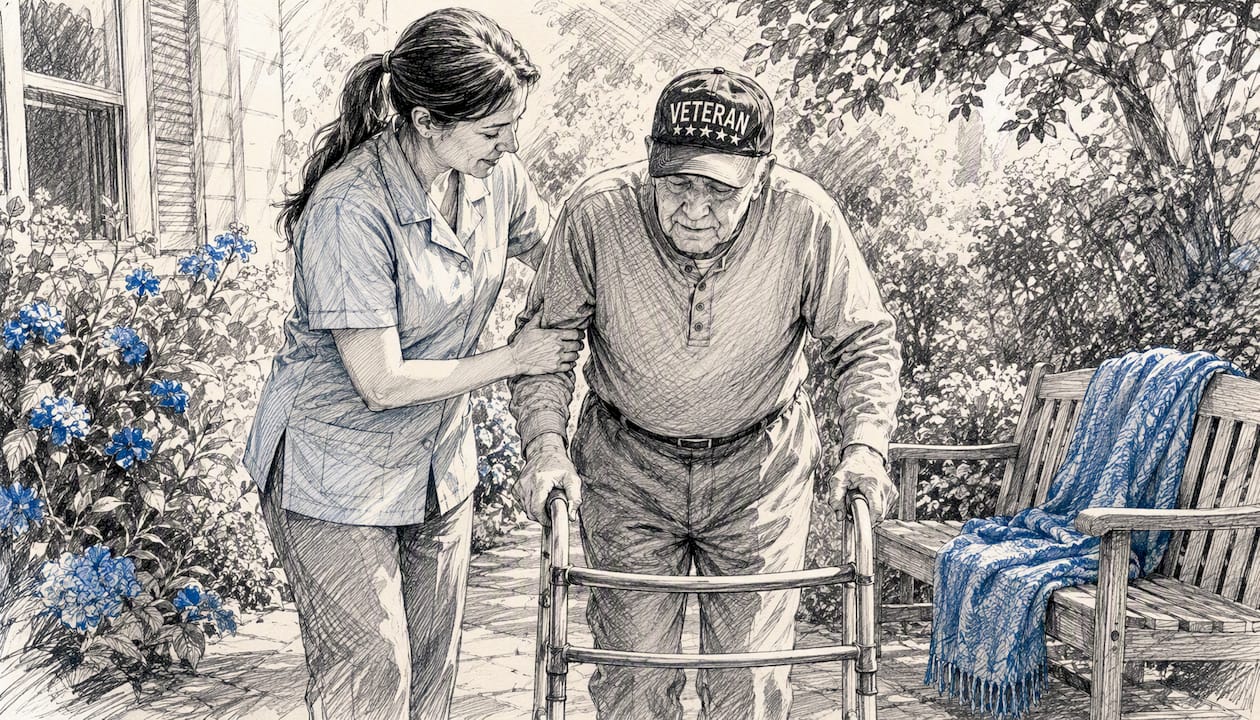
Two other VA programs also create local demand. Veteran Directed Care (VDC) gives Veterans a flexible budget to hire caregivers directly, including paid non-family caregivers under local program rules. The Program of Comprehensive Assistance for Family Caregivers (PCAFC) provides monthly stipends and CHAMPVA coverage — but only to designated family caregivers, not agency employees. If a family member asks you about a “VA stipend,” that distinction matters.
Qualifications most employers require for these roles
Texas does not require a state license for non-medical personal care aides. What local employers and VA-approved agencies consistently ask for:
- Age 18 or older
- Clear criminal background check (federal and state)
- CPR/First Aid certification
- Dementia or Alzheimer’s awareness training (often provided by the agency)
- Reliable transportation within Collin County
- CNA certification is helpful but not required for non-medical roles
Pay and labor market conditions in Plano and Collin County
Demand for veteran in-home caregivers in Collin County is steady and growing, driven by the area’s large and active military-connected population. Agency-employed personal care aides in the Plano area typically earn hourly wages in the range that reflects the competitive DFW labor market; specific rates vary by agency, shift type, and experience. Part-time, full-time, and occasional respite shifts are all common. Benefits such as paid training, mileage reimbursement, and flexible scheduling vary by employer. VA caregiver stipends under PCAFC are separate from these wages and go directly to designated family caregivers, not agency staff.
Background checks and Texas-specific requirements
Texas does not require a separate state registry for non-medical personal care aides, but VA-approved agencies must conduct thorough background screenings. Expect:
- A Texas Department of Public Safety criminal history check
- An OIG (Office of Inspector General) exclusion list check
- Possible FBI fingerprint check for roles involving VA-referred clients
- Drug screening at the agency’s discretion
Agencies enrolled in VA’s CCN through TriWest must meet VA credentialing standards, which means your background clearance is part of the agency’s compliance — not just a hiring formality.
CareBuilders at Home of Plano & Allen is hiring veteran caregivers now
If you want a VA-approved employer with local roots, CareBuilders at Home of Plano & Allen serves Veterans in Plano, Allen, Richardson, Wylie, and surrounding Collin County. Roles include personal care aide, companion caregiver, homemaker, respite caregiver, and virtual caregiver support positions. Schedules range from part-time and full-time to overnight and occasional respite coverage. The agency provides dementia training, veteran benefit navigation support, and coordinates directly with VA Caregiver Support Teams on client care. As a VA-approved provider, it can receive CCN referrals through TriWest for Region 4 clients. To apply, visit the personal care services page or the veterans care page and submit your resume with a note about your availability and any prior caregiving experience.
| Hiring type | VA referral eligibility | Typical pay/benefits | Required training |
|---|---|---|---|
| Agency employee (full/part-time) | Yes, via CCN/TriWest enrollment | Hourly wage, paid training, mileage | CPR, dementia training, background check |
| Independent contractor | Limited; agency-dependent | Hourly rate, no benefits | CPR, background check |
| VDC-hired caregiver | Yes, under Veteran’s budget | Managed budget rate | Per local VDC program rules |
| PCAFC family caregiver | Stipend only (not agency wage) | Monthly stipend, CHAMPVA | VA-required caregiver education |
Helpful resources for veteran caregiver job seekers
- VA Community Care Network overview — how CCN works and regional TPA contacts
- TriWest provider enrollment portal — for agencies seeking to join CCN Region 4 (not for individual caregivers)
- PCAFC program page — eligibility, VA Form 10-10CG, and stipend details for designated family caregivers
- CareBuilders at Home veterans care page — local VA-approved services and hiring information
For eligibility questions about PCAFC or PGCSS, contact your local VA Caregiver Support Program team or call the national Caregiver Support Line. VA Form 10-10CG is the joint application for PCAFC and is for designated family caregivers, not agency employees.
What veteran caregiving actually feels like on the ground
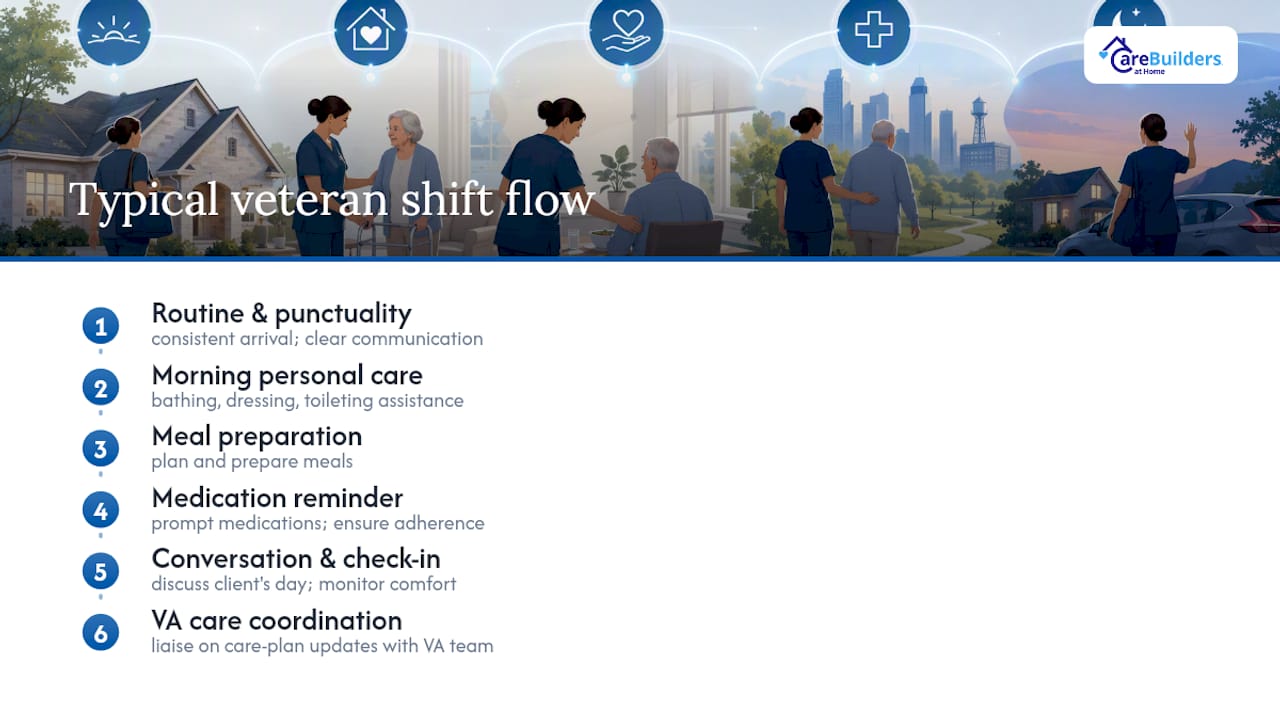
There is something distinct about working with a Veteran client that you notice within the first few visits. Many Veterans value routine, clear communication, and a caregiver who shows up consistently and on time. A typical shift might start with morning personal care, move into meal preparation, and end with a medication reminder and a conversation about the client’s day. What makes it meaningful is the coordination piece: when a client’s VA Caregiver Support Team reaches out about a care plan update, you are part of that conversation as the person in the home. Keeping a Veteran comfortable and safe in their own residence is not a small thing. It is often the difference between independence and institutional care. That is the work, and it matters every single day.
Sources
- Community Care Network – Community Care
- Program of Comprehensive Assistance for Family Caregivers
- Policy brief: Home and Community Based Services
- Caregiver Support Program