


30 Days of VA Respite Care: Who Qualifies and How to Apply in the U.S.
Most Veterans enrolled in VA health care who need help with daily activities, and who have a family caregiver, qualify for VA respite care, though the exact fit depends on clinical need and where you live. Formal respite typically covers around 30 days a year, with room for more when the care team agrees it’s clinically necessary. Your next move: call the veteran’s VA primary care team, ask for the social worker, or dial the Caregiver Support Line to start the assessment process.
TL;DR:
- VA respite care typically provides at least 30 days annually, but extensions are possible when clinically necessary and caregiver requests are documented.
- Eligibility depends on the veteran’s functional needs and caregiver status, not solely on disability ratings, requiring a thorough clinical and caregiver assessment.
- Application involves multiple steps with the VA, including assessments and documentation review, often taking weeks or months to finalize.
- Local availability and waitlists heavily influence access to institutional respite, making early planning and coordination essential.
- Costs vary based on provider type and veteran priority group, with VA-funded respite often free for higher-priority veterans but potentially incurring copays for others.
Table of Contents
- What Counts as VA Respite Care?
- Who Qualifies for VA Respite Care?
- How Do You Apply for VA Respite Care?
- How Many Days of Respite Care Does the VA Provide?
- What Does VA Respite Care Cost?
- Planning Around Local Availability and Waitlists
- What Clinical Criteria Actually Determine Eligibility?
- Why Do VA Respite Requests Get Denied?
- What Documentation Do You Need to Prove Eligibility?
- Has VA Respite Eligibility Changed Recently?
- Does Your Eligibility Status Affect What You Pay?
- Why Planned Respite Matters More Than Caregivers Realize
- How We Help You Turn VA Eligibility Into Real Relief
- Sources
What Counts as VA Respite Care?
Respite means giving the primary caregiver a planned break while someone else steps in to care for the veteran. The VA Caregiver Support Program breaks this into three categories: self-guided respite (informal arrangements you set up yourself, like asking a neighbor to sit with your spouse), informal respite (unpaid help from family or friends), and formal respite, which is the VA-arranged, VA-funded kind.
Formal respite comes in three types:
- In-home respite: A trained aide comes to the veteran’s house so the caregiver can leave for a few hours or days.
- Adult day health respite: The veteran attends a structured day program with medical and social support, then returns home each evening.
- Nursing home or Community Living Center respite: The veteran stays overnight at a facility, usually for planned trips, medical procedures, or caregiver recovery time.
Caregivers use these for ordinary reasons. Running errands, attending a caregiver training session, taking a short vacation, or simply catching up on sleep after weeks of broken nights all qualify as legitimate uses of respite.
Who Qualifies for VA Respite Care?
Enrollment in VA health care is the starting gate. The VA’s geriatrics and extended care page confirms that enrolled veterans become eligible for respite once they meet clinical criteria, and that actual services vary by location.
Clinical eligibility usually comes down to functional need, not a specific disability rating. The care team looks at whether the veteran needs help with activities of daily living (bathing, dressing, mobility) or needs supervision for safety reasons, such as with dementia or fall risk.
Caregiver status matters too. If the veteran is enrolled in the Program of Comprehensive Assistance for Family Caregivers (PCAFC), a designated primary or secondary family caregiver may need to complete caregiver training and demonstrate competence before certain respite arrangements are finalized.
A few caveats worth flagging before you get your hopes up:
- If a nursing home stay requires a non-VA facility, community care eligibility rules apply and can differ by VA region.
- Waitlists for adult day health programs and nursing home beds are common in high-demand areas.
- Local program availability, not national policy, is often the real limiting factor.
Quick fact: No single VA form or disability percentage automatically grants respite eligibility. Approval rests on a documented clinical and caregiver assessment specific to the veteran’s situation.
How Do You Apply for VA Respite Care?
Applying starts with a conversation, not paperwork. Reach out to the veteran’s VA primary care team, ask specifically for the assigned social worker, or call the Caregiver Support Line at 1-855-260-3274 to get pointed toward the right local contact.
From there, the process generally follows this sequence:
- Clinical assessment. The care team evaluates the veteran’s functional and medical needs.
- Caregiver assessment. The social worker reviews the caregiver’s role, availability, and support needs.
- Veteran Functional Assessment. This documents specific limitations tied to daily activities.
- Home-care assessment. Conducted in person or through VA Video Connect, this confirms what kind of respite fits the household.
- Documentation review. Paperwork, potentially including VA Form 10-10EC for extended care services, gets submitted for approval.
The PCAFC application process factsheet outlines a similarly structured, multistep flow for caregivers seeking program benefits, with centralized review adding time to the timeline.
Plan for weeks, sometimes months, between your first call and confirmed respite days, especially for institutional stays. PCAFC decisions carry appeal rights if your application gets denied or downgraded.
Pro Tip: Call the Caregiver Support Line before your first VA appointment. Ask them to flag your case so the social worker already has context when you walk in.
How Many Days of Respite Care Does the VA Provide?
The VA guarantees a baseline of at least 30 days of formal respite per calendar year, combined across in-home, adult day health, and nursing home types, according to 38 CFR 71.40.
That 30-day figure isn’t a hard ceiling.
The regulation specifies that respite days may exceed 30 annually “when clinically appropriate” and requested by the veteran’s primary family caregiver. In practice, this means a caregiver recovering from surgery or facing a documented health crisis can ask the care team to authorize additional days beyond the standard allotment.
A five-night nursing home stay counts as five days against the annual total. A single afternoon of in-home respite typically counts as a partial day, though how VA facilities tally partial days can vary locally, so ask your social worker directly.
What Does VA Respite Care Cost?
Cost depends on two things: who provides the care and the veteran’s assigned priority group. VA-delivered respite often carries no direct charge for qualifying veterans, while community-provider respite may involve a copay tied to income and disability rating.
Before scheduling anything, ask the VA social worker these questions:
- Will this specific respite stay generate a copay, and if so, how much?
- Does CHAMPVA cover any portion of this care?
- Are there PCAFC-related travel or training reimbursements that apply to my situation?
Getting a written cost estimate upfront avoids the unpleasant surprise of a bill arriving weeks after the respite stay ends.
Planning Around Local Availability and Waitlists
Local demand, not national policy, usually decides whether you get respite when you need it. Adult day health programs and nursing home beds fill up fast in many regions, so planning months ahead for institutional respite is not optional if you want a real chance at securing a spot.
Here’s a practical sequence:
- Confirm program or bed availability with your social worker as soon as you know you’ll need respite.
- Prepare a one-page care summary covering medications, daily routines, and emergency contacts to hand off to whoever provides the respite.
- Lean on informal or self-guided respite while you wait for formal approval.
- If your request stalls, escalate through your local Caregiver Support Program team or call the Caregiver Support Line directly.
Pro Tip: Keep that one-page care summary updated year round, even when you’re not actively requesting respite. You’ll never scramble to write it under pressure.
What Clinical Criteria Actually Determine Eligibility?
Beyond the general “needs help with daily activities” standard, VA care teams look at specific functional markers when deciding how much respite a veteran qualifies for and which type fits best.
A veteran who needs supervision for safety, such as someone with moderate to advanced dementia who wanders or forgets to turn off the stove, often qualifies for a higher tier of in-home respite hours than someone who simply needs help getting dressed. Mobility limitations that require two-person assistance for transfers (getting in and out of bed or a wheelchair) push cases toward nursing home or Community Living Center respite rather than a single home health aide visit.
Cognitive decline gets weighed differently than physical limitation. A veteran who is physically capable but disoriented or prone to unsafe decisions may need adult day health respite specifically because it offers structured supervision, not just companionship. Care teams also factor in whether the veteran has multiple chronic conditions requiring coordinated monitoring, since that complexity can justify longer or more frequent respite authorizations.
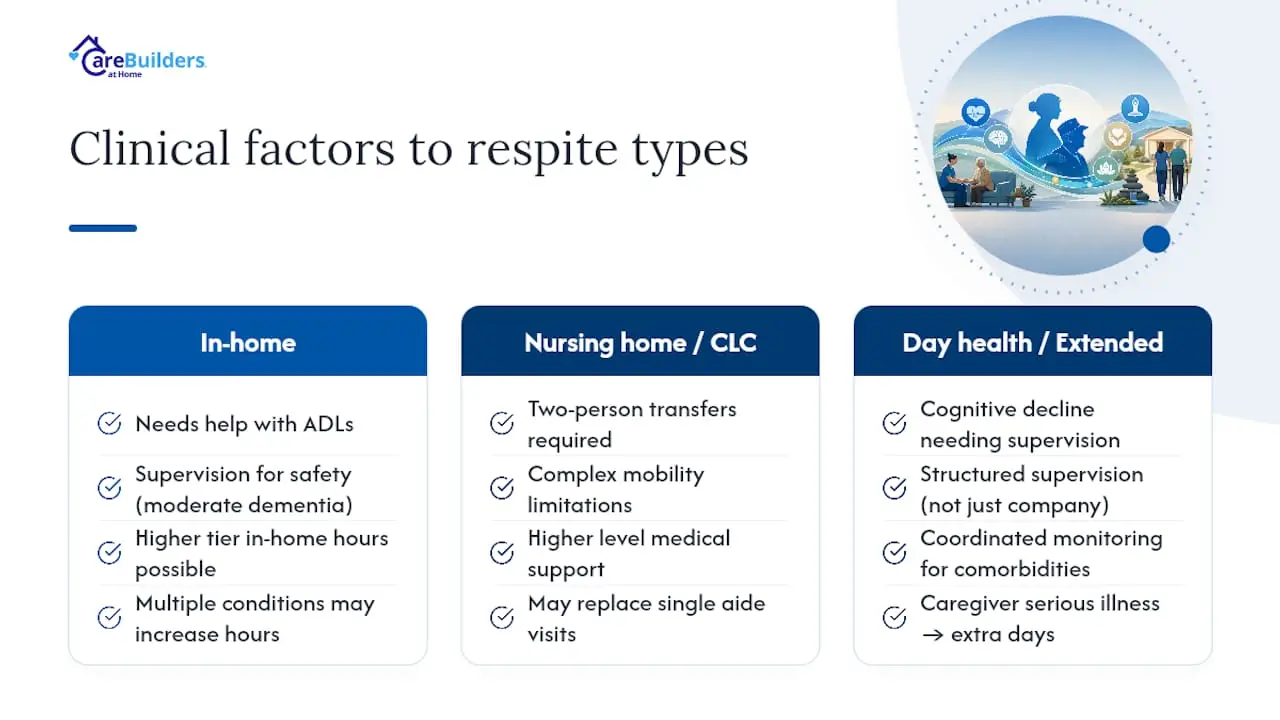
The caregiver’s own health matters clinically too. A caregiver managing their own serious medical condition, documented by a physician, strengthens the case for additional respite days beyond the standard allotment under the flexibility built into 38 CFR 71.40. None of these factors work in isolation. The social worker weighs them together during the assessment, which is why two veterans with similar diagnoses can end up with different respite authorizations based on daily functional reality.
Why Do VA Respite Requests Get Denied?
Denials usually trace back to a handful of recurring issues, and most are fixable with better documentation or a follow-up conversation.
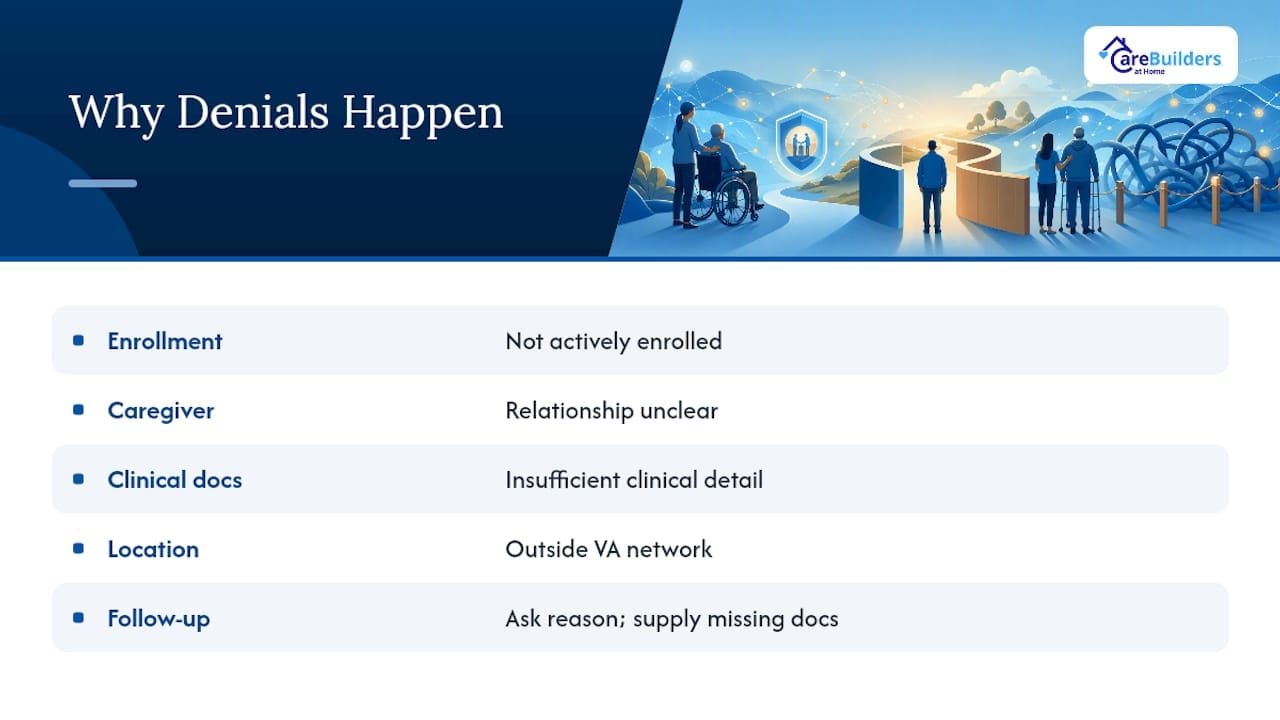
Incomplete enrollment is the most common snag. If the veteran isn’t fully enrolled in VA health care, or their enrollment status has lapsed, the request stalls before clinical review even begins. Confirm active enrollment before submitting anything else.
A second frequent cause is a caregiver assessment that doesn’t clearly establish the caregiving relationship. If the person requesting respite isn’t formally recognized as the primary or secondary caregiver, especially under PCAFC, the application may get bounced back for clarification.
Insufficient clinical documentation trips up plenty of requests too. A vague description like “needs some help” doesn’t give the care team enough to justify a specific respite type or duration. Ask your social worker exactly what functional detail they need, then have the veteran’s physician document it precisely.
Geographic mismatch causes denials as well. Requesting a nursing home respite stay at a facility outside the veteran’s community care network without prior authorization is a common, avoidable rejection.
If you get denied, ask for the specific reason in writing, then address that exact gap rather than resubmitting the same request. PCAFC decisions carry formal appeal rights, and even non-PCAFC respite denials usually allow a follow-up review once missing documentation is supplied.
What Documentation Do You Need to Prove Eligibility?
Gathering the right paperwork before your first appointment speeds everything up considerably.
Start with proof of VA health care enrollment, which the primary care team can confirm on the spot. Bring a current medication list and a summary of the veteran’s diagnoses, particularly anything affecting mobility, cognition, or safety.
Documentation of the caregiving relationship matters for PCAFC-related respite specifically. This might include proof of legal guardianship, a signed caregiver agreement, or the caregiver’s own statement of daily responsibilities. The Veteran Functional Assessment and the home-care assessment, both completed during the application process, become part of the official record and don’t require you to bring anything extra beyond honest, detailed answers.
If you’re requesting extended care services, VA Form 10-10EC may factor into the paperwork, though your social worker will confirm whether it applies to your specific respite request. Keep copies of everything you submit. Caregivers who track their own paper trail find it far easier to handle an appeal or follow-up request if the first application hits a snag.
Has VA Respite Eligibility Changed Recently?
Respite policy tends to shift at the margins rather than through sweeping overhauls, and the core eligibility framework described in 38 CFR 71.40 has remained the regulatory backbone for the 30-day baseline and its exceptions.
What does shift more often is how PCAFC applications get processed and reviewed, along with which community care partners are authorized in a given region. Caregivers who applied a year or two ago and got denied should consider checking back with their local Caregiver Support Program team, since staffing, review timelines, and even local facility partnerships change over time.
The most reliable way to stay current isn’t scanning news articles. It’s asking your assigned social worker directly whether anything about the local respite program, waitlist situation, or documentation requirements has changed since your last conversation. Regional VA offices sometimes interpret community care eligibility rules differently from one facility to the next, so a policy update in one state may not apply the same way in yours.
Does Your Eligibility Status Affect What You Pay?
Eligibility and cost are tied together more closely than most caregivers expect. A veteran’s priority group, which is partly determined by disability rating and income, directly shapes whether formal respite comes free or with a copay attached.
Veterans in higher priority groups, particularly those with service-connected disabilities rated at a significant percentage, typically face no direct charge for VA-delivered respite. Veterans in lower priority groups may see a copay applied, especially when the respite care happens through a community provider rather than a VA facility directly.
The type of respite matters financially too. In-home respite delivered by a VA-contracted agency often carries different cost rules than a nursing home stay at a Community Living Center. This is exactly why asking your social worker for a written cost estimate before scheduling anything isn’t optional. Eligibility approval and cost approval are two separate conversations, and assuming one guarantees the other has caught more than a few caregivers off guard.
Why Planned Respite Matters More Than Caregivers Realize
Respite isn’t a luxury. It’s how you stay steady enough to keep caring for the veteran you love. As a provider with trained caregivers and virtual monitoring integrated into the support, we help families turn respite from a paperwork hurdle into real, usable relief. Start with the VA care team, then let us help with the rest.
— cbahplano
How We Help You Turn VA Eligibility Into Real Relief
We offer an alternative to piecing together respite care on your own in the local area. Once your veteran qualifies for VA respite, coordinating actual coverage, especially in-home hours during nights or weekends, still falls on the caregiver. That’s where we step in directly.
Our VA-approved status means we understand the paperwork trail social workers expect, and our dementia-trained caregivers can step into the specific respite window your care plan calls for, whether that’s a few hours of personal care support or ongoing coverage while you handle a family emergency. With virtual caregiver monitoring, families can gain visibility into the veteran’s safety even when not in the house.
If you’re ready to see how in-home respite fits your family’s situation, request a personal care assessment and we’ll walk through it with you.
Sources
- Respite – VA Caregiver Support Program
- Respite Care – Geriatrics and Extended Care
- 38 CFR 71.40 — Caregiver benefits