


Walking Support Devices: What to Try First and How to Buy
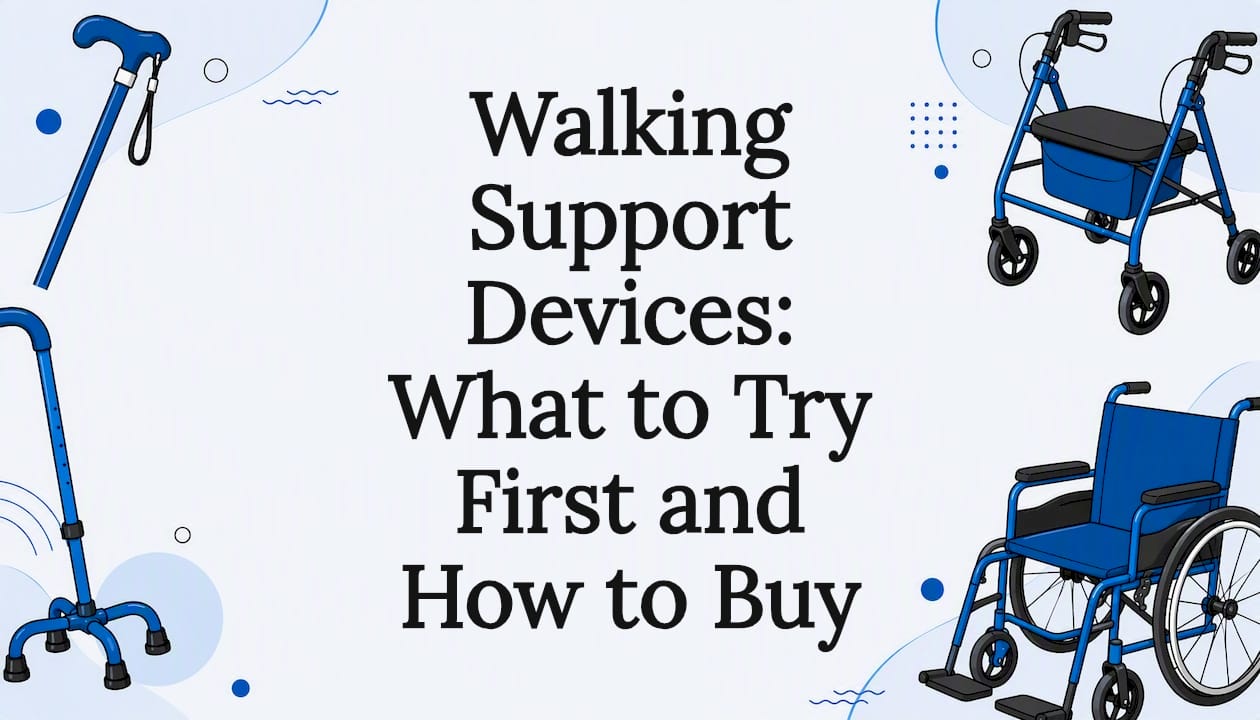
If you’re trying to narrow down which walking support device fits your situation, start here. For balance help at home, a quad cane or standard walker is usually the right first step. For longer distances or community outings, a rollator (four-wheeled walker with a seat) offers mobility plus rest breaks. For a temporary leg injury, a knee walker keeps weight off the injured limb without the upper-body strain of crutches. For anyone who can no longer walk safely even short distances, a manual or power wheelchair or mobility scooter becomes the practical answer.
| Device category | Best for | Stability vs. mobility | Portability | Insurance eligibility |
|---|---|---|---|---|
| Cane (standard or quad) | Mild balance issues, light weight-bearing | Moderate stability | High | Medicare Part B eligible |
| Standard walker | Moderate balance loss, indoor use | High stability | Moderate (foldable) | Medicare Part B eligible |
| Rollator | Distance, endurance, community use | Moderate stability, high mobility | Moderate | Medicare Part B eligible |
| Knee walker | Temporary lower-leg injury | High stability | Moderate | Often covered as DME |
| Manual wheelchair | Non-ambulatory, caregiver-assisted | Very high stability | Moderate | Medicare Part B eligible |
| Power wheelchair / scooter | Long-distance, limited upper-body strength | Very high stability | Low | Medicare Part B, criteria apply |
Your immediate next steps:
- Measure your height and wrist height (standing, arms relaxed) before any fitting appointment.
- Ask your doctor for a referral to a physical or occupational therapist for a formal gait assessment.
- Confirm your supplier is Medicare-enrolled if coverage matters to you.
- Try the device in the store or during a home trial before committing to a purchase.
Key Takeaways
Choosing the right walking support device comes down to matching the device to your actual balance needs, home layout, and coverage eligibility, then testing it under real conditions before committing.
| Point | Details |
|---|---|
| Match device to use case | Canes suit mild balance issues; rollators suit distance and endurance; wheelchairs suit non-ambulatory needs. |
| Fit before you finalize | Set handle height to wrist crease, test brakes, practice turns, and trial on a slope before purchasing or renting. |
| Insurance requires documentation | Medicare Part B and VA coverage both require a face-to-face encounter, a WOPD, and a Medicare-enrolled supplier. |
| Maintain regularly | Inspect brakes, wheels, grips, and fasteners monthly; replace worn parts before they cause a fall. |
| CareBuilders at Home of Plano & Allen | Combines trained caregivers, virtual monitoring, and VA benefits navigation to support mobility safety when a device alone isn’t enough. |
Table of Contents
- What are the main walking support devices and how do they compare?
- How do you choose, fit, and trial a walking aid safely?
- Where can you buy walking aids and which brands should you research?
- How do Medicare, the VA, and insurance typically cover walking support devices?
- How do you maintain and accessorize a walking aid?
- When a device alone isn’t enough: how in-home care fits a mobility safety plan
- What caregivers actually observe about devices and home realities
- Pair your mobility plan with in-home care and monitoring from CareBuilders at Home
- Sources
What are the main walking support devices and how do they compare?
Mobility aids range from a simple single-point cane to a power wheelchair, and the right choice depends on how much support you actually need, not just what feels familiar. Here is a practical breakdown of each type.
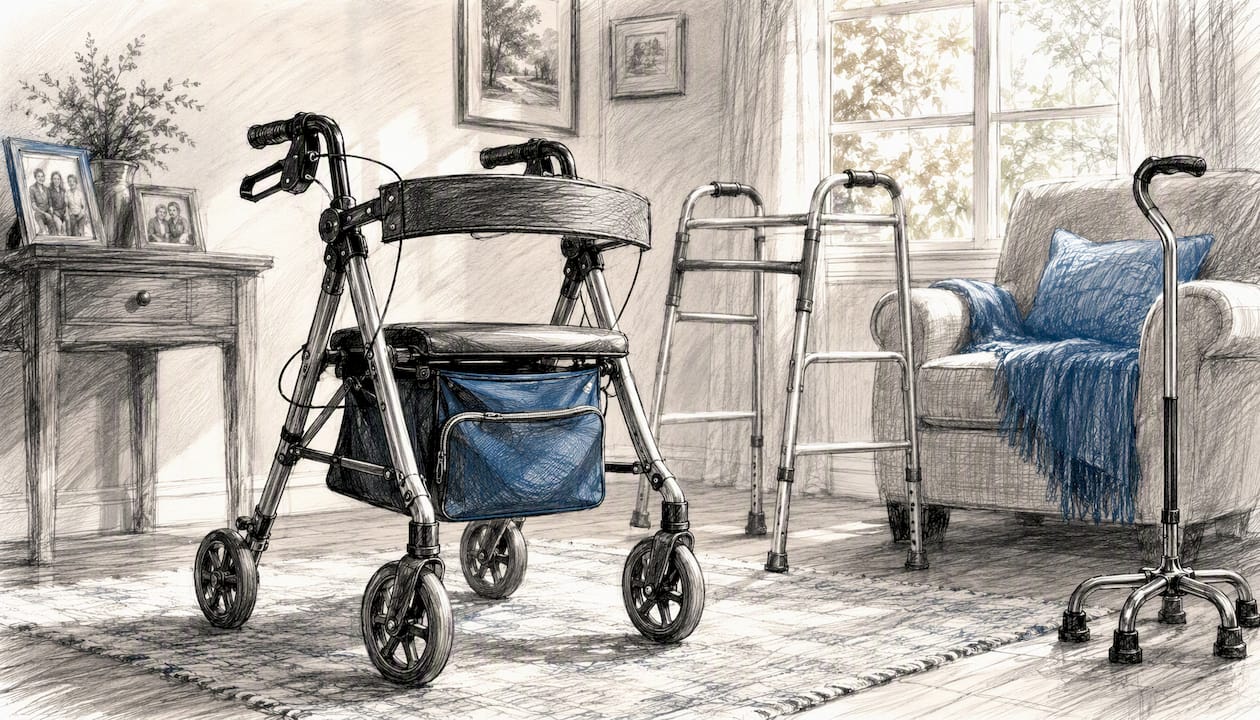
Canes off-load a small amount of weight and improve proprioceptive feedback. They suit people with mild balance issues or one-sided weakness. A quad cane (four-footed base) gives more stability than a single-point cane on uneven surfaces. Brands like Vive offer adjustable aluminum canes with ergonomic grips that are worth comparing.
Standard walkers (no wheels) give the largest base of support and are best for indoor use where slow, deliberate movement is acceptable. They require lifting with each step, which demands more upper-body effort. Drive Medical is one of the most widely stocked walker brands in DME suppliers and major retailers.
Rollators add two or four wheels and a hand-brake system, trading some stability for fluid movement and the ability to sit and rest. The AAFP clinical review notes that rollators are appropriate for people who need mobility and endurance support but can still manage brake operation safely. Vive and Drive Medical both produce rollators across a range of weight capacities.
Knee walkers (also called knee scooters) are purpose-built for non-weight-bearing recovery from foot, ankle, or lower-leg injuries. The iWALK3.0 (by iWALK) takes a different approach: it is a hands-free crutch that straps below the knee, leaving both hands free during recovery. It suits active users with good balance and upper-leg strength.
Gait trainers are used primarily in rehabilitation settings or for people with significant neurological impairments. They provide full body-weight support and guided movement, often with a harness system. Everglide and SunStride are two brands in this space worth researching if a therapist recommends a gait trainer for progressive conditions or post-stroke recovery.
Manual wheelchairs suit people who cannot walk safely even short distances. A caregiver or the user propels them. Power wheelchairs and mobility scooters extend independence for those with limited upper-body strength or very long daily distances, though CMS clinical criteria for coverage are stricter because unnecessary substitution carries real risks.
How do you choose, fit, and trial a walking aid safely?
Getting the right device is about more than picking a style you like. A poor fit creates new risks: a cane set too high strains the shoulder; a rollator with stiff brakes can cause a forward fall; a wheelchair too wide for your doorways simply won’t work at home.
Key selection criteria
Before you try anything, think through these factors:
- Balance needs: Do you need support on one side or both? Bilateral weakness calls for a walker or rollator, not a cane.
- Endurance and distance: If you tire quickly or need to sit mid-route, a rollator with a seat is worth the extra weight.
- Upper-body strength: Standard walkers and crutches demand strong arms and shoulders. If upper-body strength is limited, consider a rollator or wheelchair.
- Home layout: Measure every doorway and hallway. Many standard US interior doors run 30–32 inches wide, which can rule out wider rollators or bariatric wheelchairs before you even try them.
- Transportation: Will the device need to fold into a car trunk? Portability matters as much as function.
- Weight limit: Always confirm the device’s rated capacity exceeds the user’s weight.
Step-by-step trial checklist
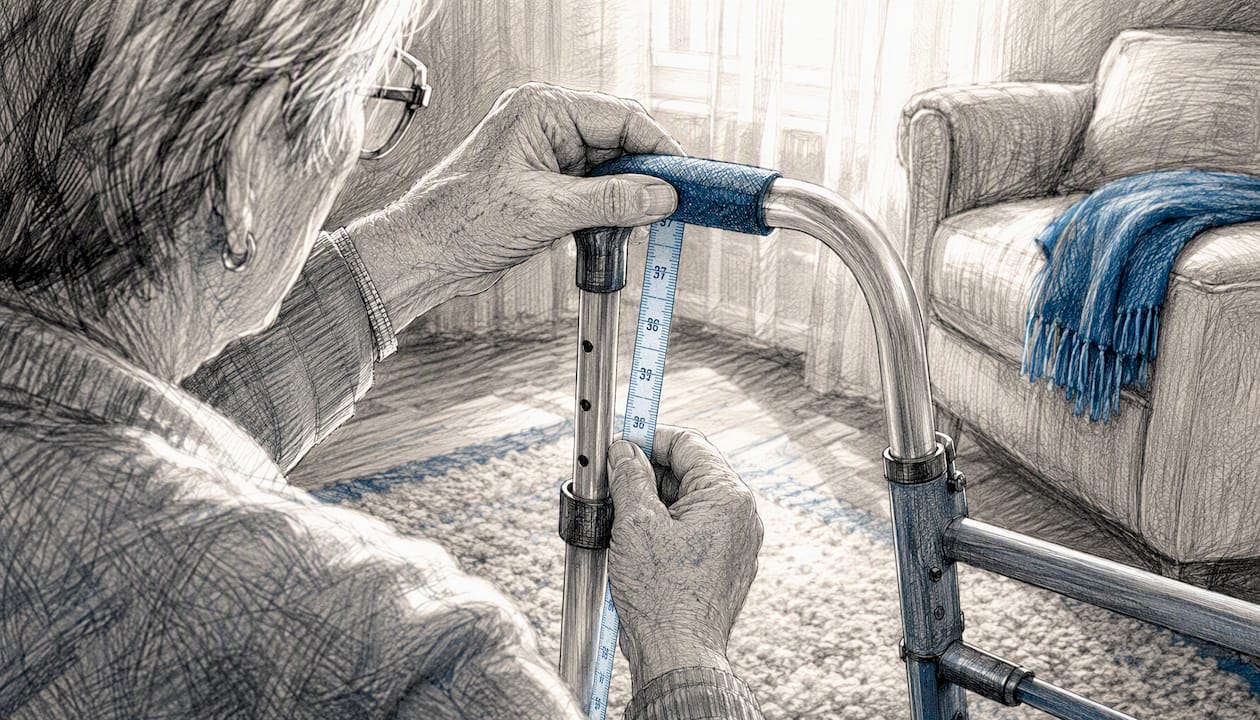
- Set handle height first. Stand upright with arms relaxed at your sides. The handle should align with your wrist crease. Adjust before taking a single step.
- Walk a short loop. Observe whether your posture stays upright or whether you lean forward onto the device.
- Practice turning. Tight turns in a narrow hallway reveal whether the device’s footprint is manageable indoors.
- Sit and stand. If the device has a seat, practice sitting from a standing position and rising without gripping the handles for leverage.
- Test the brakes. On a rollator or knee walker, squeeze the brakes firmly while walking. They should stop the device without jerking.
- Try a slope. Even a gentle ramp tests whether you can control the device going downhill.
- Check weight distribution. Load any basket or storage with typical items (a water bottle, a phone) and walk again. Added weight shifts the center of gravity.
Questions to ask your supplier and clinician
- Does this device require a written prescription or a Written Order Prior to Delivery (WOPD) for insurance purposes?
- What is the return or trial policy if the device doesn’t work at home?
- Is there a local repair network or warranty for parts and labor?
- Is an Assistive Technology Professional (ATP) available to assist with fitting?
- Which HCPCS code applies to this device, and is your supplier Medicare-enrolled?
Red flags to avoid
- Handle height that cannot be adjusted to your wrist crease
- A rollator whose brakes require significant grip strength you don’t have
- A wheelchair wider than your narrowest doorway
- Any seller who cannot provide a Medicare supplier number when coverage is your goal
- Devices sold without a trial period or return policy
Pro Tip: Clinical reviewers caution against moving directly to a power wheelchair or scooter when walking is still possible. Unnecessary substitution can promote deconditioning and reduce the motivation to stay ambulatory. Ask your therapist whether a manual aid plus physical therapy is a better first step.
Where can you buy walking aids and which brands should you research?
You have more buying options than most people realize, and the channel you choose affects price, fitting support, and insurance eligibility.
Local DME (Durable Medical Equipment) suppliers are the strongest choice when Medicare or VA coverage is a goal. They are Medicare-enrolled, can process HCPCS-coded claims, and typically have staff trained to assist with fitting. The tradeoff is a smaller product selection compared to large retailers.
Specialty mobility retailers stock a wider range of rollators, power chairs, and gait trainers, and many employ ATPs. They are well-suited for complex needs or higher-end devices.
Major online marketplaces (such as Amazon) offer competitive pricing and wide selection, but fitting support is absent and returns can be cumbersome for large items. They are reasonable for low-cost canes or accessories, less so for wheelchairs or rollators where fit is critical.
Manufacturer direct sales are an option for brands like iWALK (iWALK3.0) and Everglide, which sell directly through their own websites. Going direct can mean better product knowledge from customer service, but you lose the local fitting and repair network.
Rental programs through DME suppliers or hospital discharge services make sense for temporary needs (post-surgery recovery, short-term injury). Renting a knee walker for six weeks is almost always cheaper than buying one. For long-term needs, purchasing is typically more cost-effective after the first few months.
When researching brands, Drive Medical and Vive are widely available through both DME suppliers and online channels, which makes parts and replacements easier to find. SunStride and Everglide are more specialized and worth looking up if a therapist specifically recommends a gait trainer.
Specialist suppliers and Assistive Technology Professionals are valuable for fitting, recommending the right device, and helping with insurance paperwork. Buying a used or ill-fitting device often leads to posture problems or added costs down the line.
— Agingcare
How to vet any supplier:
- Confirm their Medicare supplier number (searchable at the Medicare Supplier Directory).
- Ask about their return and trial policy in writing before purchase.
- Verify warranty terms and whether local repair is available.
- Check whether an ATP is on staff or available by referral.
How do Medicare, the VA, and insurance typically cover walking support devices?
Coverage is available for many devices, but the paperwork requirements are specific and missing a step can mean a denied claim.
Medicare Part B and DME basics
Medicare Part B covers medically necessary walkers, canes, and wheelchairs as durable medical equipment when prescribed for home use and supplied by a Medicare-enrolled supplier. You typically pay 20% of the Medicare-approved amount after your Part B deductible.
CMS classifies walking aids as Mobility Assistive Equipment (MAE) and uses clinical criteria to determine whether a device is reasonable and necessary to restore participation in mobility-related activities of daily living (MRADLs). The clinical evaluation must document that you cannot perform MRADLs safely without the device.
CMS policy requires a face-to-face encounter with your physician or treating practitioner and a Written Order Prior to Delivery (WOPD) for specified HCPCS-coded items. Missing the WOPD or using an incorrect HCPCS code are the two most common reasons claims are denied.
| Coverage item | Medicare Part B rule |
|---|---|
| Patient cost-share | 20% of approved amount after Part B deductible |
| Supplier requirement | Must be Medicare-enrolled DME supplier |
| Documentation required | Face-to-face encounter note + WOPD |
| Replacement cycle | Commonly around five years for walkers and canes |
| Items often excluded | Powered walkers, enhancement accessories, non-home-use items |
VA assistive technology programs
The VA provides assistive technology and mobility devices tailored to veterans’ individual physical, sensory, or cognitive needs as part of rehabilitation programs. Veterans can access devices through VA medical centers and prosthetics departments, often at no out-of-pocket cost when the need is service-connected or otherwise approved. If you are a veteran navigating these benefits, working with a VA-enrolled provider or a benefits navigator can significantly reduce delays.
Step-by-step coverage checklist
- Schedule a clinical evaluation and ask your doctor to document your MRADL limitations in the visit notes.
- Confirm the device’s HCPCS code with your supplier before ordering.
- Obtain the WOPD from your prescribing clinician before the device is delivered.
- Verify your supplier is Medicare-enrolled (or VA-approved for veterans).
- Keep copies of all documentation: the prescription, the face-to-face note, and the delivery receipt.
- Ask about the replacement cycle and what documentation you’ll need when the device wears out.
Typical out-of-pocket costs when coverage applies: after the Part B deductible, most people pay roughly 20% of the Medicare-approved amount. For a standard walker, that often means $20–$40 out of pocket. For a power wheelchair, the 20% share can reach several hundred dollars depending on the approved amount.
How do you maintain and accessorize a walking aid?
A well-maintained device is a safe device. Most problems that cause falls or discomfort come from worn parts that were easy to spot and fix.
Routine maintenance checks:
- Brakes: Test rollator and knee walker brakes monthly. Cables stretch over time; a brake that feels soft or requires full-grip force to engage needs adjustment or replacement.
- Tires and wheels: Check for flat spots, cracks, or debris caught in the wheel housing. Pneumatic tires need periodic inflation; solid tires should be inspected for wear.
- Frame and welds: Look for cracks or bends at stress points, especially near the handles and leg joints. A bent frame is not safe to use.
- Grips and handles: Foam or rubber grips compress and crack with use. Replace them when they feel loose or slippery.
- Fasteners: Tighten all bolts and height-adjustment pins every few months. A loose height pin can collapse under load.
Useful accessories:
- Baskets and pouches: Keep hands free while walking. Confirm the basket’s weight rating before loading it.
- Cane holders: Clip-on holders attach to rollator frames so a cane is always within reach when you need to step away from the walker.
- Anti-tip devices: Rear-mounted stabilizers reduce the risk of tipping backward on slopes.
- Replacement tires: Stocking one spare set avoids a long wait when a tire wears out.
- Travel bags and cases: Protect folded rollators and wheelchairs during car or air travel.
- Seat cushions: Gel or foam cushions improve comfort for users who sit frequently on rollator seats.
Quick troubleshooting:
- Squeaking: Usually a dry axle or loose bolt. A drop of silicone lubricant on the axle often resolves it.
- Wheel pulling to one side: Check that both rear wheels are the same size and that the frame is not bent.
- Loose height adjustment: Replace the spring-button pin; they are inexpensive and widely available from DME suppliers.
When a device alone isn’t enough: how in-home care fits a mobility safety plan
A walking aid reduces fall risk, but it does not eliminate it, and for some people the gap between “device in hand” and “safe at home” is significant.
Scenarios where a device alone falls short:
- Cognitive impairment: A person with dementia may forget to use the device, use it incorrectly, or wander at night when no device provides protection.
- Progressive conditions: ALS, Parkinson’s disease, and advanced MS involve changing needs. A device that fits today may be inadequate in three months.
- Frequent falls: If someone has already fallen two or more times in the past year, a device adjustment alone is rarely sufficient. Environmental modifications and supervision matter too.
- Post-hospitalization transitions: The period immediately after discharge is high-risk. Fatigue, new medications, and an unfamiliar device combine to raise fall probability.
CareBuilders at Home of Plano & Allen integrates trained caregivers with virtual monitoring and fall-detection technology to address exactly these gaps. Caregivers can supervise device use during the critical adjustment period, assist with transfers, and observe gait changes that signal a need for reassessment. The 24/7 virtual caregiver platform provides continuous monitoring without requiring a caregiver to be physically present at all times, which matters for families balancing work and caregiving.
For veterans, CareBuilders at Home of Plano & Allen also helps navigate VA assistive technology benefits, reducing the paperwork burden that often delays device access.
Combining a properly fitted mobility aid with trained caregiver support and remote monitoring creates a layered safety plan that addresses both the physical and environmental factors that contribute to falls.
Practical combinations that improve outcomes:
- A rollator paired with a caregiver-supervised home trial during the first two weeks of use
- A power wheelchair combined with a medical alert smartwatch for users who spend time alone
- A standard walker used alongside scheduled companion visits for a person with early dementia
- A gait trainer in a home therapy program supported by a caregiver who assists with setup and encouragement
What caregivers actually observe about devices and home realities
The gap between a device that performs well in a showroom and one that works in a real home is wider than most families expect. Doorways that seemed fine on paper turn out to be too narrow for a rollator once you add a basket. Carpet that feels firm underfoot slows a wheeled walker enough to frustrate a user who was mobile on the clinic’s smooth floor. These mismatches are not failures of the device; they are failures of the trial process.
The most useful thing a caregiver can do before a device arrives is walk the home with a tape measure. Check every doorway, the bathroom threshold, and the path from the bedroom to the kitchen. If a rollator won’t clear the bathroom door, a standard walker or a narrower model is the practical answer, regardless of what the clinic recommended on a smooth hallway.
Staged trials matter too. Starting with short, supervised sessions, then gradually increasing distance and complexity, gives the user time to build confidence and gives the caregiver time to spot problems before they become falls. Rushing a person to full independence with a new device in the first week is one of the most common mistakes families make.
Finally, the emotional dimension is real. Many people resist using a device because it feels like an admission of decline. Framing the device as a tool for participation, not a symbol of limitation, changes how people engage with it. When correctly prescribed and fitted, mobility aids increase independence and prevent complications from inactivity. That reframe, delivered with patience and empathy, is often the most important thing a caregiver provides.
Pair your mobility plan with in-home care and monitoring from CareBuilders at Home
When a walking aid is part of a larger safety plan, having trained support alongside it makes a measurable difference. CareBuilders at Home of Plano & Allen provides non-medical in-home care for seniors and veterans in Plano, Allen, Richardson, Wylie, and surrounding Collin County, with services designed to complement device-based mobility plans.
Practical services to consider pairing with your device:
- Home safety assessment to identify fall hazards, measure clearances, and recommend modifications before a device arrives
- Caregiver-supervised device trials during the first weeks of use, when fall risk is highest
- 24/7 virtual monitoring and fall-detection wearables for users who spend time alone
- Veterans care and VA benefits navigation to help access assistive technology funding without the paperwork delays
To request an in-home assessment or learn how CareBuilders at Home of Plano & Allen can support your mobility plan, Cbahplano today.
Sources
These official and clinical sources support the coverage, safety, and selection guidance throughout this article.
- VA Assistive Technology and Mobility Devices
- Durable Medical Equipment (DME) coverage | Medicare
- Mobility Assistive Device Use in Older Adults | AAFP
- Mobility aids – MedlinePlus
This article is general information, not a substitute for advice from a qualified doctor. Consult a qualified healthcare professional about your own circumstances before acting on anything here.
Recommended
- Specialized Services – CareBuilders at Home | Senior and Veteran Care in Plano, Allen & Richardson TX
- Brain Health Care Fitness – CareBuilders at Home | Senior and Veteran Care in Plano, Allen & Richardson TX
- Companion Services – CareBuilders at Home | Senior and Veteran Care in Plano, Allen & Richardson TX