


24-Hour Home Monitoring in Plano, TX: What Families Need to Know
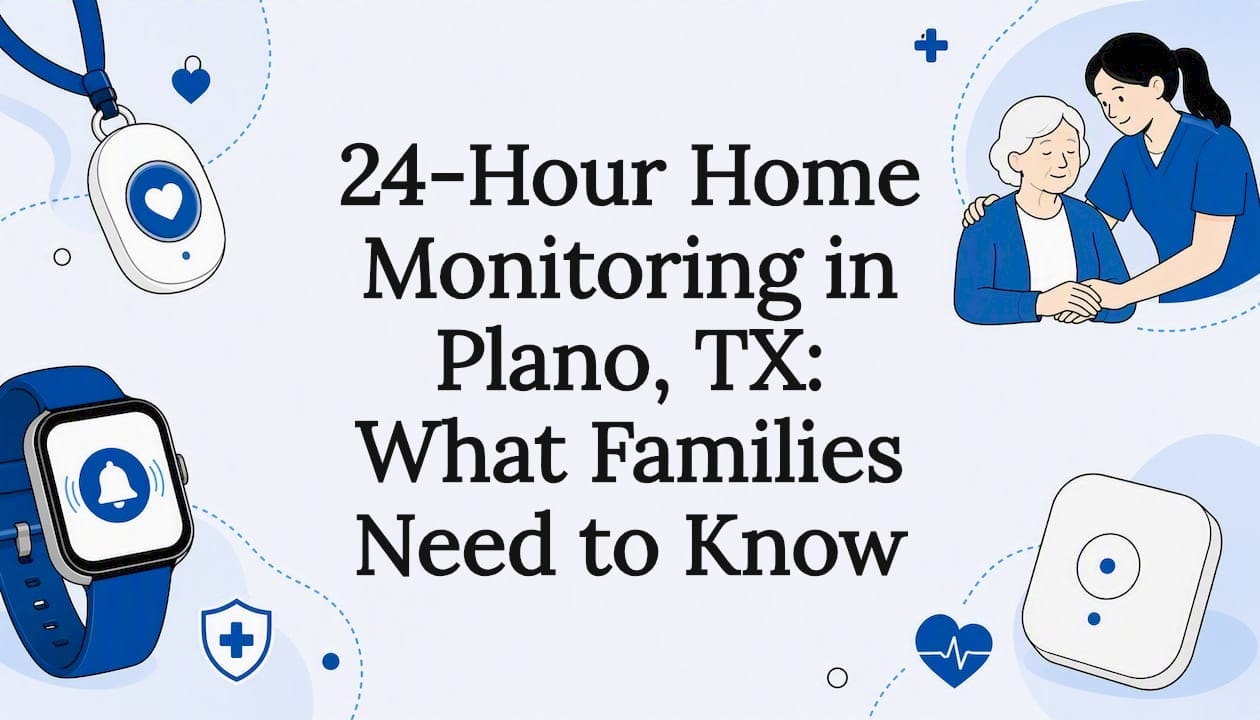
In Plano, TX, 24-hour home monitoring for seniors and veterans means continuous in-person and/or virtual caregiver coverage combined with sensor and medical-alert monitoring, all backed by a clear escalation plan. It is not a security alarm system. It is a care model designed to keep your loved one safe, supported, and connected at home around the clock.
Day-to-day, you can expect a combination of these components:
- In-person caregivers on rotating awake shifts or a live-in arrangement. Live-in care typically uses one caregiver with scheduled rest periods; rotating awake shifts provide constant active supervision, generally associated with higher cost.
- Wearable devices such as a pendant or medical alert smartwatch for fall detection and manual SOS alerts.
- Ambient sensors monitoring door use, motion, and daily routines to flag deviations before they become emergencies.
- A monitoring hub that routes alerts to caregivers, family members, or emergency services based on a written escalation protocol.
On payment: private pay is the most common path. Medicare generally does not cover custodial, non-medical 24-hour home care. VA benefits and some long-term care insurance policies may help, especially for veterans.
Key Takeaways
24-hour home monitoring in Plano means continuous caregiver coverage plus sensor and medical-alert technology, all supported by a staffed escalation plan, not a passive alarm system.
| Point | Details |
|---|---|
| Two staffing models exist | Live-in care costs less; rotating awake shifts provide constant active supervision at higher cost. |
| Staffed response matters | Community health workers responded to a majority of monitoring alerts, while family-only alert systems respond far less reliably. |
| Medicare won’t cover this | Custodial non-medical 24-hour care is private pay; VA benefits and long-term care insurance may offset costs. |
| Technology supplements caregivers | Sensors and wearables work best paired with trained human responders, not as a standalone solution. |
| CareBuilders at Home of Plano & Allen | A local, VA-approved provider in Collin County offering in-person and virtual 24-hour monitoring with dementia-trained caregivers. |
Table of Contents
- Why families choose a combined human and technology model
- CareBuilders at Home of Plano & Allen: local 24-hour care you can count on
- Useful resources for families researching 24-hour monitoring
- Sources
Why families choose a combined human and technology model
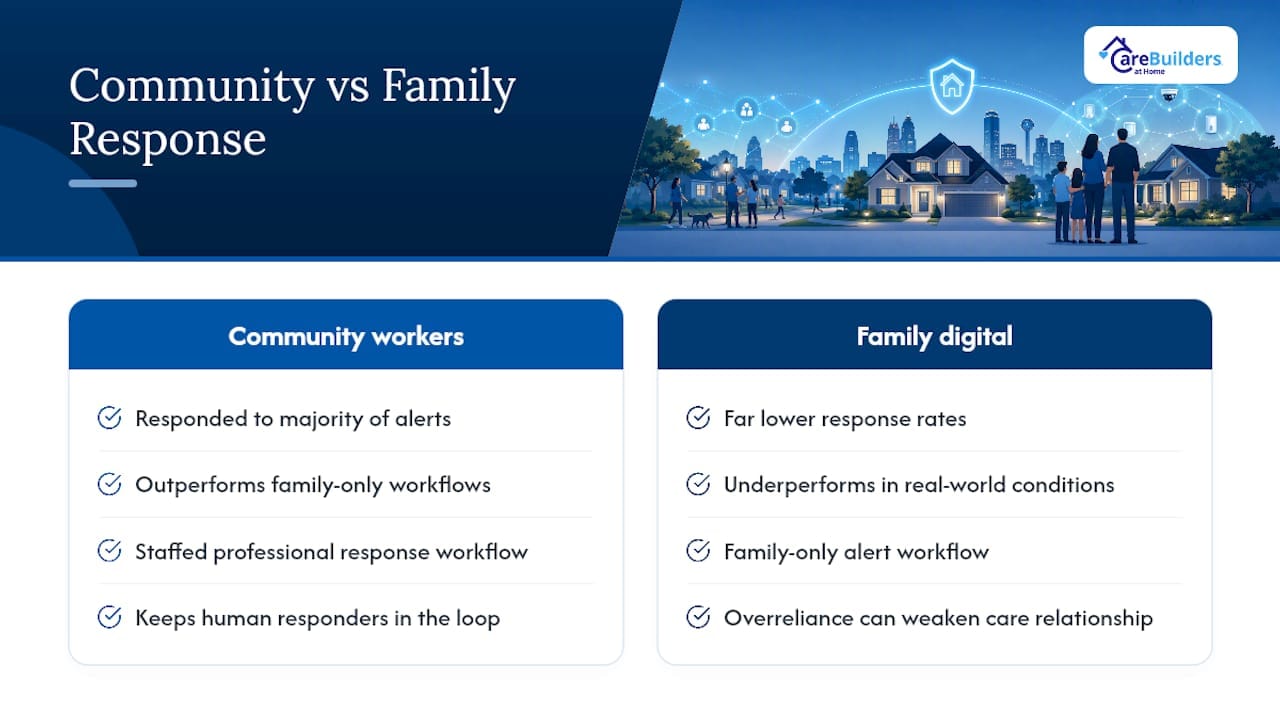
Sensor technology alone is not enough. A community-in-the-loop trial published in JMIR Aging found that community health workers responded to a majority of monitoring alerts, while family digital response rates were far lower. That gap matters: it shows that staffed, professional response workflows outperform family-only alert systems in real-world conditions.
A systematic review in BMC Geriatrics confirmed that smart home health technologies support independence and can detect falls and changes in daily activities, but common barriers are usability, social acceptance, and cost. Families who choose systems that feel natural to their loved one see better long-term adoption.
The research also carries a clear caution. A 12-month evaluation in Frontiers in Public Health found that monitoring must supplement, not replace, human caregiving. Overreliance on sensors can weaken the personal care relationship that matters most to your loved one’s wellbeing.
The practical takeaway: choose a model that pairs trained caregivers with technology, keeps human responders in the loop, and integrates monitoring into your loved one’s daily routine rather than disrupting it. A daily health check-in routine can also help families stay connected between caregiver visits.
Pro Tip: Ask any provider you consider to walk you through their written escalation protocol. Who gets the alert first? What is the expected response time? What triggers a 911 call? If they cannot answer in writing, keep looking.
CareBuilders at Home of Plano & Allen integrates dementia-trained caregivers with virtual monitoring and 24/7 medical alert monitoring and helps families navigate VA benefits, which makes the combined model accessible for many veterans in Collin County.
CareBuilders at Home of Plano & Allen: local 24-hour care you can count on
For families in Plano ready to act, CareBuilders at Home of Plano & Allen is a local, VA-approved provider offering both in-person caregiver coverage and virtual monitoring across Plano, Allen, Richardson, Wylie, and surrounding Collin County communities.
Their caregivers pass background checks, receive dementia-specific training, and work within a defined escalation protocol. Staffing options include shift-based overnight coverage and live-in arrangements, paired with pendant and smartwatch alerts and ambient sensor monitoring. For veterans, the team assists with benefit navigation, including Aid and Attendance eligibility, so you know exactly what financial support may be available before you commit.
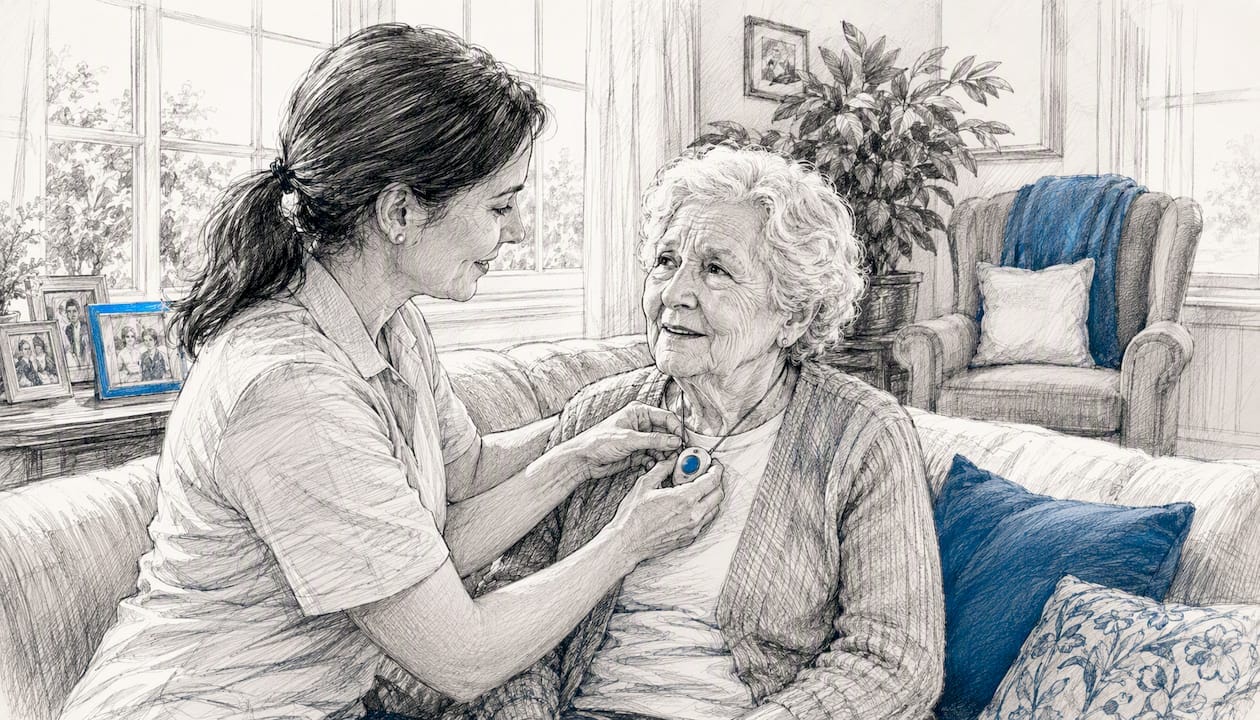
Getting started is straightforward: schedule a free home assessment, ask about caregiver training credentials and trial periods, and request the written onboarding and escalation timeline before signing anything. Personal care services and companion services can be layered with monitoring to build a plan that fits your loved one’s specific needs.
Useful resources for families researching 24-hour monitoring
These sources support the evidence and guidance in this article:
- JMIR Aging (2026) — community-in-the-loop smart health system trial: Real-world alert response data showing why staffed workflows outperform family-only notification.
- BMC Geriatrics (2024) — benefits and barriers of smart home health technologies: Systematic review of 163 studies covering what monitoring technologies do well and where adoption breaks down.
- Frontiers in Public Health (2020) — 1-year evaluation of in-home monitoring technology: Twelve-month findings on usability, co-design, and the risk of replacing human care with sensors.
- CaregiverPilot — 24-hour care glossary: Plain-language explanation of live-in vs. rotating shift models and their cost implications.
- How in-home monitoring supports geriatric patients: CareBuilders’ local explainer on ambient sensors, wearables, and monitoring workflows for seniors in Plano.
- Elder care planning in Plano, Texas: a family guide: A broader local resource for families working through care decisions in Collin County.
- Veterans care and VA benefit navigation: Details on how CareBuilders supports veterans in accessing Aid and Attendance and other VA benefit paths.
This article provides general information about non-medical in-home monitoring services and is not a substitute for professional care planning, medical, or legal advice. Confirm current VA eligibility rules and benefit amounts directly with the VA or a qualified benefits counselor.
Sources
- JMIR Aging (2026) — community-in-the-loop smart health system trial
- Frontiers in Public Health (2020) — 1‑year evaluation of in‑home monitoring technology
- CaregiverPilot — 24-hour care glossary
- Merck Manuals — Home health care overview
Recommended
- Elder Care Planning in Plano, Texas: A Family Guide – CareBuilders at Home | Senior and Veteran Care in Plano, Allen & Richardson TX
- How In-Home Monitoring Supports Geriatric Patients – CareBuilders at Home | Senior and Veteran Care in Plano, Allen & Richardson TX
- How Memory Care at Home Works: A Family Guide – CareBuilders at Home | Senior and Veteran Care in Plano, Allen & Richardson TX