


How to Build a Senior Care Support Network
A senior care support network is a coordinated system of family members, friends, neighbors, community resources, and professionals working together to help an older adult live safely and with dignity. Building this kind of network is not a one-time task. It is an ongoing process that requires honest assessment, clear communication, and shared responsibility. Planning early, ideally in your 50s or 60s, gives your family time to make thoughtful decisions rather than reactive ones. CareBuilders at Home of Plano & Allen works alongside families throughout Collin County to make that process manageable and personal.
How to build a senior care support network that actually works
A senior care support network succeeds when it is built on a clear picture of what the senior actually needs. Without that foundation, even the most well-meaning family members end up duplicating effort in some areas and missing critical gaps in others. The industry term for this coordinated approach is “care coordination,” and it applies whether you are managing care from across town or across the country.
Assessing your senior’s daily needs
Start by mapping out what your loved one can and cannot do independently. This includes personal care tasks like bathing, dressing, and grooming, as well as medication management, meal preparation, mobility, and transportation. Write it down. A written list makes it easier to delegate specific tasks to specific people later.
Social and emotional needs matter just as much as physical ones. Loneliness and isolation are serious health risks for older adults. Your assessment should include how often your loved one sees other people, whether they have meaningful activities, and whether they show signs of depression or anxiety.
Pro Tip: Ask your loved one’s primary care physician to complete a functional assessment. This gives you a clinical baseline and helps you anticipate future needs before a crisis forces your hand.
Consulting a medical professional at this stage also clarifies which needs require clinical oversight and which can be handled by trained non-medical caregivers. That distinction shapes every decision you make next.
Who should be in a senior care support network?
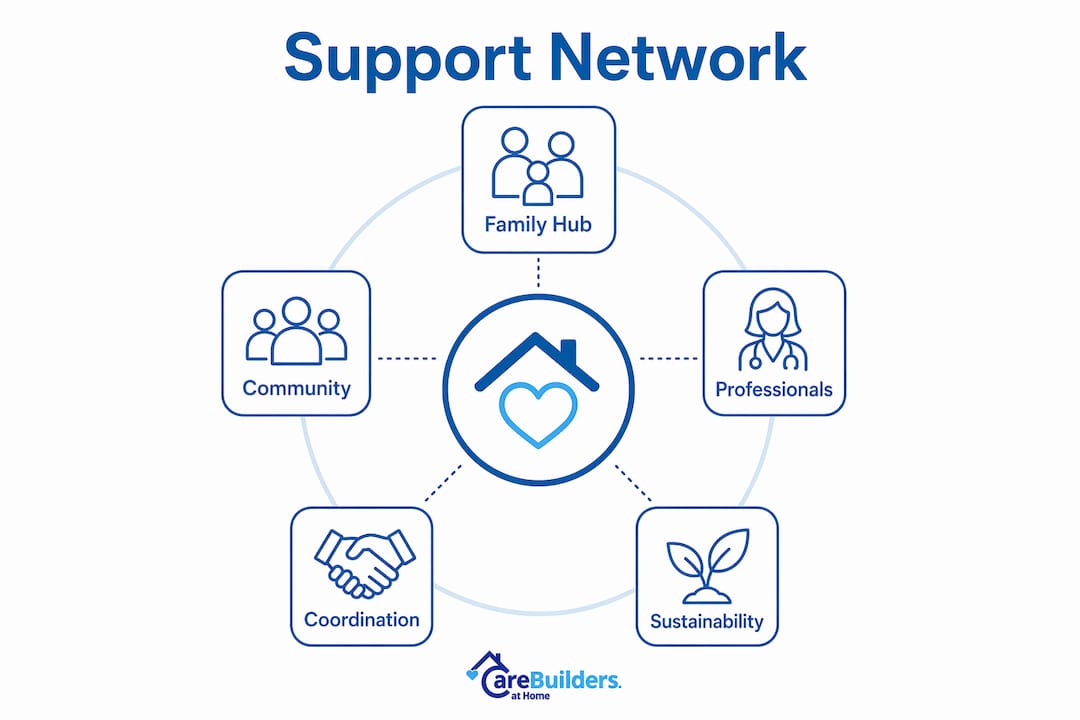
The right network includes people from three overlapping circles: family and close friends, community resources, and paid professionals. Each circle plays a different role, and the strongest networks draw from all three.
The family hub coordinator
A family member acting as a hub coordinator is the single most effective structural decision you can make. This person does not do everything. They organize, communicate, and delegate. Attempting to manage all caregiving tasks alone is the most common reason family caregivers burn out within the first year.
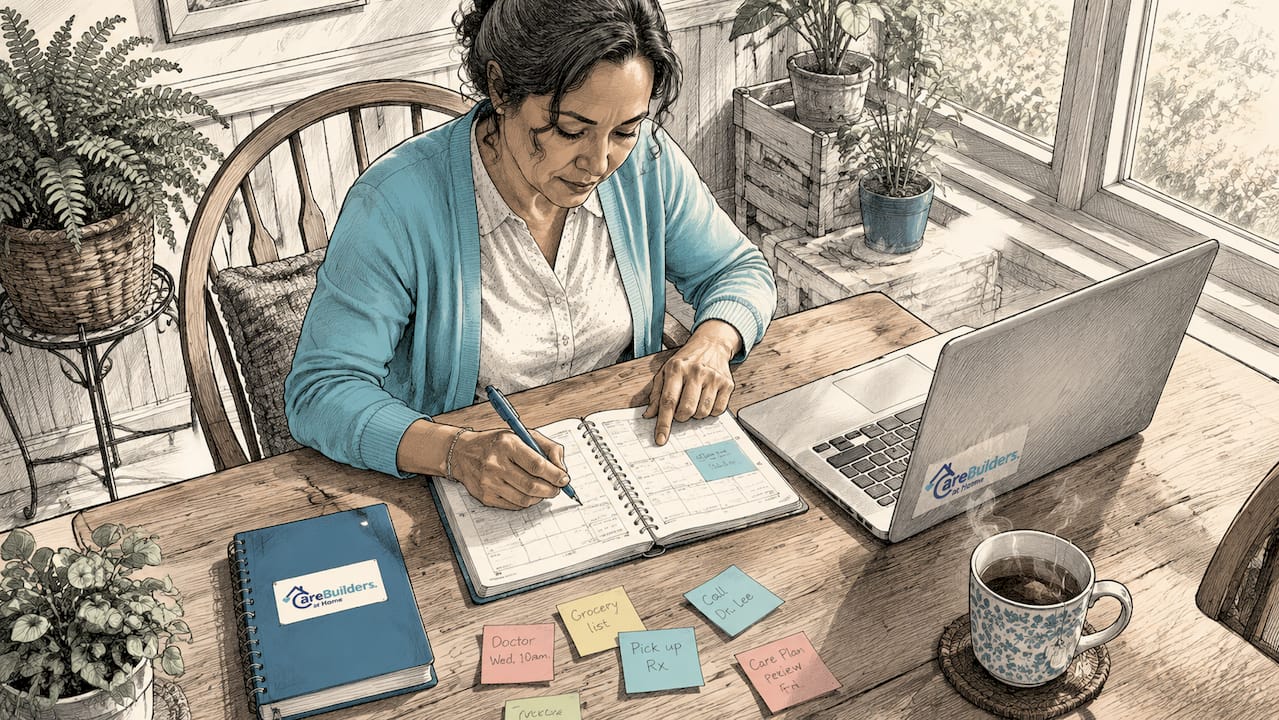
The hub coordinator keeps track of appointments, communicates with medical providers, and ensures that tasks are distributed fairly. This role works best when it is formally agreed upon by the family, not just assumed by the person who lives closest.
Community and informal supporters
Neighbors, faith communities, and volunteer organizations can fill meaningful gaps. The key is using bounded asks: specific, limited, and repeatable requests that make it easy for people to say yes and follow through. “Can you drive Mom to her Tuesday appointment twice a month?” is far more effective than “Can you help out when we need it?”
A reliable local contact who can perform welfare checks, accompany your loved one to appointments, and communicate clearly with the family is worth more than a dozen vague offers of help. Even a trusted neighbor can fill this role when given clear expectations.
Professional members of the network
| Professional Role | Primary Function |
|---|---|
| Primary care physician | Manages clinical care and coordinates referrals |
| Elder law attorney | Prepares legal documents and advises on benefits |
| Aging Life Care Professional | Coordinates services, attends appointments, and communicates with family |
| Financial advisor | Plans for long-term care costs and asset protection |
| In-home care agency | Provides daily personal care, companionship, and respite support |
An Aging Life Care Professional is especially valuable when your loved one’s needs are complex or when family members live far away. These professionals act as a liaison between medical providers, care agencies, and the family. They attend appointments, translate clinical information, and help the family make informed decisions without having to be physically present for every interaction.
Pro Tip: Secure the three core legal documents before cognitive decline becomes a concern: durable power of attorney, healthcare proxy, and an updated will. These must be signed while your loved one still has legal capacity. Waiting until a crisis is one of the most costly mistakes families make.
How does technology support senior care coordination?
Technology reduces caregiver burden and increases safety when used thoughtfully. The goal is not to replace human connection. It is to handle routine monitoring and communication tasks so that family members can focus on meaningful time together.
Here are four technology tools that work well in a coordinated senior care network:
-
Shared digital calendars and task lists. A shared calendar visible to all network members eliminates confusion about who is handling which appointment or task. Rotating task lists reduce stress and ensure that no single person carries the full load. A personalized elder care plan that documents these responsibilities gives the whole team a single source of truth.
-
Medical alert systems. Wearable alert devices give seniors a way to call for help immediately after a fall or medical event. Daily check-in services and medical alert systems reduce caregiver anxiety and provide a safety baseline, especially for seniors who live alone. CareBuilders at Home of Plano & Allen offers 24/7 medical alert monitoring as part of its care technology options.
-
Virtual caregiver services. Remote monitoring technology, including AI-powered ambient sensors, can detect changes in routine that may signal a health concern. CareBuilders at Home of Plano & Allen uses virtual caregiver technology to give families real-time awareness without requiring constant physical presence.
-
Video calls and messaging apps. Regular video check-ins maintain emotional connection and allow family members to observe their loved one’s condition visually. Long-distance caregivers who use technology for safety monitoring can then use their calls for genuine conversation rather than surveillance.
Technology works best when your loved one consents to it and feels comfortable using it. Introduce new tools gradually and involve the senior in the decision.
How do you keep a senior care support network sustainable?
A support network that burns out its members within six months helps no one. Sustainability requires structure, scheduled rest, and a willingness to ask for and accept help.
The most effective support plans share four qualities. They are simple enough for everyone to follow, specific enough to assign clear ownership, shared across the whole network, and reviewed regularly as needs change. Rotating task lists and written care plans reduce stress and keep the network responsive to new challenges.
- Schedule respite care proactively. Respite care prevents caregiver burnout and should be built into the care plan from the start, not treated as a last resort. In-home care agencies and community programs both offer respite options. Viewing respite care as a sign of failure is a mistake. It is a sign of good planning.
- Distribute responsibility using bounded asks. Assign specific, recurring tasks to specific people. “You handle grocery delivery on Fridays” is sustainable. “Help whenever you can” is not.
- Design communication around dignity. Check-ins with your loved one should feel like connection, not inspection. Preserve their sense of control and privacy wherever possible.
- Review the plan every three to six months. Needs change. A plan that worked well six months ago may leave gaps today. Schedule a brief family meeting to assess what is working and what needs adjustment.
- Update legal documents before capacity declines. Legal and financial planning done proactively is far less stressful and expensive than reactive decisions made after a crisis. Review advance directives, power of attorney, and care preferences annually.
Pro Tip: Treat the care plan as a living document. Store it somewhere every network member can access, such as a shared folder or a care coordination app, and update it after every significant health change.
Professional caregiver support extends the capacity of family networks significantly. When a trained in-home caregiver handles daily personal care, family members can focus on the relationship rather than the tasks.
Key Takeaways
Building a sustainable senior care support network requires early planning, clear role assignment, and regular review across family, community, and professional layers.
| Point | Details |
|---|---|
| Start planning early | Begin building your network in your 50s or 60s to avoid crisis-driven decisions. |
| Designate a hub coordinator | One family member should organize and delegate, not do everything alone. |
| Use bounded asks | Assign specific, recurring tasks to make community support sustainable. |
| Integrate technology thoughtfully | Medical alerts, shared calendars, and virtual monitoring reduce burden without replacing human connection. |
| Schedule respite care | Build rest into the care plan from the start to prevent caregiver burnout. |
What I’ve learned about building care networks that last
The families I see struggle most are the ones who waited. They waited for a fall, a diagnosis, or a hospital discharge to start thinking about who would help and how. By that point, every decision carries emotional weight and time pressure. The network gets assembled in a panic, and the cracks show quickly.
The families who do this well share one trait: they had an honest conversation before it was urgent. They named a hub coordinator, identified the gaps, and brought in professionals not as a sign of failure but as a deliberate choice. They saw an Aging Life Care Professional or a care agency like CareBuilders at Home of Plano & Allen as an ally, not a replacement for family love.
The other thing I’ve seen consistently is that caregiver burnout is not a personal weakness. It is a structural problem. When one person carries too much for too long without scheduled breaks or shared responsibility, the network collapses. The fix is not willpower. It is design. Build the breaks in. Assign the tasks. Review the plan. That is what makes a network last.
— cbahplano
How CareBuilders at Home of Plano & Allen supports your family’s care network
Families in Plano, Allen, Richardson, Wylie, and surrounding Collin County communities can rely on CareBuilders at Home of Plano & Allen for professional in-home care that fits directly into a coordinated support network. From personal care services that cover daily hygiene, mobility, and medication reminders to companion care that addresses social and emotional needs, the team is trained to work alongside your family, not around it. As a VA-approved provider, CareBuilders at Home of Plano & Allen also helps veterans access the benefits they have earned. If you are ready to take the next step, contact CareBuilders at Home of Plano & Allen to discuss a care plan built around your loved one’s specific needs and your family’s capacity.
FAQ
What is a senior care support network?
A senior care support network is a coordinated group of family members, friends, community helpers, and professionals who share responsibility for an older adult’s care and wellbeing. It functions as a system of communication and task-sharing, not a single caregiver doing everything alone.
When should you start building a support network for a senior?
Planning ideally begins in the 50s to late 60s, before a health crisis forces reactive decisions. Early planning gives families time to secure legal documents, identify professionals, and establish communication routines.
Who should be included in a senior care support network?
The network should include a family hub coordinator, trusted neighbors or community members, a primary care physician, an elder law attorney, and, when needed, a professional in-home care provider or Aging Life Care Professional.
How do you prevent caregiver burnout in a senior care network?
Scheduling respite care proactively and distributing tasks using specific, bounded asks are the two most effective strategies. Burnout rises when one person carries the full load without scheduled breaks or shared responsibility.
What legal documents does a senior care support network need?
The three core documents are a durable power of attorney, a healthcare proxy, and an updated will. These must be completed before cognitive decline limits your loved one’s legal capacity to sign them.
Recommended
- sensi.ai – CareBuilders at Home | Senior and Veteran Care in Plano, Allen & Richardson TX
- Personal Care – CareBuilders at Home | Senior and Veteran Care in Plano, Allen & Richardson TX
- Virtual Caregiver – CareBuilders at Home | Senior and Veteran Care in Plano, Allen & Richardson TX
- Arrange in-home care for an elderly parent: essential steps