


How To Arrange In-Home Care for an Elderly Parent
Arranging in-home care for an elderly parent is the process of coordinating the right support so your loved one can safely remain at home, with help covering daily tasks, personal care, and companionship. The industry term for this is non-medical in-home care, which differs from home health in one key way: home health requires a physician referral and delivers skilled medical services, while in-home care provides daily living support without medical procedures. Getting this distinction right from the start saves families weeks of confusion. The 622 Area Agencies on Aging across the country serve as free local starting points, connecting more than 11 million older adults annually with care coordination resources.
How to arrange in-home care for an elderly parent: start with a needs assessment
The single most important first step is a formal needs assessment. Without one, families tend to either over-hire or under-hire, and both outcomes hurt the person receiving care. A physician or your local Area Agency on Aging (AAA) can conduct this assessment at no cost, and the results give you a clear picture of what kind of support your parent actually needs.
During the assessment, gather the following health information and keep it organized in one place:
- Current medications, dosages, and schedules
- Known allergies and adverse drug reactions
- Advance directives, including living wills and healthcare proxy documents
- Primary care physician and specialist contact information
- Insurance cards and policy numbers
- Recent hospital discharge summaries or diagnostic reports
Functional ability is equally important to document. Assess whether your parent can bathe, dress, prepare meals, manage finances, and move safely around the home without assistance. These are called Activities of Daily Living (ADLs), and they directly determine how many hours of care per day your parent needs.
Pro Tip: Create a caregiving binder, either physical or digital, that holds all health records, care plans, and emergency contacts. Share access with every family member involved in care decisions. This single habit prevents more miscommunication than any other practice.

Once you have a clear picture of your parent’s needs, you can move forward with confidence. Skipping this step is the most common mistake families make, and it almost always leads to a poor caregiver match.
What are your hiring options for in-home care?
Two paths exist for hiring in-home assistance for aging parents: working through a licensed agency or hiring an independent caregiver directly. Each has real trade-offs in cost, convenience, and legal responsibility.
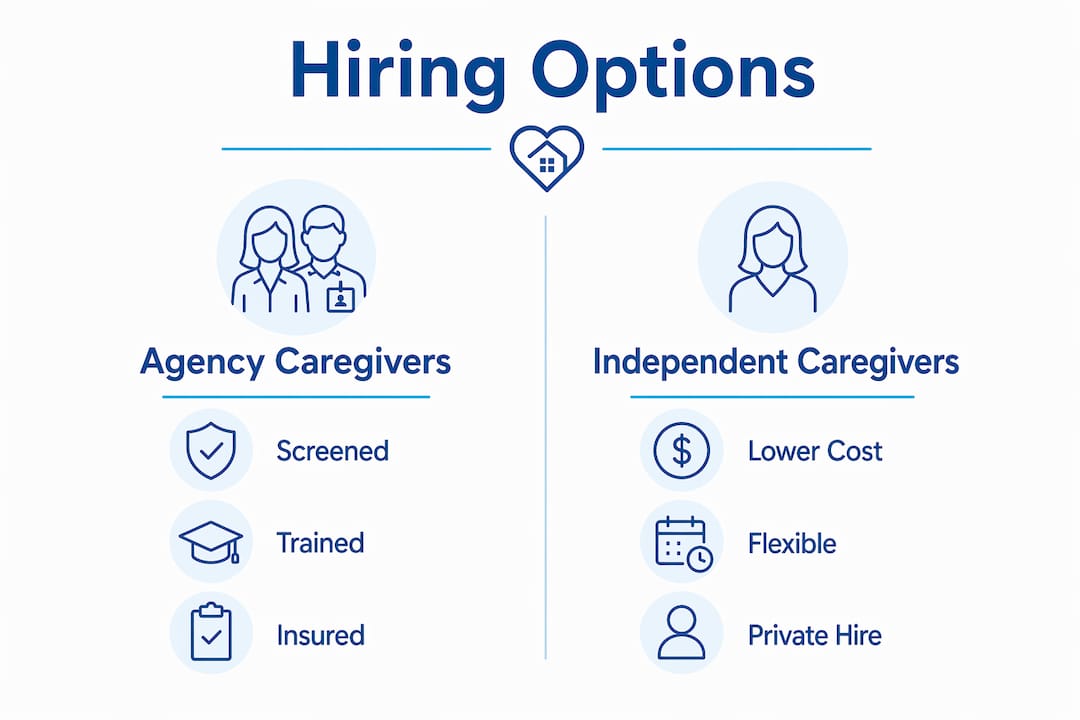
Agency caregivers
Agencies recruit, screen, train, and insure their caregivers. They handle payroll taxes, workers’ compensation, and backup staffing when a caregiver calls in sick. That infrastructure comes at a price. Agency rates average $20–$27 per hour, which reflects the added cost of management and compliance. For families who want dependable coverage without administrative work, agencies are the simpler path.
Independent caregivers
Hiring privately costs less on the surface. Independent caregivers typically charge $14–$20 per hour, but that lower rate shifts significant legal responsibility onto your family. When you hire someone directly, you become their employer. That means managing payroll taxes, providing workers’ compensation coverage, and arranging backup care when they are unavailable. Families consistently underestimate these administrative burdens until they are already in the middle of them.
| Factor | Agency caregivers | Independent caregivers |
|---|---|---|
| Hourly cost | $20–$27 | $14–$20 |
| Background checks | Handled by agency | Family’s responsibility |
| Payroll and taxes | Handled by agency | Family’s responsibility |
| Backup coverage | Agency provides | Family arranges |
| Flexibility | Moderate | High |
| Dispute mediation | Agency representative | No third party |
Agencies add roughly 20–40% to the cost compared to private hires. That premium buys you oversight, legal compliance, and a layer of protection that independent hiring cannot provide.
When choosing between the two paths, consider these factors:
- How much time your family can dedicate to employer responsibilities
- Whether your parent needs specialized care, such as dementia support
- How quickly you need care to start
- Your parent’s comfort level with new people
Pro Tip: If you are arranging round-the-clock elder care or need coverage seven days a week, agencies almost always make more practical sense. Managing schedules, taxes, and backup caregivers for a full-time private hire is a part-time job in itself.
How to select and onboard the right caregiver
Selecting the right caregiver is where the process becomes personal. A good caregiver match improves your parent’s daily quality of life. A poor match creates stress for everyone involved.
Follow these steps to make a confident hiring decision:
Interview at least three candidates. Best practice requires interviewing multiple candidates with your parent present whenever possible. Your parent’s comfort with the person matters as much as the caregiver’s credentials.
Run a background check. Verify criminal history, driving record if transportation is needed, and professional references. Agencies do this automatically. Private hires require you to use a third-party screening service.
Call at least two references. Ask specifically about reliability, how the caregiver handled difficult situations, and whether the reference would hire them again.
Schedule a paid trial shift. A trial shift, typically two to four hours, lets you observe how the caregiver interacts with your parent in the actual home environment. Watch for patience, attentiveness, and how they respond when your parent resists help.
Define duties in writing before the first official day. Written care agreements that specify tasks, limits, and communication expectations prevent most conflicts before they start. Include what the caregiver is and is not responsible for, how they should contact family members, and what to do in an emergency.
Set a communication schedule. Decide in advance how often you want updates, through what channel (text, phone, a shared app), and who the primary family contact is.
Pro Tip: Ask candidates this question during interviews: “Tell me about a time a client refused care. What did you do?” The answer reveals more about their character and skill than any credential.
Best practices for managing and monitoring in-home care long term
Arranging care is the beginning, not the finish line. Long-term success depends on consistent oversight and clear communication between your family and the caregiver.
A detailed, living care plan is the foundation of good ongoing management. This document should list specific daily tasks, medication reminders, emergency contacts, and escalation steps. Update it whenever your parent’s condition changes. Shared digital documents or dedicated caregiving apps make this easy for multiple family members to access in real time.
Effective long-term management also requires:
- Weekly check-ins with the caregiver to review how your parent is doing and address any concerns early
- Monthly family meetings to align on care goals and divide responsibilities
- Assigned family roles, such as a care manager, a finance manager, and a communication lead, to reduce confusion and overlap
- A clear escalation protocol so everyone knows who to call and when if something goes wrong
Agency representatives serve as neutral third parties when disputes arise between family members or between the family and the caregiver. This mediation function is one of the most underappreciated benefits of working with an agency. Families managing private hires have no equivalent resource and often find disagreements harder to resolve.
One financial boundary deserves special attention. Financial experts strongly advise against giving caregivers access to bank accounts or credit cards. This is the primary preventive measure against elder financial abuse, and it applies regardless of how much you trust the individual.
Finally, recognize when home care is no longer enough. If your parent’s medical needs exceed what a non-medical caregiver can safely manage, or if care needs have grown to require 24-hour supervision beyond what home care can provide, a conversation with their physician about next steps is the right move.
Key takeaways
Arranging dependable in-home care for an elderly parent requires a formal needs assessment, a clear understanding of agency versus independent hiring trade-offs, written care agreements, and consistent long-term oversight.
| Point | Details |
|---|---|
| Start with a needs assessment | Use your local AAA or physician to document health needs and daily living abilities before hiring. |
| Know your hiring options | Agencies cost $20–$27/hr and handle compliance; independent hires cost $14–$20/hr but shift legal duties to your family. |
| Always use a written agreement | Define caregiver tasks, limits, and communication methods in writing before the first shift. |
| Build a living care plan | Update the care plan regularly and share it digitally so all family members stay aligned. |
| Protect against financial abuse | Never give a caregiver access to bank accounts, regardless of the level of trust established. |
What I have learned after years of watching families navigate this process
By Vasu
The families who struggle most with in-home care are not the ones who chose the wrong agency or hired the wrong person. They are the ones who never defined what they wanted in the first place.
I have seen families spend weeks interviewing caregivers without ever writing down what the caregiver’s actual job is. Then, three months in, they are frustrated that the caregiver is not doing things they never asked for. The caregiver is equally frustrated. Everyone feels let down, and the parent is caught in the middle.
The written care agreement is not a formality. It is the single document that determines whether the arrangement works. I would go further and say that if a family is not willing to put the caregiver’s duties in writing, they are not ready to hire yet.
The other thing I have seen because real harm is financial commingling. Families build genuine trust with a caregiver over months or years, and that trust feels like a reason to relax the rules. It is not. Elder financial abuse most often happens in relationships where trust was high. Keep finances completely separate, always.
One more thing: involve your parent in the hiring process. Their comfort with the caregiver is not a secondary concern. It is the primary one. A caregiver your parent dislikes will not be effective, no matter how qualified they are on paper.
— Vasu
Cbahplano’s care services for seniors and veterans in Plano and beyond
Families in the Plano, Allen, and Richardson area have a dependable local option for quality in-home assistance. Cbahplano, operating as CareBuilders at Home, provides companion care for seniors and specialized support for veterans, with care plans built around each person’s specific needs.

Cbahplano’s caregivers are trained to support safety, companionship, and independence at home. As a VA-approved provider, Cbahplano also helps veterans access their earned benefits to cover care costs. Whether your parent needs a few hours of company each week or more structured daily support, the team works with your family to build a plan that fits. Contact Cbahplano to start a conversation about veteran care options or personal assistance for your loved one.
FAQ
What is non-medical in-home care?
Non-medical in-home care provides daily living support, such as bathing, meal preparation, and companionship, without medical procedures. It does not require a physician referral, unlike home health services.
How do I find elderly care resources in my area?
Contact your local Area Agency on Aging, one of 622 AAAs nationwide, for free care coordination and referrals. They serve more than 11 million older adults annually and can connect you with vetted local providers.
How much does in-home care cost per hour?
Agency caregivers typically cost $20–$27 per hour, while independent caregivers charge $14–$20 per hour. Regional rates vary, and agencies include compliance and backup staffing in their fees.
Do I need a written agreement with a caregiver?
A written care agreement is strongly recommended before the first shift. It defines the caregiver’s duties, communication expectations, and limits, and it prevents most disputes before they arise.
When should I consider alternatives to in-home care?
Consider alternatives when your parent’s medical needs exceed what a non-medical caregiver can safely manage, or when round-the-clock supervision is required beyond what home care can realistically provide. Consult their physician to evaluate next steps.
One Response