


Does Medicare Cover Home Care for Seniors and Veterans?

Original Medicare does not cover ongoing non-medical, custodial in-home care when that’s the only help your loved one need. There is one narrow exception: Medicare will pay for a home health aide, but only while the beneficiary also receives part-time or intermittent skilled care, like nursing or physical therapy, from a Medicare-certified home health agency. Once that skilled care ends, aide coverage ends with it.
Here’s what that means in practice:
- Bathing, dressing, meal prep, housekeeping, and transportation are not covered on their own.
- A home health aide is covered only as an add-on to skilled treatment, never as a standalone service.
- If your family needs help beyond that narrow window, you have real alternatives, and we’ll walk through each one below.
We know how disorienting this can feel when you’re trying to keep a parent or spouse safe at home. Take a breath. The rest of this guide covers the skilled-care rule in plain terms, what to do when coverage runs out, and where families in Plano, Allen, Richardson, and Wylie can turn next.
Key Takeaways
Original Medicare covers a home health aide only alongside part-time skilled care, leaving most non-medical daily support to Medicaid, VA benefits, Medicare Advantage extras, or private pay.
| Point | Details |
|---|---|
| Medicare’s coverage limit | Original Medicare excludes ongoing custodial care unless paired with active skilled services. |
| Coverage ends abruptly | Aide hours stop the same day skilled nursing or therapy visits end, so plan ahead. |
| Alternatives exist | Medicaid waivers, VA Aid & Attendance, and Medicare Advantage extras can fill the gap. |
| Dual eligibility helps | Medicare and Medicaid together can cover skilled care and personal care simultaneously. |
| CareBuilders at Home fits the gap | Offers VA-approved, dementia-trained non-medical care with 24/7 monitoring across Plano, Allen, Richardson, and Wylie. |
Table of Contents
- What Medicare Home Health Coverage Actually Includes
- How Does the Skilled-Care Requirement Actually Work?
- What Funding Options Exist Beyond Medicare?
- How Do You Check Coverage and Get Started?
- Why Families Turn to CareBuilders at Home When Medicare Coverage Ends
- What the Rules Actually Reveal About Medicare’s Priorities
- Get Non-Medical Care That Picks Up Where Medicare Leaves Off
- Sources
What Medicare Home Health Coverage Actually Includes
Families often assume “home health care covered by Medicare” means any help delivered at home. It doesn’t. Medicare draws a hard line between skilled medical services and custodial personal care, and that line determines whether you’ll pay out of pocket.
Custodial care covers the everyday tasks your loved one may need help with: bathing, dressing, toileting, meal preparation, light housekeeping, and rides to appointments. None of that is covered by itself, according to Medicare’s own coverage guidance.
What Medicare does pay for looks different:
- Skilled nursing care ordered by a doctor
- Physical, occupational, or speech therapy
- Medical social services
- A part-time home health aide, but only when skilled care is also happening
The gap that trips up most families: Medicare will pay for a nurse to change a wound dressing, but not for someone to help Mom get dressed every morning unless that nurse visit is still active.
How Does the Skilled-Care Requirement Actually Work?
Medicare ties aide coverage to a “part-time or intermittent” skilled-care plan, meaning your loved one’s doctor has ordered nursing, therapy, or another skilled service through a Medicare-certified agency, according to Medicare’s home health eligibility guide. The aide’s hours are secondary to that skilled plan, not a benefit that exists on its own.
Here’s the timeline that catches families off guard:
- A doctor certifies a plan of care, often after a hospital stay or new diagnosis.
- The agency provides skilled visits alongside limited aide hours for personal care tasks.
- Once the skilled portion of the plan ends, whether that’s after two weeks or two months, aide coverage stops the same day.
- The agency should issue an Advance Beneficiary Notice of Noncoverage (ABN) once it expects Medicare to stop paying, giving you a written heads-up and a paper trail for appeals.
Pro Tip: Ask the agency for an estimated end date for skilled services as soon as care begins. Families who wait for the ABN to arrive are often scrambling for a caregiver within days, not weeks.
What Funding Options Exist Beyond Medicare?
When Medicare’s skilled-care window closes, families aren’t out of options. They’re just out of Medicare. CMS is explicit that Fee-for-Service Medicare excludes custodial and long-term home care, but several other programs exist to fill that space.

Medicaid covers personal care through state programs and Home and Community-Based Services (HCBS) waivers, though rules and waitlists vary sharply by state. Start with your state Medicaid office, LongTermCare.gov, or your local Eldercare Locator agency to check eligibility.
Medicare Advantage plans sometimes bundle in supplemental non-medical benefits, like limited in-home support or meal delivery, but scope and availability shift by plan and by year, according to NCOA’s analysis of Medicare Advantage benefits. Call the plan administrator directly rather than assuming based on marketing materials.
VA Aid & Attendance offers a monthly benefit to qualifying wartime veterans and surviving spouses who need help with daily activities at home. Eligibility depends on service history and financial limits, and our veteran benefits guide for Allen, Texas walks through where to start.
PACE, long-term care insurance, and private pay round out the list. LTC policies often carry waiting periods and daily benefit caps, so confirm the trigger conditions before assuming a policy will cover live-in or round-the-clock care.
One overlooked detail: if your loved one qualifies for both Medicare and Medicaid, known as dual eligibility, Medicare can fund the skilled portion while Medicaid covers the personal care hours. That combination unlocks more support than either program offers alone.
| Funding Source | What It Typically Covers |
|---|---|
| Medicaid (HCBS waivers) | Personal care and homemaker services, subject to state rules and waitlists |
| Medicare Advantage | Limited supplemental non-medical benefits, varies by plan |
| VA Aid & Attendance | Monthly benefit toward in-home care for qualifying veterans and spouses |
| Long-term care insurance | Daily benefit toward custodial or live-in care, after waiting period |
| Private pay | Full flexibility, no eligibility rules, direct cost to family |
How Do You Check Coverage and Get Started?
Before you make a single call, gather what you’ll need: recent hospital discharge summaries, physician orders, a current medication list, and a plain description of what your loved one struggles to do alone, dressing, walking, managing medications, and so on.
Then work through this sequence:
- Call the treating physician’s office and ask whether a home health plan of care has been or can be ordered.
- Contact a Medicare-certified home health agency directly and ask about intake requirements.
- If your loved one has a Medicare Advantage plan, call the plan administrator to ask about supplemental benefits before assuming Original Medicare rules apply.
When you’re on the phone with an agency or plan, ask these questions directly:
- Are you Medicare-certified, and will an aide’s hours continue only alongside skilled care?
- Will I receive an ABN, and how far in advance?
- What’s the expected timeline for skilled services, and what will private-pay cost after that?
If coverage is denied, you can appeal through Medicare’s standard process. In the meantime, private pay, short-term respite care, or VA benefit coordination can bridge the gap while you sort out longer-term funding, and our guide to post-discharge home care covers that transition in more detail.
Why Families Turn to CareBuilders at Home When Medicare Coverage Ends
This is exactly the gap CareBuilders at Home of Plano & Allen was built to fill. When skilled care winds down and Medicare stops paying for an aide, families still need someone reliable in the house, and that’s where we come in.
Our services include:
- Non-medical personal care and companion support for daily living tasks
- Dementia and Alzheimer’s-trained caregivers for families managing memory-related conditions
- VA-approved in-home care for veterans navigating Aid & Attendance benefits
- 24/7 virtual monitoring and fall detection technology layered on top of in-person caregiving
We regularly coordinate directly with home health agencies and VA case managers, so a family’s short-term Medicare-covered skilled care and our ongoing non-medical support don’t feel like two disconnected systems. We serve Plano, Allen, Richardson, Wylie, and the surrounding Collin County community. If you’re weighing your options, our personal care services page and veteran care page outline what a coordinated plan looks like in practice.
What the Rules Actually Reveal About Medicare’s Priorities
Medicare’s home health rules aren’t confusing by accident. They’re built around a specific goal: recovery from illness or injury, not ongoing daily living support. Once you see the skilled-care requirement through that lens, the abrupt end to aide coverage stops feeling like a bureaucratic trap and starts looking like exactly what it is, a program designed for treatment episodes, not custodial care.
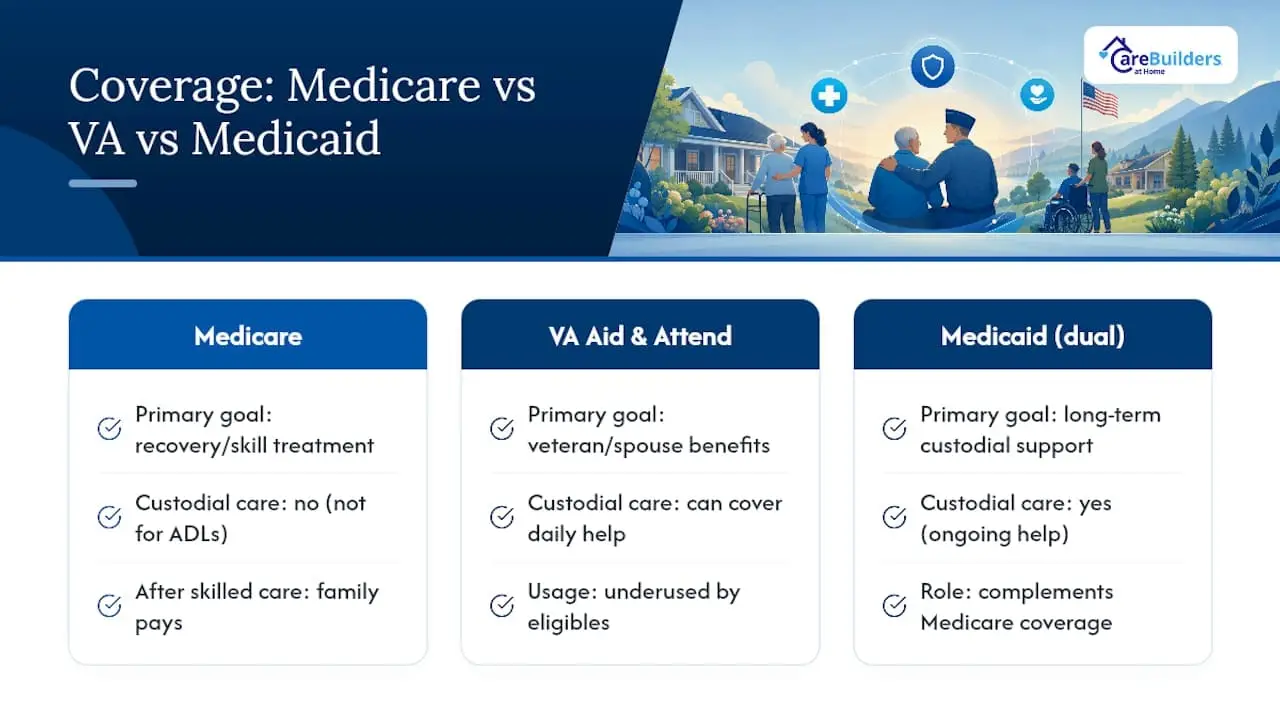
The conventional advice, “check if Medicare covers it,” undersells the real question families should be asking. The better question is: what happens the day skilled care ends, and who is paying then? Too many families wait for the ABN to force that conversation instead of having it during intake.
If your loved one is a veteran, VA Aid & Attendance deserves more attention than it usually gets. It’s underused relative to how many veterans and surviving spouses qualify. And if dual Medicaid eligibility applies, that combination often does more heavy lifting than either program alone. Start there, not with Medicare’s fine print.
— cbahplano
Get Non-Medical Care That Picks Up Where Medicare Leaves Off
CareBuilders at Home of Plano & Allen exists for the exact moment this article describes: when Medicare’s skilled-care coverage ends but your family’s need for help doesn’t. Unlike a Medicare-certified agency bound to short-term treatment plans, we build ongoing care plans around your loved one’s actual daily needs, personal care, companionship, dementia support, all paired with 24/7 virtual monitoring for added safety.
We work with families across Plano, Allen, Richardson, and Wylie who are past the skilled-care window and need dependable, flexible support without starting from scratch. Our team also helps veterans access VA Aid & Attendance benefits alongside our care services, so you’re not managing two separate systems on your own.
If you’re ready to talk through what a plan could look like for your family, visit our personal care services page to request a consultation and get specific answers about coverage, cost, and scheduling.
Sources
- Medicare
- CMS MLN — Items and services not covered under Medicare
- NCOA — The new non-medical benefits of Medicare Advantage plans in 2026
Recommended
- CareBuilders at Home – Exceptional Senior and Veteran Care in Plano, Allen and Richardson
- CareBuilders at Home – Exceptional Senior and Veteran Care in Plano, Allen and Richardson
- CareBuilders at Home – Exceptional Senior and Veteran Care in Plano, Allen and Richardson
- Veterans Care – CareBuilders at Home | Senior and Veteran Care in Plano, Allen & Richardson TX