


What Post-Discharge Home Care Services Provide for Families
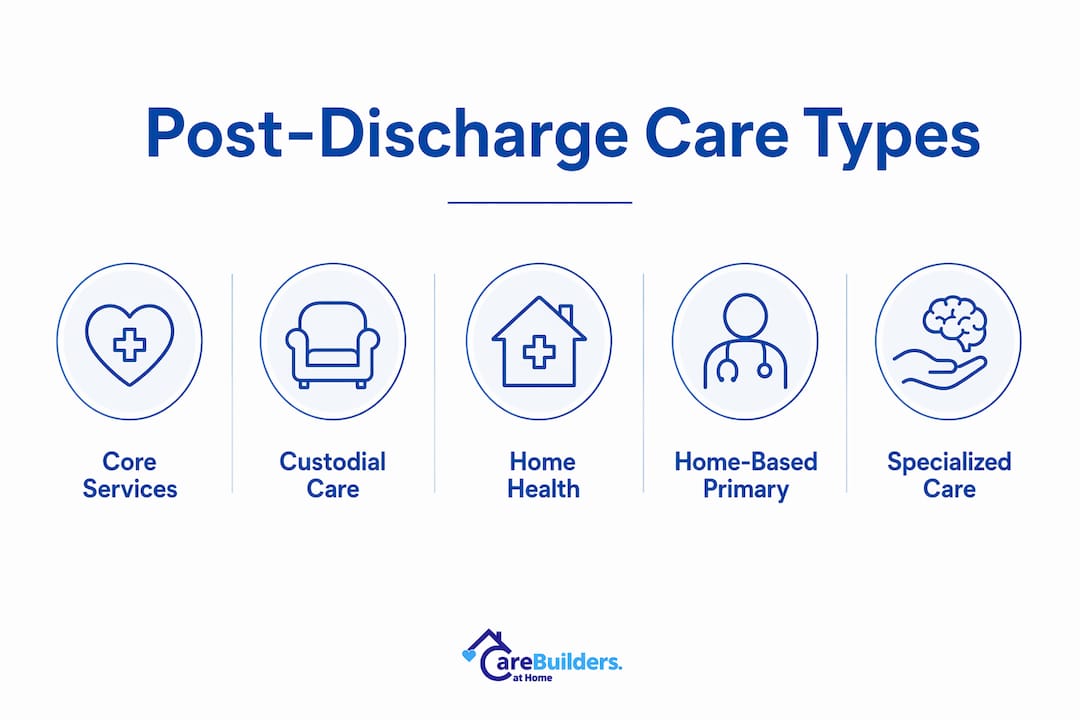
Post-discharge home care services provide three core types of support: custodial care for daily living assistance, skilled home health for nursing and therapy, and home-based primary care under physician or advanced provider oversight. Understanding which type fits your loved one’s situation is the most important decision you will make after a hospital stay, and getting it right from the start can mean the difference between a smooth recovery and an unnecessary return to the hospital.
Here is a quick look at what each category covers and when it applies:
Service categories at a glance:
- Custodial care: Personal assistance with bathing, dressing, grooming, meal preparation, and companionship. Provided by trained aides or family members. Not medically ordered, but over 53 million Americans were providing this type of informal care in 2020.
- Home health agency services: Skilled nursing, wound care, medication management, and physical, occupational, or speech therapy. Ordered by a physician and typically covered by Medicare when the patient qualifies as homebound.
- Home-based primary care (HBPC): Physician or nurse practitioner house calls for medically complex, homebound patients. Originally designed for veterans, HBPC has expanded to serve frail older adults with multiple chronic conditions.
| Service Type | Who Provides It | Typical Services | Medical Order Required? |
|---|---|---|---|
| Custodial Care | Family, paid aides | Bathing, dressing, meals, companionship | No |
| Home Health Agency | Licensed nurses, therapists, aides | Wound care, therapy, medication management | Yes |
| Home-Based Primary Care | Physicians, nurse practitioners | Chronic care management, house calls, advance planning | Yes |
One thing families often miss: custodial care and home health are not interchangeable. Custodial care supports daily life; home health treats a specific medical condition. Medicare covers home health only when a physician orders it and the patient meets the homebound status requirement, meaning leaving home takes considerable effort and assistance. Knowing this distinction upfront protects you from unexpected costs and coverage gaps.
How discharge planning sets the stage for safe home recovery
Discharge planning is not a single conversation on the day your loved one leaves the hospital. It is an ongoing process that should begin within 24 hours of admission, and it directly shapes how well post-discharge home care services work once your family member is home.
Hospital teams commonly use the Five Ds of Discharge framework to organize what patients and families need to understand before leaving:
- Diagnosis: What condition is being treated, and what does it mean for daily life at home?
- Drugs: A reconciled medication list with the purpose, dose, timing, and side effects of every medication.
- Doctor: Who is the named clinical contact for questions after discharge, and when is the follow-up appointment?
- Directions: Specific instructions for wound care, activity restrictions, diet, and warning signs to watch for.
- Diet: Any nutritional requirements or restrictions tied to the diagnosis or recovery.
The AHRQ’s IDEAL Discharge Planning process takes this further by treating families as full partners, not just observers. One of its most practical tools is the teach-back method: before leaving the hospital, the patient or family member repeats the care instructions back to the nurse in their own words. If something is unclear, the nurse clarifies it on the spot, rather than leaving gaps that surface at 10 PM on a Tuesday.
Discharge planning best practices for families:
- Ask the care team to schedule a dedicated discharge planning meeting that includes you, not just the patient.
- Request a written, reconciled medication list with clear explanations of each drug’s purpose.
- Confirm the name and direct phone number of a clinical contact for post-discharge questions.
- Ask whether home health services have been ordered and when the first visit will occur.
- Verify that follow-up appointments are scheduled before leaving the hospital.
- Use the teach-back method: repeat instructions back to the nurse to confirm you understood correctly.
Pro Tip: Ask the hospital social worker or discharge planner specifically whether your loved one qualifies for Medicare-covered home health services. Many families leave without knowing this benefit exists, and the window to initiate it is narrow.
The Centers for Medicare and Medicaid Services implemented guidelines that reduce payment to hospitals exceeding expected readmission rates, which means hospitals have a financial incentive to get discharge planning right. That said, the quality of planning varies widely, and your active participation as a family member is one of the most reliable safeguards available.
Common risks and challenges during the post-discharge period
The transition from hospital to home is the highest-risk window in a patient’s care journey. Nearly 1 in 5 hospitalized patients face serious challenges during this period, most often because of fragmented communication and ineffective handoffs between hospital staff and home care providers.
Research shows that three-quarters of post-discharge complications could have been prevented or reduced with better preparation. Common problems include adverse drug events, hospital-acquired infections carried home, and procedural complications that go unrecognized without clinical oversight.
Source: AHRQ IDEAL Discharge Planning
Medication errors are among the most frequent and serious risks. Changes or discrepancies between what a patient was taking before hospitalization and what they are prescribed at discharge create confusion that can lead to double-dosing, missed doses, or dangerous interactions. Families who are not given a clear, reconciled medication list are especially vulnerable to this.
Risk factors families should watch for during home care:
- Sudden changes in alertness, confusion, or behavior, which can signal medication problems or infection.
- Wound sites that show redness, swelling, or discharge beyond what the discharge instructions described.
- Difficulty following the prescribed diet or taking medications on schedule.
- A patient who seems reluctant to report pain or new symptoms, often out of a desire not to worry family.
- Gaps in communication between the hospital, the home health agency, and the primary care physician.
- Falls, particularly in the first two weeks at home when the patient is still adjusting to reduced mobility.
Fragmented care is the underlying cause of most of these problems. When the hospital, the home health nurse, and the primary care doctor are not sharing information in real time, critical details fall through the cracks. Families who designate one person as the primary care coordinator, and who keep a written log of symptoms, medications, and caregiver visits, tend to catch problems earlier. That simple habit has more practical value than most families realize.
What home care support services actually look like after discharge
Home care support after hospital discharge covers a wider range of services than most families expect. The specific mix depends on the patient’s diagnosis, functional ability, and whether a physician has ordered skilled services, but the general categories are consistent across most home health programs in the United States.
Skilled nursing and therapy services (physician-ordered, typically Medicare-covered):
- Wound care and surgical dressing changes.
- Medication management, including teaching patients and families how to administer injections or manage infusion therapy.
- Physical therapy to rebuild strength, improve gait, and reduce fall risk.
- Occupational therapy to restore the ability to perform daily tasks like dressing, cooking, and bathing safely.
- Speech-language pathology for patients recovering from stroke or surgery affecting swallowing or communication.
- Monitoring of vital signs and post-surgical recovery status.
Under Medicare’s home health benefit, a physician must order these services, and visits typically occur two to three times weekly for up to 60 days per episode. On average, beneficiaries receive 8 to 9 visits every 30 days. That schedule is intermittent by design, which means the family or a paid caregiver fills the gaps.
Non-medical custodial support (no physician order required):
- Bathing, grooming, and personal hygiene assistance.
- Help with dressing and mobility around the home.
- Meal preparation and monitoring of nutritional intake.
- Light housekeeping and laundry.
- Companionship and emotional support during recovery.
- Transportation to follow-up appointments.
Post-discharge home visits from a physician or licensed clinician add another layer. Under CMS guidelines, patients discharged from an inpatient facility can receive up to nine home visits in a 90-day period. These visits cover wound care instructions, medication guidance, help understanding the medical plan, and identifying who to call if a problem arises.
“Home health care provides intermittent nursing and therapy services ordered by a physician, usually involving wound care, medication management, rehabilitation, and monitoring of post-surgical recovery at home.”
Source: JAMA Internal Medicine
One practical reality families often discover too late: home health is intermittent, not continuous. A nurse visiting twice a week cannot substitute for daily hands-on support. If your loved one needs help with bathing, meals, and mobility every day, custodial care from a trained aide is what fills that gap. Pairing both types of service, skilled home health for medical needs and personal care support for daily living, gives recovering patients the most complete coverage.
How you can prepare and actively participate in your loved one’s home care
Your role as a family caregiver does not begin when your loved one walks through the front door. It begins in the hospital, during discharge planning, and the preparation you do in those final days shapes how smoothly the first weeks at home go.
Before discharge, work through this checklist:
- Confirm that a home health agency has been contacted and the first visit is scheduled.
- Obtain a written, reconciled medication list with the name, purpose, dose, and potential side effects of every drug.
- Get the direct phone number of a clinical contact you can call with questions after hours.
- Ask the nurse to walk you through any wound care, equipment operation, or medication administration you will need to manage at home.
- Use the teach-back method: repeat the instructions back to confirm you understood them correctly.
- Verify that follow-up appointments with the primary care physician are booked before leaving.
- Assess the home environment for fall hazards: loose rugs, poor lighting, and bathroom safety equipment.
Pro Tip: Request a home safety assessment from the home health occupational therapist during the first visit. They are trained to spot hazards you might overlook, and many Medicare-covered home health episodes include this service at no additional cost.
One of the most common sources of caregiver stress is the confusion between custodial care and medically necessary home health. Families sometimes assume Medicare will cover all in-home support, only to discover that personal care and companionship are not included in the home health benefit. Understanding this distinction early, and planning for the cost of custodial care separately, prevents a painful surprise during recovery.
Ongoing participation strategies:
- Keep a daily log of symptoms, medications taken, and any changes in the patient’s condition to share with visiting nurses and the primary care physician.
- Attend home health visits when possible so you hear the nurse’s observations directly.
- Ask the home health team to explain any changes to the care plan in plain language.
- Watch for signs of caregiver burnout in yourself: disrupted sleep, irritability, and feeling stretched thin are signals that you need additional support.
Families who treat themselves as members of the care team, rather than bystanders, consistently produce better outcomes for their loved ones. The IDEAL Discharge Planning framework from AHRQ was built on exactly this principle: the patient and family are not recipients of a plan, they are co-authors of it.
Specialized home care for dementia patients and veterans after discharge
Some patients need more than standard home health or custodial care after discharge. Patients living with dementia and veterans with service-related conditions often require tailored approaches that go well beyond what a general home health agency provides.
Dementia care at home
Patients with dementia face unique challenges after a hospital stay. The disruption of routine, unfamiliar faces, and medication changes can accelerate confusion and behavioral changes. Returning home helps, but only if the home environment and the caregivers are prepared for what dementia-specific care actually requires.
Effective dementia care at home typically involves:
- Caregivers trained in dementia-specific communication techniques, including how to redirect without confrontation.
- Structured daily routines that reduce anxiety and confusion.
- Environmental modifications to prevent wandering and falls.
- Consistent caregiver assignments so the patient is not repeatedly meeting new faces.
- Family education on recognizing behavioral changes that signal a medical problem.
Technology plays a growing role here. Virtual monitoring and fall detection tools allow families and care coordinators to track safety in real time without being physically present around the clock. For families managing dementia care from a distance, this kind of virtual caregiver support provides a meaningful layer of reassurance.
Veteran-focused home care
Home-Based Primary Care was originally designed for veterans who need team-based, in-home support for ongoing conditions that affect their health and daily activities. Veterans who qualify are typically homebound or home-limited, making regular clinic visits difficult or impossible.
“Home-Based Primary Care was originally designed for veterans who need team-based, in-home support for ongoing diseases and illnesses that affect their health and daily activities.”
Source: AHRQ PSNet
VA-approved home care providers can help veterans access benefits they have earned, including coverage for personal care, skilled nursing, and specialized support services. Navigating VA benefits is genuinely complex, and working with a provider who understands the system saves families significant time and frustration.
Specialized home care for veterans and patients with dementia involves tailored approaches, often providing around-the-clock support, advanced caregiver training, and integration of monitoring technologies. The goal is not just safety. It is preserving dignity, routine, and quality of life for people whose needs are more complex than a standard recovery plan addresses.
Key Takeaways
Post-discharge home care services provide the most effective recovery support when families understand the three service types, engage actively in discharge planning, and match the level of care to the patient’s actual medical and daily living needs.
| Point | Details |
|---|---|
| Three core service types | Custodial care, home health agencies, and home-based primary care each serve different needs and eligibility requirements. |
| Discharge planning is foundational | The Five Ds framework and IDEAL process help families leave the hospital with a clear, actionable care plan. |
| Transition period carries the highest risk | Nearly 1 in 5 hospitalized patients face serious challenges post-discharge, most caused by fragmented communication and medication errors. |
| Specialized care for dementia and veterans | Patients with dementia and veterans need tailored approaches, including trained caregivers, consistent routines, and technology-assisted monitoring. |
| CareBuilders at Home of Plano & Allen | Provides VA-approved, dementia-specialized, non-medical in-home care with 24/7 monitoring for seniors and veterans in Collin County. |
Why the future of post-discharge care belongs to families, not just clinicians
There is a persistent assumption in American healthcare that post-discharge care is primarily a clinical responsibility. Nurses visit, therapists assess, physicians order. The family waits. That model is changing, and not a moment too soon.
The evidence increasingly points toward integrated, team-based care models where family caregivers are treated as co-managers, not support staff. The shift toward virtual technologies and interdisciplinary teams in home-based care is real and accelerating. Remote monitoring, telehealth check-ins, and electronic care coordination tools are making it possible for a patient’s primary care physician, home health nurse, and family caregiver to share information in near real time. That kind of coordination was logistically impossible a decade ago.
What concerns me about the current state of post-discharge care is not the technology gap. It is the expectation gap. Families are sent home with a medication list and a phone number, and they are expected to manage a recovery that would have required a hospital stay a generation ago. The acuity of patients being discharged to home has increased steadily as hospital stays have shortened. The support infrastructure has not kept pace.
The families who navigate this best are the ones who refuse to be passive. They ask questions in the hospital. They show up to home health visits. They keep logs. They call the clinical contact when something feels wrong, rather than waiting to see if it resolves. That kind of engaged caregiving is not instinctive for most people. It has to be taught, modeled, and supported by the care team.
Specialized care for aging populations, particularly those living with dementia or managing service-related conditions as veterans, will only grow in demand as the population ages. The home care providers who will matter most in the coming years are the ones who train their caregivers deeply, integrate technology thoughtfully, and treat families as genuine partners rather than an afterthought. That is the standard worth holding every provider to.
CareBuilders at Home of Plano & Allen supports families through every step of recovery
When your loved one comes home after a hospital stay, the gap between what home health visits cover and what daily life actually requires can feel wide. CareBuilders at Home of Plano & Allen fills that gap with compassionate, non-medical in-home care built specifically for seniors and veterans in Plano, Allen, Richardson, Wylie, and surrounding Collin County communities.
As a VA-approved provider, CareBuilders at Home of Plano & Allen helps veteran families access the benefits they have earned while receiving consistent, trained care at home. For families managing a loved one’s dementia, the team brings specialized caregiver training, structured routines, and technology-assisted monitoring, including fall detection and virtual oversight, that give you real peace of mind between visits. Care plans adapt as your loved one’s needs change, with 24/7 support available when it matters most.
Explore personal care services or learn how to arrange in-home care for your family member. The team at CareBuilders at Home of Plano & Allen is ready to help you build a plan that supports recovery, protects safety, and honors your loved one’s dignity at home.
Recommended
- Senior Recovery After Hospitalization: A Family Guide to Safe Discharge
- Companion Services – CareBuilders at Home | Senior and Veteran Care in Plano, Allen & Richardson TX
- Personal Care – CareBuilders at Home | Senior and Veteran Care in Plano, Allen & Richardson TX
- Specialized Services – CareBuilders at Home | Senior and Veteran Care in Plano, Allen & Richardson TX