


Stop 15–30 Minute Misses: Parkinson’s Care at Home for U.S. Families
Yes, most people with Parkinson’s disease can stay safely at home with the right supports in place. Start today with three things: lock in a consistent medication schedule, walk through the house for fall hazards, and line up a few hours of respite so you’re not carrying this alone. If falls, confusion, or missed medications have become frequent, treat that as your signal to bring in outside help now, not later.
Table of Contents
- What Types of In-Home Care Fit Parkinson’s Care at Home?
- Why Does Medication Timing Matter So Much in Parkinson’s Care?
- How Much Exercise Actually Helps with Parkinson’s Symptoms?
- What Home Safety Changes Actually Prevent Falls?
- When Is It Time to Bring in Outside Help?
- How Do Caregivers Avoid Burnout While Providing Home Care?
- How Can a Specialized Home Care Provider Fill the Gaps?
- What Should Meals Look Like for Someone with Parkinson’s?
- How Do You Manage Mood, Sleep, and Cognitive Changes at Home?
- How Do You Communicate with Someone Who Has Speech Difficulties?
- How Do You Prepare for a Medical Emergency at Home?
- A Realistic Way to Think About Starting Home Care
- How CareBuilders at Home Supports Parkinson’s Care at Home
- Where to Find Reliable Parkinson’s Care Resources
- Sources
- FAQ
What Types of In-Home Care Fit Parkinson’s Care at Home?
Parkinson’s care at home rarely means one kind of help. It usually means layering a few different services as needs shift.
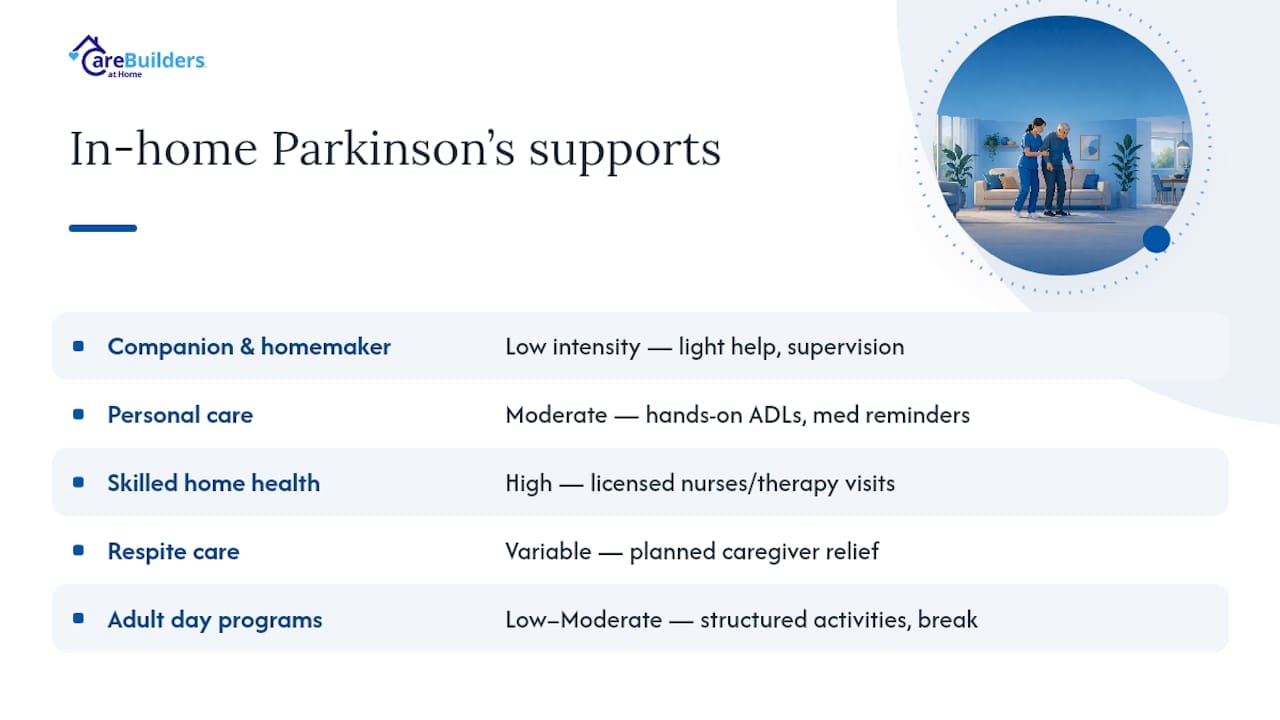
Companion and homemaker care covers light housekeeping, meal prep, transportation, and friendly supervision. This fits early-stage Parkinson’s, when someone is mostly independent but shouldn’t be left entirely alone for safety or isolation reasons.
Personal care steps in when bathing, dressing, transfers, or toileting become difficult. Caregivers trained in personal care also handle medication reminders, which matters enormously given how tightly Parkinson’s symptoms track dosing times.
Skilled home health brings in licensed nurses or therapists, usually ordered by a physician, for wound care, injections, or physical and occupational therapy visits. This is a medical service layered on top of, not instead of, daily nonmedical support.
Respite care gives the primary caregiver planned time off, whether that’s a few hours a week or a longer stretch during travel or illness.
Adult day programs offer structured social and physical activity outside the home, which can slow isolation and give caregivers a predictable break.
Deciding between hourly help, live-in care, and skilled home health comes down to two questions: how much hands-on assistance does daily function require, and how complex is the medication regimen? A person on a simple twice-daily levodopa schedule with good balance needs far less than someone on a five-times-daily regimen with frequent freezing episodes.
Why Does Medication Timing Matter So Much in Parkinson’s Care?
Parkinson’s medications, especially levodopa, work on a narrow window. “On” periods are when medication is active and movement is smoother; “off” periods are when it wears off and symptoms return, sometimes sharply. A delay of just 15 to 30 minutes in a dose can tip someone from a functional “on” state into a frozen, fall-risk “off” state. This isn’t a minor scheduling inconvenience. It’s the single biggest lever a caregiver controls day to day.
Build a system that doesn’t depend on memory alone:
- Post a visible, current medication list on the refrigerator or near the pill station, including exact times and dosages.
- Set phone alarms or use a medication app for every dose, not just the tricky ones.
- Use a labeled pill organizer sorted by day and time slot.
- Keep a two-week emergency medication supply on hand in case of a pharmacy delay, storm, or hospital stay.
- Log “on” and “off” times daily. That log helps a neurologist fine-tune dosing far faster than a verbal recap at the next appointment.
Hospital stays are a known weak point. Emergency departments and hospital units frequently don’t follow a patient’s home Parkinson’s schedule, and even a few hours off-schedule can trigger a serious decline. Bring the written medication list to every hospital visit and insist, respectfully but firmly, that doses be given on the home timetable. If the regimen involves more than three or four daily doses or injectable therapies, it’s worth asking your neurologist about a referral to a Parkinson’s disease nurse specialist, whose role in home-based care includes medication management and catching early warning signs before they become hospitalizations, according to a 2024 scoping review.
Pro Tip: Protein can compete with levodopa for absorption in the gut. If mealtime doses seem less effective, ask the neurologist whether shifting medication to 30 to 60 minutes before meals, rather than with them, helps.
How Much Exercise Actually Helps with Parkinson’s Symptoms?
The Parkinson’s Foundation recommends at least 2.5 hours of physical activity per week for people with Parkinson’s, and that number isn’t arbitrary. Regular movement helps slow functional decline and measurably reduces fall risk, which is one of the leading causes of hospitalization in this disease.
What that looks like in a real week:
- PT-prescribed balance and strength exercises, done two to three times weekly
- Forced-rate cycling, which research increasingly links to symptom improvement
- Chair-based strength training for those with limited standing tolerance
- A daily walk, timed deliberately during “on” periods when movement is easiest
Freezing of gait, that sudden inability to step forward, responds better to short rhythmic or visual cues than to verbal instructions like “just walk.” A metronome app, a spoken count, or a strip of colored tape on the floor can break a freeze in seconds. These cueing techniques are simple enough that a physical or occupational therapist can teach them to a family caregiver in one or two sessions.
Mornings deserve extra patience. The overnight gap since the last dose means stiffness and freezing are often worst right after waking, so build extra time into the morning routine instead of rushing. If falls are increasing or a mobility aid like a cane or walker is being considered, get a PT evaluation before buying anything. The wrong aid, sized or trialed incorrectly, can actually increase fall risk.

What Home Safety Changes Actually Prevent Falls?
Falls are preventable more often than families realize, and most of the fix is inexpensive.
- In the bathroom, install grab bars anchored into wall studs (not suction-mounted ones), add a shower chair, switch to a handheld showerhead, and apply non-slip strips to the tub and floor.
- Remove or tape down area rugs throughout the house. Loose rugs are one of the most common, and most avoidable, fall triggers.
- Improve lighting in hallways and stairwells, and add motion-sensor nightlights between the bedroom and bathroom.
- Clear pathways of cords, clutter, and low furniture that sits below eye level.
- Replace round doorknobs with lever handles, which are easier to operate with reduced fine motor control.
- Swap low, soft couches for firmer chairs with sturdy armrests that make standing up easier.
These changes address the most common hazards tied to bathroom falls, poor lighting, and trip hazards. Quick wins like rug removal and nightlights can happen this weekend. Larger changes, like widening doorways or installing a walk-in shower, are worth planning around an occupational therapist’s home safety assessment, which will catch risks specific to how that person actually moves through their own space.
When Is It Time to Bring in Outside Help?
There’s no single “right” moment to hire professional support, but certain signs are reliable triggers. Watch for repeated falls, medication doses that are frequently missed or confused, a sudden decline in daily activities the person used to manage alone, unplanned weight loss, or recurring infections. Caregiver exhaustion counts too. Rising caregiver fatigue is itself a legitimate reason to bring in help, not something to push through.
Before that first call, do a quick self-assessment:
- How often are falls happening, and were any close calls?
- Is the medication schedule too complex for one person to track reliably?
- Are there new signs of confusion or memory changes?
- How many hours a week can the family realistically sustain without burning out?
When you interview a home care agency or independent caregiver, ask directly about Parkinson’s-specific training, how they handle timed medication reminders, what happens if a scheduled caregiver calls in sick, and how they communicate changes back to the family. Have the medication list, a brief care summary, and emergency contacts ready before that first visit. If skilled nursing seems necessary, ask your physician whether the case meets Medicare home health criteria, which generally requires a homebound status and a physician-ordered plan of care.
How Do Caregivers Avoid Burnout While Providing Home Care?
Caregiver wellbeing isn’t a luxury add-on to the care plan. It’s a core part of it, and treating your own rest as optional is how burnout sneaks up fast.
Respite comes in a few forms, and each fits a different situation:
- In-home respite, where a trained caregiver covers a few hours so you can run errands or simply rest
- Adult day programs, which give structured activity for your loved one and a predictable stretch of free time for you
- Short facility stays, useful for a weekend trip or a family emergency
When asking family or friends for help, be specific. “Can you sit with Dad from 2 to 5 on Thursday” gets a yes far more often than “I could use some help sometime.” Task-based requests remove the guesswork for people who genuinely want to help but don’t know where to start.
Pro Tip: Schedule respite on the calendar like a medical appointment, not as something you’ll get to “if there’s time.” Non-negotiable breaks are the ones that actually happen.
If coordinating care, appointments, and paperwork becomes its own full-time job, a geriatric care manager or medical social worker can take that logistics burden off your plate.
How Can a Specialized Home Care Provider Fill the Gaps?
Family caregivers can’t be everywhere at once, and that’s exactly where a trained in-home care team earns its place. A caregiver who understands Parkinson’s specifically, rather than senior care generally, knows why a 15-minute medication delay matters and won’t treat it as optional.
Here’s how the right support maps to common gaps:
- Medication reminders that follow the exact home schedule, including during shift changes
- Personal care assistance for bathing, transfers, and dressing that preserves as much independence as possible
- 24/7 virtual monitoring and fall detection technology that adds a safety layer between in-person visits
- Planned respite hours that give family caregivers real, reliable breaks
- Support for veterans navigating VA benefits toward the cost of care
Technology paired with trained caregivers doesn’t replace the family’s role. It extends it, catching the moments no single family member can cover around the clock.
What Should Meals Look Like for Someone with Parkinson’s?
Nutrition affects Parkinson’s symptoms more directly than most families expect. Constipation is common with the disease, so fiber from vegetables, fruit, and whole grains, along with steady water intake, matters daily, not just occasionally.
Timing matters as much as content. Since dietary protein can interfere with levodopa absorption, some neurologists recommend concentrating protein intake at dinner rather than spreading it evenly, so daytime doses work better. Ask the prescribing physician before making that change, since not every regimen needs it.
Swallowing difficulty, or dysphagia, tends to develop as the disease progresses. Watch for coughing during meals, throat clearing after swallowing, or unexplained weight loss. Thicker liquids and softer, smaller bites are often easier and safer than thin liquids or large chunks of food. If choking risk increases, a speech-language pathologist can do a formal swallow evaluation and recommend specific texture modifications.

Practical scheduling helps too. Small, frequent meals are generally easier to manage than three large ones, especially during “off” periods when fatigue makes a big meal feel like a chore. Keep easy, low-effort options like protein shakes or pre-cut fruit on hand for days when cooking isn’t realistic.
How Do You Manage Mood, Sleep, and Cognitive Changes at Home?
Non-motor symptoms often affect daily life more than tremor or stiffness do, and they’re easy to miss because they don’t look like “Parkinson’s” the way physical symptoms do.
Depression and apathy are common and are not simply someone “giving up.” They stem from changes in brain chemistry tied to the disease itself. Regular routine, social contact, and daylight exposure help, but persistent low mood deserves a conversation with the neurologist, since medication adjustments or a referral to counseling can make a real difference.
Sleep disturbances, including vivid dreams, acting out dreams physically, and frequent nighttime waking, are extremely common. A consistent bedtime routine, a room free of trip hazards for nighttime bathroom trips, and limiting screens before bed all help. If a sleep partner reports thrashing or shouting during sleep, mention it to the doctor. It can be an early marker worth tracking.
Cognitive changes, from mild slowness in processing to more significant memory issues, can develop over time. Keep instructions short and one step at a time, allow extra time for responses, and avoid quizzing or correcting in front of others. It rarely helps and often causes unnecessary frustration for everyone in the room.
How Do You Communicate with Someone Who Has Speech Difficulties?
Speech changes in Parkinson’s, often quieter volume, slurred words, or a monotone voice, can leave a person fully sharp mentally but hard to understand, which is exhausting for everyone involved.
A few adjustments help immediately. Face the person directly and reduce background noise like TV or running water before starting a conversation. Ask them to slow down and take a breath before speaking rather than pushing through in one long exhale. Yes-or-no questions or simple choices (“water or coffee?”) reduce the effort needed to respond compared to fully open-ended questions.
A speech-language pathologist can teach techniques like LSVT LOUD, a structured program specifically built for Parkinson’s-related voice changes, along with breathing exercises that support louder, clearer speech. For more advanced speech loss, simple communication boards, picture cards, or a tablet with a text-to-speech app can bridge the gap without demanding the person strain their voice all day.
Above all, resist the urge to finish sentences or guess at words too quickly. It’s well meant, but it often shuts a person down instead of helping them.
How Do You Prepare for a Medical Emergency at Home?
A clear plan turns a frightening moment into a manageable one. Keep a written summary near the phone and in a bag by the door: current medications with exact doses and times, allergies, primary physician and neurologist contact information, and emergency contacts.
Falls deserve their own protocol. If a fall happens and the person is alert with no obvious injury, help them up slowly using proper transfer technique rather than pulling on arms, which can dislocate a shoulder. If there’s any head injury, loss of consciousness, or inability to move a limb, call 911 rather than attempting to move them.
Sudden worsening of symptoms, confusion, high fever, or difficulty breathing all warrant urgent medical attention rather than a wait-and-see approach. Parkinson’s medications should never be stopped abruptly, even during a hospital stay, since sudden withdrawal can cause a serious reaction. Make sure any emergency responder or hospital team sees the medication list immediately.
Keep a charged phone and a medical alert device within reach at all times, particularly if falls or freezing episodes have become frequent. A brief written plan taped inside a kitchen cabinet, listing what to do and who to call, sounds simple, but it saves precious minutes when someone else has to act fast.
A Realistic Way to Think About Starting Home Care
Families rarely need to fix everything in one week, and trying to often backfires. Pick one priority, usually medication timing or fall risk, and get that solid before layering on the next change.
Your own stamina matters as much as any checklist here. A caregiver running on empty makes worse decisions and burns out faster, which helps no one. Use the Parkinson’s Foundation helpline, ask your neurology team about local resources, and don’t wait for a crisis to request a Home Care Navigation Guide or similar planning tool. Small, steady steps beat heroic ones that collapse by week three.
— cbahplano
How CareBuilders at Home Supports Parkinson’s Care at Home
A specialized home care provider can fill critical gaps families face when managing complex care needs, combining trained caregivers with virtual monitoring and fall detection technology to support medication timing and safety checks.
Personal Care Services cover bathing, transfers, and medication reminders on the exact schedule the neurologist set. Companion & Homemaker Services fill in lighter support and much-needed respite hours for family caregivers. Veterans navigating benefits toward the cost of care can work with CareBuilders as a VA-approved provider, and families wanting an added layer of safety between visits can look at 24/7 Medical Alert Monitoring with fall detection built in.
Getting started begins with a conversation about current needs, medication complexity, and how many hours make sense right now. Families are encouraged to talk through care plans that fit their situations.
Where to Find Reliable Parkinson’s Care Resources
Start with the Parkinson’s Foundation, whose helpline connects families to local resources and exercise guidance. For clinical perspective on home-based nursing support, the PMC scoping review on nursing roles in Parkinson’s home care is worth reading. For medication scheduling tools specifically, this caregiver’s guide to medication management offers practical systems families can set up this week.
This article is general information, not a substitute for advice from a qualified doctor. Consult a qualified healthcare professional about your own circumstances before acting on anything here.
Sources
FAQ
What Tips Help Caregivers of Someone with Parkinson’s?
Protect medication timing above almost everything else, since even a short delay can trigger an “off” period. Build in daily exercise, reduce fall hazards early, and schedule your own respite time as a fixed part of the care plan rather than an afterthought.
What Activities Are Good for People with Parkinson’s Disease?
Structured PT-guided balance work, forced-rate cycling, chair-based strength training, and daily walks timed to “on” periods all support function and reduce fall risk. The Parkinson’s Foundation recommends at least 2.5 hours of physical activity weekly to help with this.
Does Medicare Pay for In-Home Care for Parkinson’s?
Medicare covers skilled home health, like nursing visits or physical therapy, when a physician orders it and the person meets homebound criteria. Non-medical personal care and companion services, the kind most families rely on day to day, are typically paid privately, through long-term care insurance, or through VA benefits for eligible veterans.
What Should I Know About Recent Parkinson’s Research?
Research continues to focus heavily on earlier detection, refined deep brain stimulation techniques, and better understanding of non-motor symptoms like sleep and mood changes. For home caregivers, the most actionable takeaway remains consistent: tracking “on” and “off” periods closely gives your neurology team the clearest picture for adjusting treatment.
How Do I Know It’s Time to Hire Outside Help?
Frequent falls, missed or confused medication doses, and rising caregiver exhaustion are the clearest signals. If you’re noticing two or more of these, it’s a reasonable time to start interviewing providers rather than waiting for a crisis to force the decision.