


Plano Families: 30-Day Transitional Care Checklist to Avoid Readmission
Transitional care at home is the set of services and support that help a person recover safely for the 30 days after leaving the hospital, with the goal of preventing another trip to the emergency room. The single most important thing you can do before your loved one leaves the hospital is to ask the discharge planner for a written care plan covering the transition period and confirm who will make the first follow-up contact. Options range from Medicare-covered home health to non-medical support, such as CareBuilders at Home.
Table of Contents
- What services are included in transitional care at home?
- What does Medicare cover during the 30-day transition?
- Your 0 to 30-day discharge checklist
- How do you arrange care and vet an agency?
- How we think about transitional care at home
- Ready to arrange transitional care at home?
- FAQ
- Sources
What services are included in transitional care at home?
Transitional care at home usually blends a few distinct types of help, and knowing which one your family member needs keeps you from paying for the wrong thing or missing a gap in coverage. Personal care covers bathing, dressing, toileting, and mobility assistance. Companion and homemaker services cover meal prep, light housekeeping, and transportation to follow-up appointments. Medication reminders help prevent the dosing mistakes that send people back to the hospital, and case management keeps every provider on the same page about the care plan. Remote or virtual monitoring adds another layer of reassurance between in-person visits.
It helps to understand who performs each task. Non-medical caregivers, like the ones families hire through agencies such as CareBuilders at Home, assist with daily living and companionship but do not perform clinical tasks. Medicare-certified home health clinicians, by contrast, are nurses or therapists who handle wound care, injections, and skilled therapy under a physician’s order.
- Personal care: bathing, dressing, grooming, and help getting around safely.
- Companion and homemaker support: meals, errands, light cleaning, and rides to appointments.
- Medication reminders: prompts to take the right dose at the right time, not clinical management.
- Case management: one point of contact who tracks appointments, equipment, and provider communication.
- Remote monitoring: check-ins or sensor-based alerts between scheduled visits.
Non-medical social supports often get overlooked, but a ride to a follow-up visit or a well-stocked refrigerator can matter as much as a skilled nursing visit when it comes to reducing readmission risk.
What does Medicare cover during the 30-day transition?
Transitional Care Management, known as TCM, is a Medicare benefit built around the 30 days right after a hospital stay. It requires a staff member to contact the patient within two business days of discharge and a face-to-face visit with a provider within 7 days for high-complexity cases or 14 days for moderate-complexity cases, billed under CPT codes 99495 and 99496.
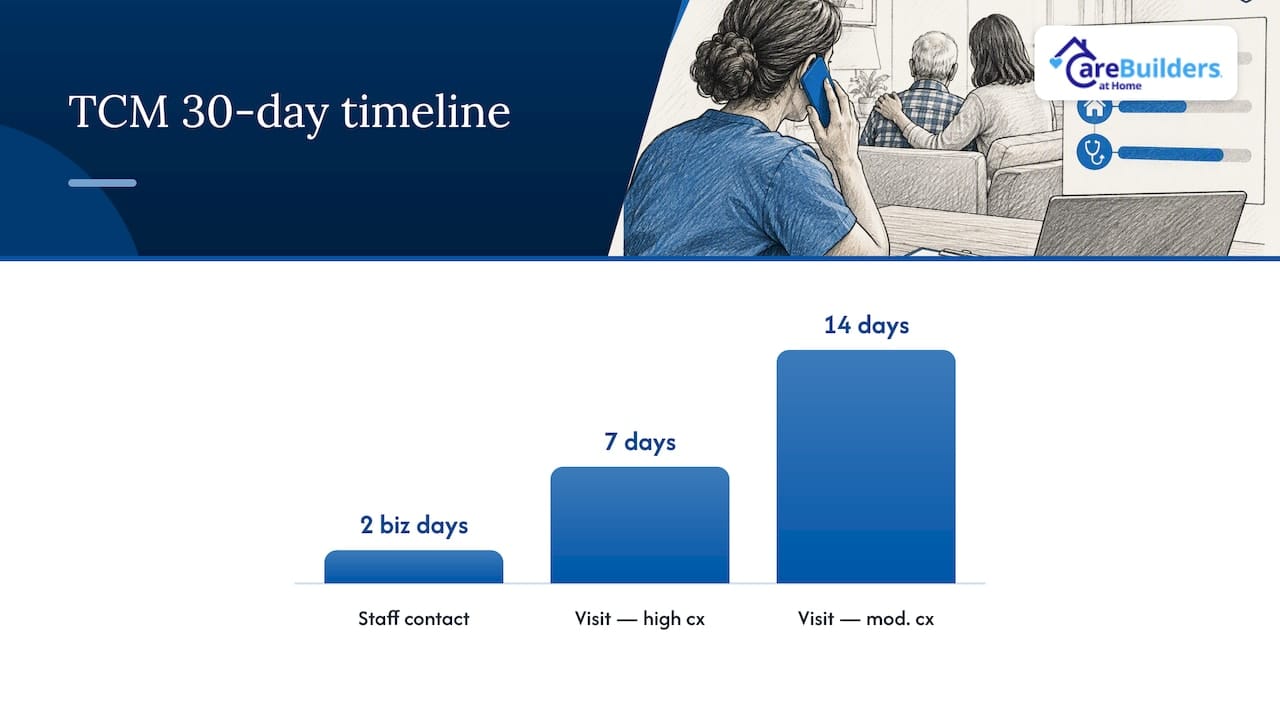
A 7 or 14-day window determines whether TCM billing applies correctly. Missing that face-to-face visit timeline can affect both billing and the chance to catch a problem before it becomes an emergency.
TCM is not the same as home health or non-medical home care, and the eligibility rules differ sharply:
- Medicare home health requires a physician’s order, homebound status, and a documented skilled need such as wound care or physical therapy.
- Non-medical home care, like personal care or companion services, is not Medicare-covered and is typically paid privately, through long-term care insurance, or in some cases through VA benefits.
- Medicare Advantage plans often restrict which home health agencies are in-network, so confirm coverage before assuming a provider is included.
Veterans with VA eligibility may have access to additional in-home support through VA-approved providers, which is worth asking about directly during discharge planning.
Your 0 to 30-day discharge checklist
A little structure in the first month prevents most of the common breakdowns families run into, from missed medications to confusion over who is supposed to call whom.
- Before discharge: request a written discharge summary, a current medication list, any equipment orders, scheduled follow-up appointments, and your preferred home care agency on file.
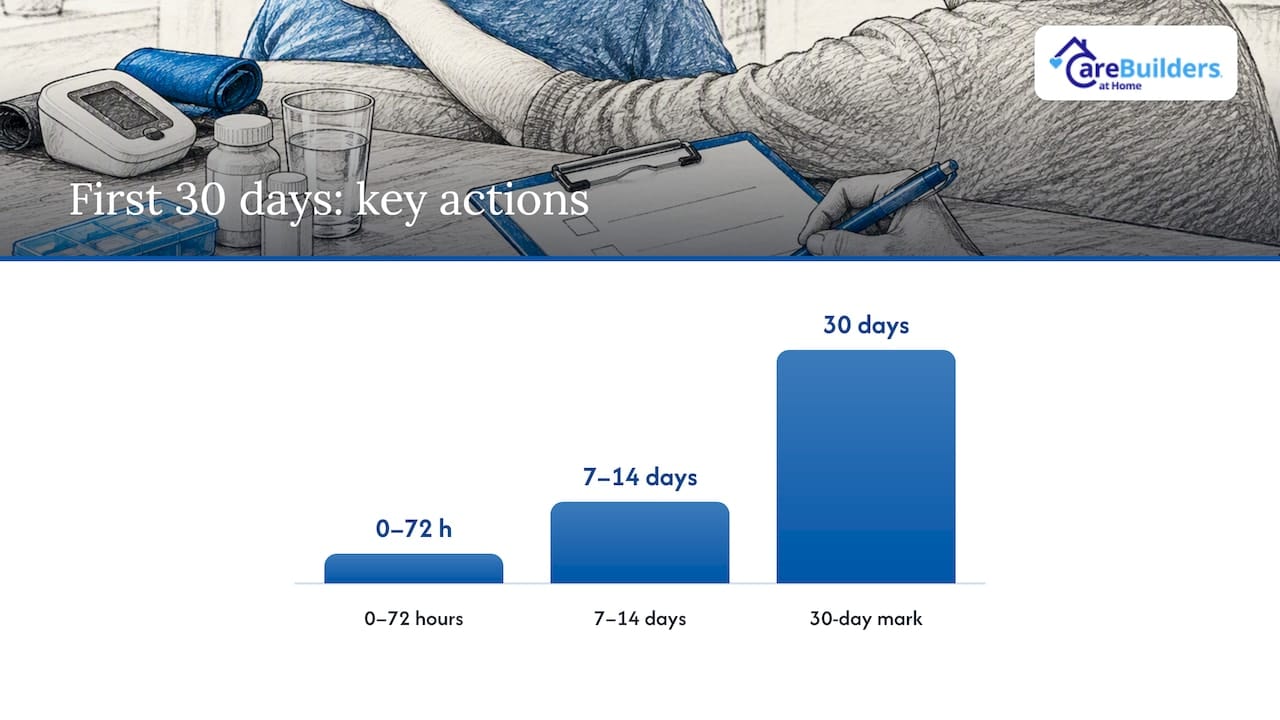
- 0 to 72 hours: complete medication reconciliation at home, hold the first caregiver visit or home-health assessment, and make quick safety adjustments like clearing fall hazards.
- 7 to 14 days: complete the face-to-face TCM or home-health visit and begin any ordered therapy.
- 30-day mark: reassess with the care team, confirm a longer-term plan or escalate if new problems have appeared.
Pro Tip: Ask the discharge nurse to “teach back” every medication change before you leave the hospital, since discharge instructions frequently contain errors or mismatched medication lists.
Following the discharge planning checklist Medicare publishes gives you a document to compare against what the hospital actually hands you.
How do you arrange care and vet an agency?
Arranging transitional care at home goes faster when you walk in with a short script and a clear checklist rather than waiting for the hospital to explain every option.
Start by insisting on a written plan before discharge day, verifying your insurance or Medicare Advantage network, requesting teach-back on any new task, and scheduling the first home visit with a confirmed communication routine for updates. If a Medicare Advantage plan is involved, a resource like Core Insurance Solutions can help you compare network restrictions before you commit to an agency.
When you call an agency, ask these questions directly:
- How are caregivers trained, and are background checks completed before placement?
- Is support available 24/7, and is remote monitoring part of the service?
- Is the agency VA-approved for veteran benefits?
- Does the agency provide case management that coordinates with the hospital or physician?
- How often will someone update our family on changes in condition?
Red flags are easy to spot once you know to look: no written plan, vague answers about coverage, or an agency that cannot schedule a timely first visit. Any of those should send you looking elsewhere.
How we think about transitional care at home
We built our approach around the idea that the first 30 days home are where recovery is won or lost, so our non-medical services are designed to fill the exact gaps that cause readmissions: missed meals, unsupervised mobility, and medication confusion. Our caregivers focus on personal care and companionship, our specialized dementia care addresses the needs of families managing memory loss, and our virtual monitoring platform adds a layer of visibility between visits. As a VA-approved provider, we also help veteran families understand what benefits might apply to their situation.
Mapped against a 30-day plan, that looks like a caregiver present during the first 72-hour window, regular check-ins through the two-week mark, and monitoring support that continues as long as it is needed.
— cbahplano
Ready to arrange transitional care at home?
If your family member is coming home soon, the services that help most in those first weeks are the ones you can book quickly: a post-discharge personal care assessment, companion support for meals and transportation, and remote monitoring for peace of mind overnight. Have the discharge summary and medication list in hand before you call, since that speeds up how quickly a care plan can start.
We serve families in Plano, Allen, Richardson, Wylie, and the surrounding Collin County area, and we can usually schedule an initial personal care assessment within days of your call. Reach out to talk through what your loved one needs for the next 30 days and beyond.
This article is general information, not a substitute for advice from a qualified doctor. Consult a qualified healthcare professional about your own circumstances before acting on anything here.
FAQ
What does transitional care at home mean?
Transitional care at home refers to the combination of medical follow-up and non-medical support that helps someone recover safely during the 30 days after a hospital stay. It can include anything from a Medicare TCM visit to personal care and companion support arranged privately.
How long will Medicare pay for transitional care?
Medicare’s Transitional Care Management benefit covers a defined 30-day period after discharge, which includes a required contact within two business days and a face-to-face visit within 7 or 14 days depending on how complex the case is. Non-medical home care outside that window is generally not covered by Medicare.
What to do when an elderly parent can’t take care of themselves?
Start with the hospital’s discharge planner to get a written plan and a list of what your parent needs, whether that is skilled home health, non-medical personal care, or both. From there, AHRQ’s discharge planning guidance recommends lining up follow-up appointments and in-home support before the day of discharge rather than scrambling afterward.
What is post-caregiver syndrome and what are its symptoms?
Caregiver burnout, sometimes called caregiver stress syndrome, describes the physical and emotional exhaustion that builds up from the ongoing demands of caring for someone else. Common signs include feeling stretched thin, changes in sleep or appetite, and a sense of isolation, and bringing in outside support such as companion care or respite help can ease that load.
Sources
- Agency for Healthcare Research and Quality — Transitions of care
- Medicare — Transitional care management services