


VA Aid and Attendance Benefits: One Form Won’t Prove Care Needs
Aid and Attendance is an added monthly payment on top of a VA pension for wartime veterans or their surviving spouses who need regular help with daily activities, are bedridden, live in a nursing home because of a disability, or meet specific visual impairment thresholds. If this sounds like your situation or your loved one’s, your next three moves are simple: check the Maximum Annual Pension Rate and your net worth against the current limit, get a clinician to complete VA Form 21-2680, and reach out to a Veterans Service Organization for free guidance.
Table of Contents
- Eligibility at a glance: service, pension baseline, and medical need
- How much does Aid and Attendance add: MAPR and typical rates
- Financial eligibility: income, net worth, and medical expense deductions
- Medical evidence and forms: VA Form 21-2680 and VA Form 21-0779
- How to apply: filing options and what to expect
- Getting help: VSOs, accredited representatives, and attorneys
- Common mistakes, practical tips, and faster wins
- How CareBuilders at Home supports veterans applying for Aid and Attendance
- How marital status and a spouse’s income affect eligibility
- Aid and Attendance versus Housebound benefits: what’s the difference
- What Aid and Attendance can help pay for
- Coordinating Aid and Attendance with other benefits
- Timelines, processing, and what happens with appeals
- Author perspective: what to prioritize first
- How we help veterans document and apply for Aid and Attendance
- FAQ
- Sources
Eligibility at a glance: service, pension baseline, and medical need
Qualifying for Aid and Attendance means clearing two separate gates. The first is service and income related: you need wartime service and you need to already qualify for, or be applying for, a VA pension, which is means-tested. The second gate is medical: you have to show a genuine need for regular help.
The VA recognizes several paths to meeting that medical need, according to its Aid and Attendance and Housebound guidance:
- You need help performing daily activities such as bathing, dressing, eating, or using the bathroom.
- You’re bedridden because of a disability.
- You’re a patient in a nursing home due to physical or mental incapacity.
- Your eyesight is limited to 5/200 or less in both eyes, or your visual field is contracted to 5 degrees or less.
Surviving spouses can qualify too, but documentation matters here in a particular way. You’ll need to show continuous cohabitation with the veteran until death (with narrow exceptions) and provide marriage records that establish the timing of the union relative to the veteran’s service. Remember that Aid and Attendance never stands alone. It’s a medical rating that is layered onto a pension you already qualify for financially, so the income and net worth pieces come first.
How much does Aid and Attendance add: MAPR and typical rates
MAPR stands for Maximum Annual Pension Rate, and it’s the ceiling the VA uses to calculate your pension payment, including any Aid and Attendance add-on. When you qualify for A&A, the VA applies a higher MAPR than it would for a basic pension alone, which usually means a larger monthly payment.
For the period of December 1, 2025 through November 30, 2026, the MAPR with Aid and Attendance is $29,093 for a veteran with no dependents and $18,697 for a surviving spouse. These figures adjust periodically for cost-of-living changes, so always check the current tables before estimating your own payment. Dependents, including a spouse, raise the applicable MAPR further, and the survivors pension rate tables break down those variations for surviving spouses with dependents.
Financial eligibility: income, net worth, and medical expense deductions
The VA looks at two financial measures: countable income and net worth. Countable income generally includes wages, Social Security, and most retirement income, though the VA allows you to subtract unreimbursed medical expenses, which often makes a real difference for families paying for in-home or facility care.
Net worth combines your assets and your countable income, but your primary residence and one vehicle are usually excluded from that calculation.
- The net worth limit for the period of December 1, 2025 through November 30, 2026 is $163,699.
- Assets above that threshold typically have to be spent down or otherwise accounted for before you qualify.
- Unreimbursed medical expenses, including home care invoices, facility fees, and insurance premiums, reduce your countable income dollar for dollar once they exceed a small threshold.
Documentation needs to be specific. Itemized invoices from a care provider, a signed lease or contract from an assisted living facility, and a physician’s statement that you need a protected living environment all help the VA classify room-and-board as a deductible medical expense rather than ordinary living cost, something Board of Veterans’ Appeals decisions return to again and again.
Here’s a simple illustration: say a veteran has $2,200 in monthly income and pays $1,800 a month for in-home personal care. Once that care cost is counted as an unreimbursed medical expense, countable income for pension purposes can drop close to zero, often clearing the way for the full MAPR payment instead of a reduced one.
Medical evidence and forms: VA Form 21-2680 and VA Form 21-0779
VA Form 21-2680, formally called the Examination for Housebound Status or Permanent Need for Regular Aid and Attendance, is the backbone of most A&A claims. A physician, physician assistant, or other qualified clinician has to complete it, and it needs to speak directly to your functional limitations rather than just list diagnoses.
If the applicant lives in a nursing home or assisted living facility, the claim usually also needs VA Form 21-0779, the Request for Nursing Home Information in Connection with Claim for Aid and Attendance, which a facility administrator completes.
A strong Form 21-2680 typically addresses:
- Which specific activities of daily living require help, and how often.
- Whether the applicant needs protection from the hazards of daily life due to cognitive or physical impairment.
- Whether the condition is permanent, and the expected course of the impairment.
- Any mobility limitations, including bed confinement or wheelchair use.
Both forms can be submitted alongside an online claim through VA.gov or mailed in with the rest of your pension application packet.
Pro Tip: Ask your clinician to describe daily routines in specific terms, like “needs assistance standing from a seated position” rather than general phrases like “needs help,” since specificity speeds up adjudication.
How to apply: filing options and what to expect
You can file a pension claim with Aid and Attendance online through VA.gov, by mail using the paper forms, or in person at a regional office with help from a VSO. Whichever path you choose, submitting what’s called a Fully Developed Claim, meaning all your supporting evidence arrives with the initial application, tends to move faster than a standard claim.
- Start an intent to file through VA.gov or with an accredited representative, which locks in an effective date for potential benefits even before your full application is ready.
- Gather and submit your completed Form 21-2680 (and Form 21-0779 if applicable), financial records, and medical expense documentation as a Fully Developed Claim.
- Track your claim status through your VA.gov account or the eBenefits and ASPIRE tools, and respond quickly to any request for more evidence.
Filing an intent to file matters because if your complete claim arrives within a year, your effective date, and potentially your retroactive pay, goes back to that earlier notice rather than the date your full paperwork was received.
Getting help: VSOs, accredited representatives, and attorneys
You don’t have to navigate this alone, and in most cases you shouldn’t have to pay for help with the initial application. VA-recognized Veterans Service Organization representatives are accredited and provide this assistance at no cost.
- VSO representatives help you gather medical evidence, complete forms correctly, and file a Fully Developed Claim, all free of charge.
- Accredited attorneys or claims agents can charge fees, but only after the VA issues an initial decision on your claim.
- You can appoint a representative using VA Form 21-22 for a VSO or Form 21-22a for an individual accredited agent or attorney.
- Once appointed, your representative can communicate directly with the VA on your behalf and help respond to any evidence requests.
Finding help usually starts with a local VSO chapter or the accredited representative search tool on VA.gov.
Common mistakes, practical tips, and faster wins
Most delays and denials trace back to a short list of avoidable problems: an incomplete Form 21-2680 that skips the specific functional detail examiners need, missing itemized medical bills, a net worth calculation that overlooks countable assets, or simply never filing an intent to file before submitting the full claim.
- Ask your clinician for a narrative that names specific ADLs and how often help is needed, not just a checklist.
- Keep itemized invoices, facility leases, and insurance statements organized by month.
- Collect a witness statement from a caregiver or family member describing day-to-day needs when the medical record alone feels thin.
- File your intent to file the same day you start gathering documents, so your effective date is locked in early.
Pro Tip: Build a single folder, physical or digital, with every medical, financial, and care document before you file, so nothing holds up adjudication later.
In the next week or two, request your clinician appointment for Form 21-2680, pull together the last three months of care invoices, and call a local VSO to start your intent to file.
How CareBuilders at Home supports veterans applying for Aid and Attendance
We offer tailored in-home, non-medical care, including specialized dementia care and virtual monitoring, that produces documentation A&A claims need. Caregivers generate itemized invoices, detailed care notes, and consistent observation records that help clinicians and VSOs describe functional need accurately on Form 21-2680.
That paper trail matters because adjudicators look for specifics, not generalities, about daily assistance. Families can get help organizing invoices, lease agreements, and caregiver summaries into a format that supports both the medical and financial sides of a claim.
How marital status and a spouse’s income affect eligibility
Marriage changes both sides of the Aid and Attendance equation. A married veteran’s MAPR is higher than that of a veteran with no dependents, which can mean a larger monthly payment once A&A is approved. At the same time, a spouse’s income and assets count toward the household’s total income and net worth for VA pension purposes, since the VA evaluates the veteran’s household financial picture as a whole rather than the veteran alone.
This cuts both ways. A spouse with substantial earnings or savings can push a household over the net worth limit even when the veteran’s own resources would otherwise qualify. On the other hand, a spouse’s own unreimbursed medical expenses, including the cost of their own care, can be deducted from household countable income the same way the veteran’s expenses are, which sometimes brings a borderline household back under the threshold.
For surviving spouses applying on their own behalf, remarriage generally ends eligibility for survivor’s pension and A&A, with some narrow exceptions depending on timing and circumstances. Divorce or legal separation from the veteran before death typically disqualifies a former spouse from survivor benefits as well.
Because household income and assets are evaluated together, it’s worth gathering both spouses’ financial records, medical expense documentation, and insurance statements before filing, rather than assuming only the veteran’s finances are relevant. A VSO or accredited representative can help sort through which expenses and assets apply to the household calculation.
Aid and Attendance versus Housebound benefits: what’s the difference
Aid and Attendance and Housebound benefits both increase a VA pension, but they address different situations and you can’t receive both at the same MAPR rate simultaneously. Aid and Attendance applies when you need regular help with daily activities, are bedridden, live in a nursing home due to disability, or meet the visual impairment criteria. Housebound benefits, by contrast, apply when a permanent disability keeps you substantially confined to your home, even if you don’t need hands-on help with daily tasks.
The practical distinction matters for how you document your claim. An A&A claim centers on functional need, what you can and can’t do for yourself day to day. A Housebound claim centers on confinement, showing that your disability substantially restricts your ability to leave your home without assistance, regardless of whether you need help once you’re there.
Both benefits use the same basic application path and often the same VA Form 21-2680, since that form includes sections for both housebound status and the Aid and Attendance need. A clinician completing the form should address both possibilities when relevant, since the VA will evaluate whichever rating your evidence supports, and in some cases award the one that provides the greater benefit.
What Aid and Attendance can help pay for
Aid and Attendance doesn’t fund one single type of care. It adds to your pension so you have more flexibility to pay for whatever regular assistance your situation requires, and the services it most commonly supports include help with bathing, dressing, eating, and transferring in and out of bed or a chair.
In-home personal care often qualifies, including the kind of non-medical assistance our caregivers provide: companionship, light housekeeping tied to safety, medication reminders, and supervision for someone who needs protection from everyday hazards. For families managing dementia or Alzheimer’s related needs, specialized memory care support frequently falls under this same umbrella, since much of that care involves exactly the daily supervision and protection the VA criteria describe.
Assisted living and nursing facility costs, including the room-and-board portion in some cases, can also count as unreimbursed medical expenses that affect your countable income, provided a physician documents the need for that protected environment. Home modifications tied to a medical need, durable medical equipment, and even transportation to medical appointments can factor into your overall unreimbursed medical expense calculation as well.
The common thread across all of these examples is documentation. Whatever service you’re paying for, keeping itemized records that tie the cost to a specific medical or functional need makes it far easier for the VA to recognize that expense when calculating your pension.
Coordinating Aid and Attendance with other benefits
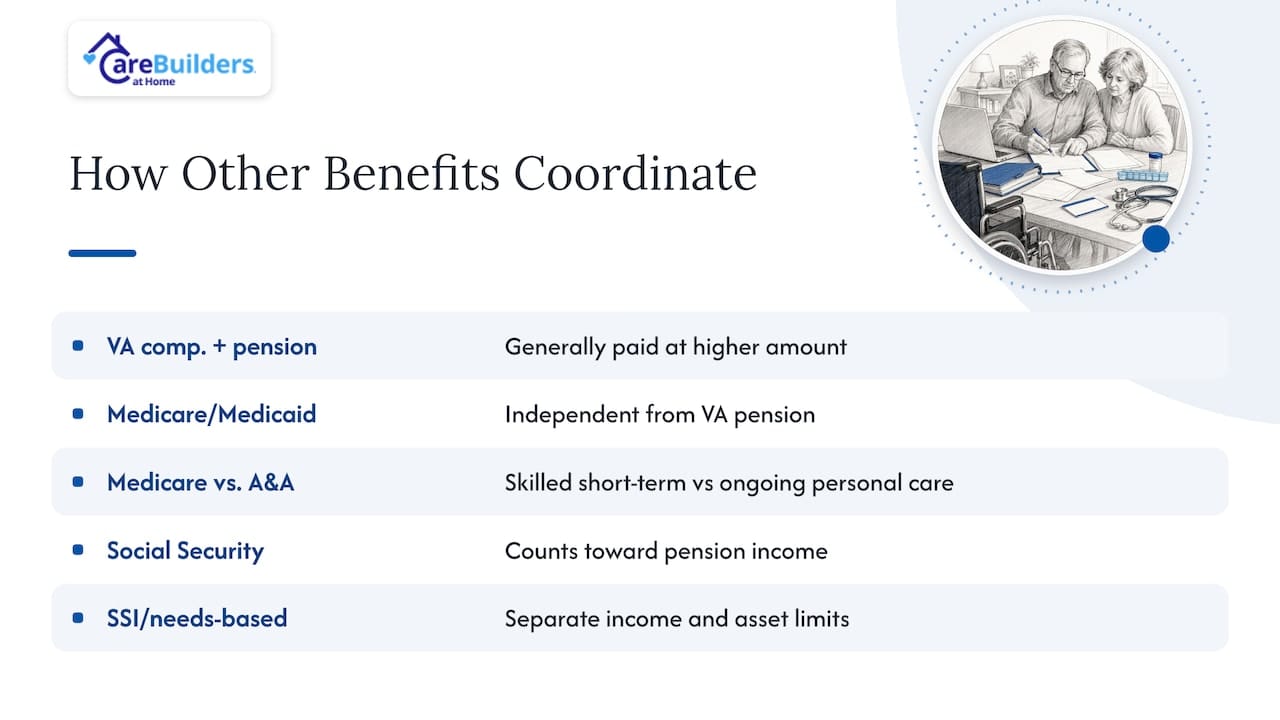
Aid and Attendance can work alongside several other VA and government programs, though the rules around stacking benefits vary by program. Veterans receiving VA disability compensation for a service-connected condition can, in some cases, also receive pension-based Aid and Attendance, though the VA generally pays whichever benefit results in the higher amount rather than both in full.
Medicare and Medicaid operate independently from VA pension benefits, and coordinating them well can stretch a family’s resources further. Medicare typically covers skilled, short-term medical care rather than the ongoing non-medical personal care that A&A often helps fund, so the two programs tend to cover different needs rather than overlap. Families managing both VA benefits and Medicare enrollment sometimes find it helpful to work with a Medicare coverage specialist to understand what home health services Medicare will pay for before relying on pension income for the rest.
Social Security retirement or disability income counts toward countable income for pension purposes, so it’s factored into the same calculation as other household earnings. Supplemental Security Income and other needs-based government programs may have their own asset and income limits that interact differently with a VA pension, so it’s worth checking each program’s specific rules rather than assuming they align with VA thresholds.
Because these programs rarely use identical definitions of income or assets, a VSO or accredited representative familiar with multiple benefit systems can help you sequence applications in the order that protects the most total benefit for your household.
Timelines, processing, and what happens with appeals
Processing times for Aid and Attendance claims vary based on how complete your initial submission is and current regional office workloads. A Fully Developed Claim, meaning you submit every piece of required evidence up front rather than waiting for the VA to request it, generally moves through the system faster than a standard claim.
Once your claim is filed, you can track its status through your VA.gov account or tools like eBenefits. If the VA requests additional evidence, responding promptly keeps your claim moving rather than sitting in a holding pattern.
Not every claim is approved on the first decision. When a claim is denied or only partially approved, appeals and remands often come down to incomplete documentation or a mismatch between the income reported and the correct MAPR for that specific claimed year. Board of Veterans’ Appeals decisions frequently send cases back for exactly this reason, asking the regional office to recalculate income against the right year’s MAPR or to request clearer medical evidence about functional need.
If your claim is denied, you generally have options to submit new evidence, request a higher-level review, or appeal to the Board of Veterans’ Appeals, each with its own timeline and evidentiary standards. Working with a VSO or accredited representative at this stage often helps identify exactly which piece of evidence was missing or unclear the first time around, which matters more than resubmitting the same paperwork and hoping for a different outcome.
Author perspective: what to prioritize first
If you’re starting from zero, prioritize in this order: get Form 21-2680 completed by a clinician who documents specifics, gather every medical expense record you can find, and call a VSO before you file anything else. If daily care is needed right now, a VA-approved in-home provider can start documenting services immediately, which gives you a paper trail while the paperwork catches up.
— cbahplano
How we help veterans document and apply for Aid and Attendance
As a VA-approved provider, we build the paper trail A&A claims depend on: itemized invoices, caregiver observation notes, and documentation that supports clinicians completing Form 21-2680.
- We offer Veterans Care Services including transitional care and benefits navigation consults.
- Our Personal Care Services generate the itemized records claims examiners look for.
- Bring your current VA paperwork, a list of daily care needs, and any existing medical records to your first conversation with us.
Reach out to schedule a benefits-navigation consultation and find out how our documentation can support your claim.
This article is general information, not a substitute for advice from a qualified financial advisor. Consult a qualified financial professional about your own circumstances before acting on anything here.
FAQ
Can a veteran receive both compensation and Aid and Attendance?
Generally no, not at full value for the same disability. VA disability compensation and pension-based Aid and Attendance serve different eligibility pathways, and the VA typically pays whichever benefit results in the higher total rather than combining both in full.
Can any veteran get Aid and Attendance?
No, eligibility requires qualifying wartime service, meeting the income and net worth limits for a VA pension, and demonstrating a specific medical need such as help with daily activities, bedridden status, nursing home care due to disability, or a qualifying visual impairment. Surviving spouses may also qualify under similar medical and financial criteria.
How much extra does VA Aid and Attendance pay?
The amount depends on your MAPR category. For the period of December 1, 2025 through November 30, 2026, the MAPR with Aid and Attendance is $29,093 for a veteran with no dependents and $18,697 for a surviving spouse, with higher rates for veterans with dependents.
What is the income limit for VA Aid and Attendance in 2026?
There isn’t a single flat income limit. The VA compares your countable income, after subtracting unreimbursed medical expenses, against the applicable MAPR for your category, and the net worth limit for the December 2025 through November 2026 period is $163,699.