


Apply for a VA HISA Grant: U.S. Veterans’ Checklist to Avoid Denials
The VA HISA grant pays for medically necessary home accessibility improvements, up to a veteran’s lifetime benefit limit, once a VA clinician documents the need. Most veterans qualify through either service-connected disability or enrollment in VA medical care, and the process starts the same way every time: ask your VA doctor or occupational therapist for a HISA prescription. That single conversation sets the whole application in motion.
TL;DR:
- The HISA benefit is cumulative over a veteran’s lifetime, with caps varying based on whether the condition is service-connected or not, so planning should consider remaining funds.
- Getting a detailed, medically justified prescription and an occupational therapy assessment improves approval chances, especially if the request clearly specifies functional limitations.
- Contractors must provide itemized, signed estimates breaking down labor, materials, and permits to meet VA review standards and avoid delays or denials.
- Incomplete or mismatched documentation, including vague descriptions or unsigned forms, are leading causes of application delays or rejections, making thorough review crucial before submission.
- Veterans should clarify their remaining benefit balance with the local PSAS office before applying or making changes to approved projects to prevent eligibility issues or reimbursement disputes.
Table of Contents
- What Is the VA HISA Grant and How Do the Benefit Tiers Work?
- Who Qualifies for a HISA Grant?
- What Does HISA Cover, and What Gets Denied?
- How to Apply for a HISA Grant, Step by Step
- How Long Does Approval Take, and How Does Payment Work?
- Tips That Actually Improve Your Approval Odds
- Contacting Your Local PSAS Office Today
- Completing VA Form 10-0103 Without Common Mistakes
- What Happens if Your HISA Application Is Denied?
- Working With Contractors on HISA-Eligible Projects
- Coordinating HISA With Other VA and Disability Benefits
- Updating or Modifying an Approved HISA Grant
- How CareBuilders at Home Supports Veterans Through Home Safety Changes
- A Complementary Next Step After Your Home Modifications
- Sources
What Is the VA HISA Grant and How Do the Benefit Tiers Work?
The Home Improvements and Structural Alterations program, known as HISA, is a Veterans Health Administration benefit that pays for permanent changes to a veteran’s home when a doctor determines those changes are medically necessary. It’s administered through the Prosthetic & Sensory Aids Service (PSAS) at your local VA Medical Center, not through the VA’s disability compensation office. That distinction matters, because PSAS handles this at the medical center level, which tends to move faster than some other VA housing benefits.
HISA operates on a lifetime cumulative limit rather than a one-time payout. Many official VA facility pages describe two tiers: a higher amount for veterans whose need is connected to a service-connected condition, and a lower amount for other qualifying medical conditions. Because some published figures vary slightly by source and update cycle, confirm your exact current cap with your local PSAS office before you plan a project around a specific number.
A few things to understand about how the cap works:
- You do not have to use the entire benefit in one project. It’s cumulative and can be drawn on more than once until the lifetime cap is reached.
- Your tier depends on whether the condition prompting the request is service-connected.
- PSAS tracks your remaining balance, so ask them directly how much you have left before applying again.
Who Qualifies for a HISA Grant?
Eligibility runs through two main doors. The first is enrollment in VA medical care under 38 U.S.C. § 1710(a), which covers most veterans receiving VA health services regardless of whether their condition is service-connected. The second is the servicemember pathway: those currently going through a medical discharge can also apply while still on active duty, which lets you start the process before you even separate.
The tier you land in depends heavily on your disability rating. Veterans with a service-connected condition rated at 50% or higher typically access the larger lifetime benefit. Veterans whose qualifying condition is non-service-connected, or whose rating falls below that threshold, are usually limited to the smaller tier. A quick self-check:
- Enrolled in VA health care? That alone opens the door to apply.
- Service-connected at 50% or above? You likely qualify for the higher benefit tier.
- Renting your home? You’ll need written landlord permission before VA approves structural work.
- Own your home? Be ready to show proof of ownership, such as a deed or mortgage statement.
Renters are not excluded from HISA, but the paperwork burden is heavier. A landlord who won’t sign off on a roll-in shower or a widened doorway can stop an otherwise solid application cold.
What Does HISA Cover, and What Gets Denied?
HISA pays for permanent, medically necessary structural changes. It does not pay for convenience upgrades or temporary equipment, and understanding that line early saves you from submitting a request that gets rejected outright.
Commonly approved modifications:
- Permanent entrance and exit ramps
- Roll-in showers and bathroom modifications for wheelchair access
- Widened doorways to accommodate a wheelchair or walker
- Lowered countertops, sinks, and cabinets
- Plumbing or electrical upgrades needed to operate home medical equipment
Commonly denied requests, per official VA facility guidance:
- Routine home repairs unrelated to a medical condition
- Portable ramps or stair glides that aren’t permanently installed
- Spas, hot tubs, or pools
- Home security systems
The through-line is medical necessity tied directly to a documented functional limitation. A prescription that says “veteran needs bathroom modification” is weaker than one that says “veteran has bilateral lower extremity amputation, requires roll-in shower with grab bars to safely bathe independently.” Specificity is what separates an approval from a request sent back for more information.
How to Apply for a HISA Grant, Step by Step
A complete application moves faster than an incomplete one, and PSAS reviewers can only approve what the paperwork actually documents. Here’s the order that works.
- Get a HISA prescription from your VA clinician. Your primary care provider or, ideally, an occupational therapist evaluates your home and functional limitations, then writes a prescription describing the diagnosis, the limitation, and the specific modification needed.
- Request an OT evaluation if one hasn’t already happened. An occupational therapist’s assessment carries real weight with reviewers because it connects the medical condition to the physical modification in concrete, observable terms.
- Collect two to three itemized contractor estimates. Each bid needs to break out labor, materials, and permit costs separately. A single lump-sum number gets flagged as insufficient for cost review.
- Take color photographs of the area to be modified. Show the current bathroom, entryway, or hallway so reviewers can see exactly what’s changing.
- Gather proof of ownership or landlord permission. Homeowners provide a deed or mortgage document. Renters need written, ideally notarized, permission from the property owner.
- Complete VA Form 10-0103. This is the official application form, and it asks for your VA enrollment details, the requested modification, and supporting documentation references.
- Submit the full packet to your local PSAS office. You can hand-deliver it to the VA Medical Center that provides your care, or mail it with delivery confirmation so you have proof it arrived.
Required documents in one place:
- VA Form 10-0103
- Physician prescription or OT evaluation
- Two to three itemized contractor estimates
- Photographs of the modification area
- Proof of ownership or notarized landlord permission
- Building plans or permits, if your local jurisdiction requires them
Submitting online through your VA health portal may be available at some facilities. Call ahead to ask whether your local PSAS accepts digital submissions or requires the paper packet in person.
How Long Does Approval Take, and How Does Payment Work?
Review timelines for HISA generally run 30 to 90 days for a complete application, and incomplete packets are the single biggest cause of delay. Because HISA is reviewed at the VHA medical center level rather than through the VBA’s larger housing grant process, it tends to move faster than programs like Specially Adapted Housing grants.
Once approved, VHA Directive 1173.14 allows veterans to request an advance payment of up to 50% of the authorized amount, and that advance must be issued no later than 30 days after approval. This matters practically: it means you don’t have to front the entire project cost before VA pays a dime.
For the remaining balance:
- File VA Form 10-0104 for reimbursement after the work is finished.
- Submit completion photos showing the finished modification.
- Include paid invoices from your contractor as proof of completed work.
- Expect final reimbursement processing to follow shortly after PSAS confirms the documentation matches the approved scope.
Tips That Actually Improve Your Approval Odds
The applications that sail through share a pattern, and the ones that stall share a different one. Specificity in the prescription is the biggest lever you control. “Veteran has diagnosed Parkinson’s disease with documented balance instability; requires permanent ramp with handrails for safe egress” tells a reviewer exactly why the modification is necessary. A vague prescription invites a request for more information, which adds weeks.
An occupational therapy evaluation strengthens almost every application because it’s a clinical assessment specifically designed to connect function and environment. Ask your VA primary care team for an OT consult referral if one hasn’t been scheduled.
On the contractor side, itemized and signed bids are non-negotiable. Be wary of any contractor who claims to be “VA approved” as a marketing pitch. VA doesn’t certify or endorse specific contractors; it reviews cost reasonableness on the estimates you submit.
Pro Tip: If your application gets denied for insufficient medical justification, request reconsideration with a strengthened prescription or a new OT evaluation before filing a formal appeal. It’s usually faster and resolves the underlying documentation gap directly.
Contacting Your Local PSAS Office Today
Find your VA Medical Center’s Prosthetic & Sensory Aids Service through the VA facility locator at va.gov. That office can tell you your remaining lifetime balance and confirm which forms your facility currently accepts.
Three things to do this week:
- Call your VA primary care team and ask for a HISA prescription referral.
- Contact two or three licensed contractors for itemized, signed estimates.
- Photograph the bathroom, entryway, or room you want modified.
When you’re ready to submit, ask PSAS directly whether they prefer hand delivery, mailed packets with delivery confirmation, or a digital upload option.
Completing VA Form 10-0103 Without Common Mistakes
Most denials and delays trace back to the same handful of errors on VA Form 10-0103, and nearly all of them are avoidable with a careful read-through before you submit.
Section identifying the veteran and VA enrollment status trips people up when they leave out their VA facility name or enrollment number. Double-check this against your VA health card or portal profile rather than relying on memory.
The section describing the requested modification needs to match, word for word in substance, what your clinician wrote in the prescription. If your prescription says “roll-in shower” and your form describes “bathroom remodel,” reviewers see a mismatch and send the packet back for clarification.
The cost and contractor information section is where lump-sum estimates cause the most trouble. Each contractor bid attached should break down labor, materials, and permit fees separately, and the total on the form should match your highest or selected bid exactly.
The signature and certification section is easy to skip when you’re filling this out in a hurry, but an unsigned form is an incomplete form. PSAS cannot process it.
Before you submit, read the entire packet as if you were the reviewer seeing it cold. Does the prescription justify the modification? Do the contractor estimates match the form’s cost figures? Is every signature line filled? A ten-minute review at this stage prevents a thirty-day delay later.
What Happens if Your HISA Application Is Denied?
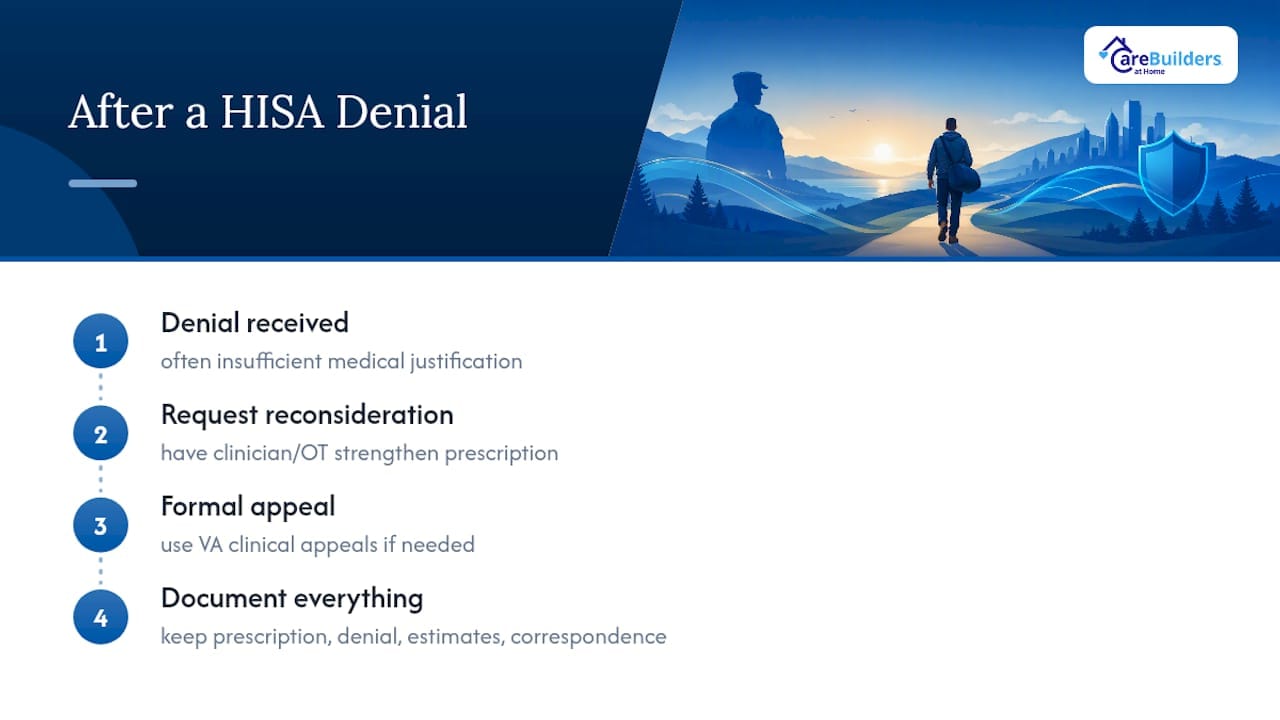
A denial isn’t the end of the road, and in most cases it’s fixable faster than you’d expect. The most common reason PSAS denies or returns a HISA application is insufficient medical justification, meaning the prescription didn’t clearly connect the diagnosis to the specific modification requested.
Your first move should be requesting reconsideration rather than jumping straight to a formal appeal. Reconsideration means going back to your VA clinician or occupational therapist, strengthening the prescription language with more specific functional detail, and resubmitting to the same PSAS office. This route is typically faster because it addresses the actual gap PSAS identified rather than starting a new administrative review track.
If reconsideration doesn’t resolve the issue, or if the denial involves a dispute over your eligibility category rather than documentation, you can pursue a formal appeal through VA’s standard clinical appeals process. Ask your PSAS office directly what that path looks like at your facility, since procedures can vary slightly between VA Medical Centers.
Throughout either process, keep copies of everything: the original prescription, the denial notice, contractor estimates, and any correspondence with PSAS. If you resubmit with a new OT evaluation, that document alone often resolves what a written denial notice flagged as the weak point.
Working With Contractors on HISA-Eligible Projects
The contractor you choose affects your approval odds just as much as your prescription does. VA reviewers evaluate cost reasonableness based on itemized estimates, and a contractor unfamiliar with that requirement can slow your entire application.
Ask any contractor you’re considering for a written, signed estimate that separately lists labor, materials, and permit costs. A single total number, even an accurate one, gets flagged as insufficient during PSAS review. Contractors experienced with accessibility modifications, sometimes those with a Certified Aging-in-Place Specialist (CAPS) credential, tend to already format estimates this way because they’ve worked with VA or similar programs before.
Be cautious of anyone claiming to be “VA approved” or “VA certified” as a sales pitch. The VA does not endorse or certify individual contractors for HISA work. That phrase is sometimes used by door-to-door or high-pressure sales operations targeting veterans, and it should raise a flag rather than build confidence.
Get at least two, ideally three, competing bids for the same described scope of work. This gives PSAS a clear basis for cost comparison and gives you leverage to confirm you’re paying a fair local rate. Once your contractor is selected, keep the signed contract and all invoices. You’ll need paid invoices later when you file VA Form 10-0104 for reimbursement of the remaining balance after your advance payment.
Coordinating HISA With Other VA and Disability Benefits
HISA doesn’t exist in isolation from your other VA benefits, and understanding how it interacts with them helps you plan bigger home projects without leaving money on the table or duplicating paperwork.
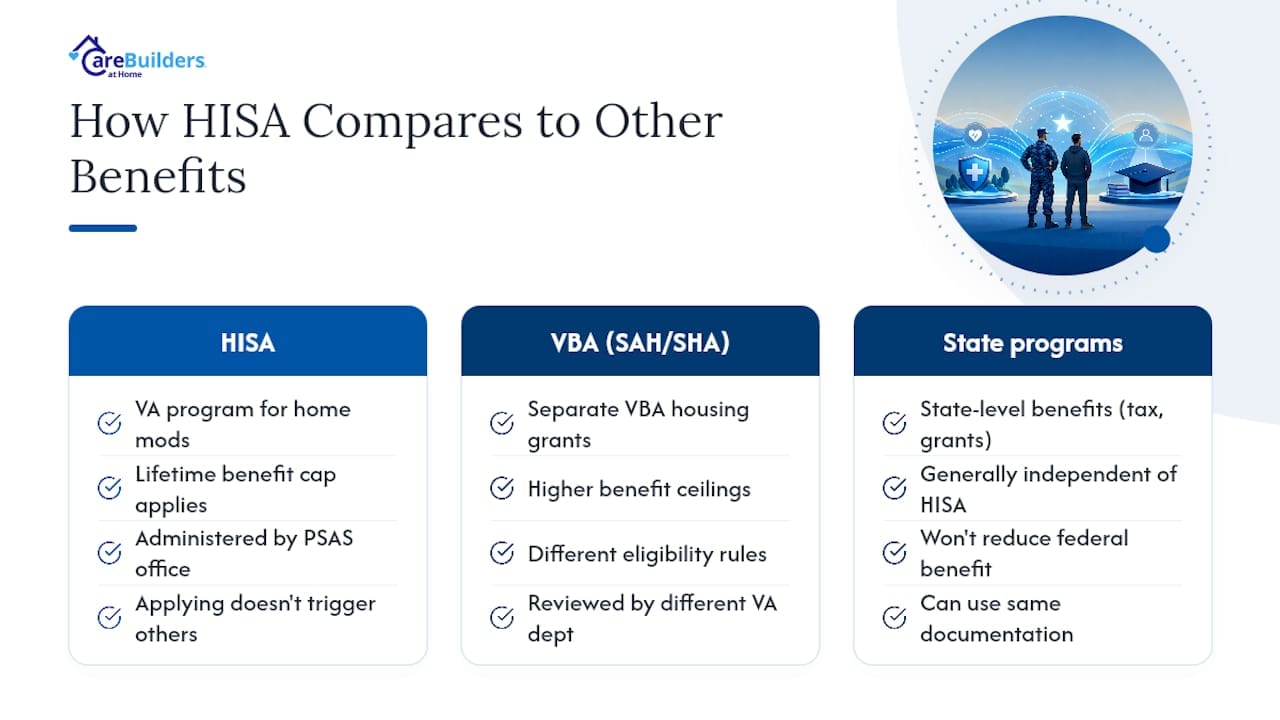
Veterans with more extensive mobility needs sometimes qualify for larger VBA housing grants like Specially Adapted Housing (SAH) or Special Housing Adaptation (SHA), which are separate programs with their own eligibility rules and higher benefit ceilings. If your needs exceed what HISA’s lifetime cap covers, ask your PSAS office whether you might also qualify for one of these VBA programs. They are administered differently and reviewed by a different VA department, so applying for one doesn’t automatically apply you for the other.
If your rating changes after a reevaluation, it’s worth checking with PSAS whether that affects your remaining benefit tier for future modifications.
State-level veteran benefit programs, including some property tax exemptions or state housing grants tied to disability status, generally operate independently of HISA and won’t reduce your federal benefit. However, documentation you’ve already gathered, your disability rating letter, medical records, and prior home modification history, often supports multiple applications at once. Keep organized copies so you’re not recreating paperwork every time you approach a different benefit program.
Updating or Modifying an Approved HISA Grant
Life circumstances change, and so do medical needs. If your condition progresses or your home situation shifts after you’ve already used part of your HISA benefit, you’re not locked out of further help as long as you haven’t exhausted your lifetime cap.
To request additional modifications, the process essentially restarts: your VA clinician documents the new or changed medical necessity, and you submit an updated or new VA Form 10-0103 packet with fresh contractor estimates for the additional work. PSAS reviews it against your remaining lifetime balance, so it helps to ask upfront exactly how much of your cap is still available.
If you move to a new residence, HISA benefits generally apply to your primary residence at the time of application, so modifications don’t transfer automatically to a new address. You’ll need to reapply for the new home, and your remaining lifetime balance still applies.
If an already-approved project needs a scope change, say, your contractor discovers a structural issue that changes the cost, contact your PSAS office before proceeding. Significant deviations from the approved scope or budget can require an amended approval, and proceeding without checking first risks a reimbursement dispute later. A quick phone call to PSAS before change orders happen saves considerable frustration during the reimbursement phase.
How CareBuilders at Home Supports Veterans Through Home Safety Changes
Helping veterans and their families navigate home safety decisions alongside VA benefits is work taken seriously by specialized nonmedical in-home care providers. We’ve seen firsthand how a HISA-funded ramp or roll-in shower only tells part of the safety story. Nonmedical in-home caregiving, virtual monitoring, and fall detection often fill the gap that structural changes alone can’t close. Author credentials and specific case examples will be added by our editorial team as they become available.
— cbahplano
A Complementary Next Step After Your Home Modifications
HISA funding solves the structural side of home safety, the ramp, the roll-in shower, the widened doorway, but it doesn’t provide the day-to-day support many veterans need once those changes are in place. That’s where CareBuilders at Home of Plano & Allen fits differently than anything VA funds directly: we provide in-home, nonmedical personal care and 24/7 virtual monitoring with fall detection, so a newly modified bathroom or entryway becomes part of a fully supported daily routine rather than a standalone renovation.
Some in-home care providers help veterans coordinate benefits alongside caregiving support in the Plano and Collin County area. If you’re a veteran or a family caregiver planning what comes after a HISA-funded project, download our free home care navigation guide for practical next steps, or reach out to talk through what in-home support could look like for your household.
Sources
- Home Improvements/Structural Alterations (HISA) | VA Fayetteville Coastal Health Care | Veterans Affairs
- Home Improvements and Structural Alterations (HISA) (Prosthetic & Sensory Aids Service)