


The Role of Adaptability in Home Care: A Family Guide
Adaptability is the single most important quality that separates safe, person-centered home care from care that merely fills a time slot. When a caregiver notices that a client’s morning confusion has worsened, shifts the visit schedule to overlap with a family member’s availability, or uses remote monitoring to catch a fall risk before it becomes a fall, that is the role of adaptability in home care made visible. Three anchors ground this claim:
- Research evidence: Peer-reviewed studies, including work published in BMC Health Services Research and BMJ Open, link adaptive capacity directly to early risk detection, reduced avoidable hospital transfers, and higher client satisfaction.
- Safety-II / resilient healthcare framework: This approach treats clinician adaptations not as rule violations but as evidence of skilled, patient-centered judgment under real-world constraints.
- Provider practice: Agencies like CareBuilders at Home of Plano & Allen build adaptability into their care model through continuity of staff, technology-enabled monitoring, and outcome-focused care plans.
The practical payoff is real: better detection of subtle decline, fewer unnecessary emergency room visits, and a quality of life that reflects who the client actually is, not just what a task list says they need.
Table of Contents
- Why does flexibility in caregiving matter so much for outcomes?
- How adaptability shows up in everyday home care
- What barriers limit adaptability in U.S. home care?
- Practical strategies to increase adaptability in home care
- How do you measure adaptability and its effect on care quality?
- How do payment models shape flexibility in home care?
- How CareBuilders at Home of Plano & Allen puts adaptability into practice
- What are the limits of adaptability, and what is coming next?
- Key Takeaways
- Why adaptability should reshape how we design home care
- CareBuilders at Home of Plano & Allen: adaptive care you can count on
- Authoritative sources and further reading
Why does flexibility in caregiving matter so much for outcomes?
Home care that cannot flex around a client’s changing needs is not truly safe. A client with early dementia may be fine with a 9 AM visit on Monday but disoriented and distressed by the same visit on Friday after a poor night’s sleep. A caregiver who can recognize that shift, adjust the morning routine, and flag the pattern to the care team is doing something a rigid checklist cannot do.
Adaptive capacity in home care depends on shared risk perception between the client, caregiver, and family. When all three parties participate in assessing what is working and what is not, on-the-spot adjustments become safer and more acceptable to everyone involved. That two-way participation is not a nice extra; it is the mechanism through which adaptability actually protects people.
Research published in BMJ Open found that homecare professionals rely on subtle verbal and nonverbal cues, team discussion, and what practitioners call clinical gaze to detect risks that no checklist would catch. Rigid compliance with standardized protocols can actually interfere with that ability. The implication for families is direct: a provider whose staff are trained only to complete tasks, not to notice and respond, is a provider whose clients are at higher risk.
Three outcomes consistently improve when adaptive care strategies are in place:
- Early detection of decline: Regular, relationship-based contact gives caregivers a baseline against which changes stand out clearly.
- Reduced avoidable hospitalizations: Catching a urinary tract infection, a medication confusion, or a fall risk early keeps clients out of the emergency room.
- Improved daily functioning: Flexible, personalized care approaches that account for local context, family support, and home environment produce better functional outcomes than national guidelines applied uniformly.
Research signal: Studies in resilient healthcare (Safety-II) show that clinicians who adapt to provide high-quality services despite resource constraints are not cutting corners. They are exercising the adaptive capacity that makes care genuinely safe.
How adaptability shows up in everyday home care
Flexibility in home health services takes several distinct forms. Understanding each one helps you ask better questions when you are choosing or evaluating a provider.
Scheduling flexibility is the most visible form. It means a caregiver can shift a visit earlier when a client has a medical appointment, extend a visit when a client is having a difficult morning, or add a check-in call when a family member raises a concern. Without this, care becomes a conveyor belt rather than a relationship.
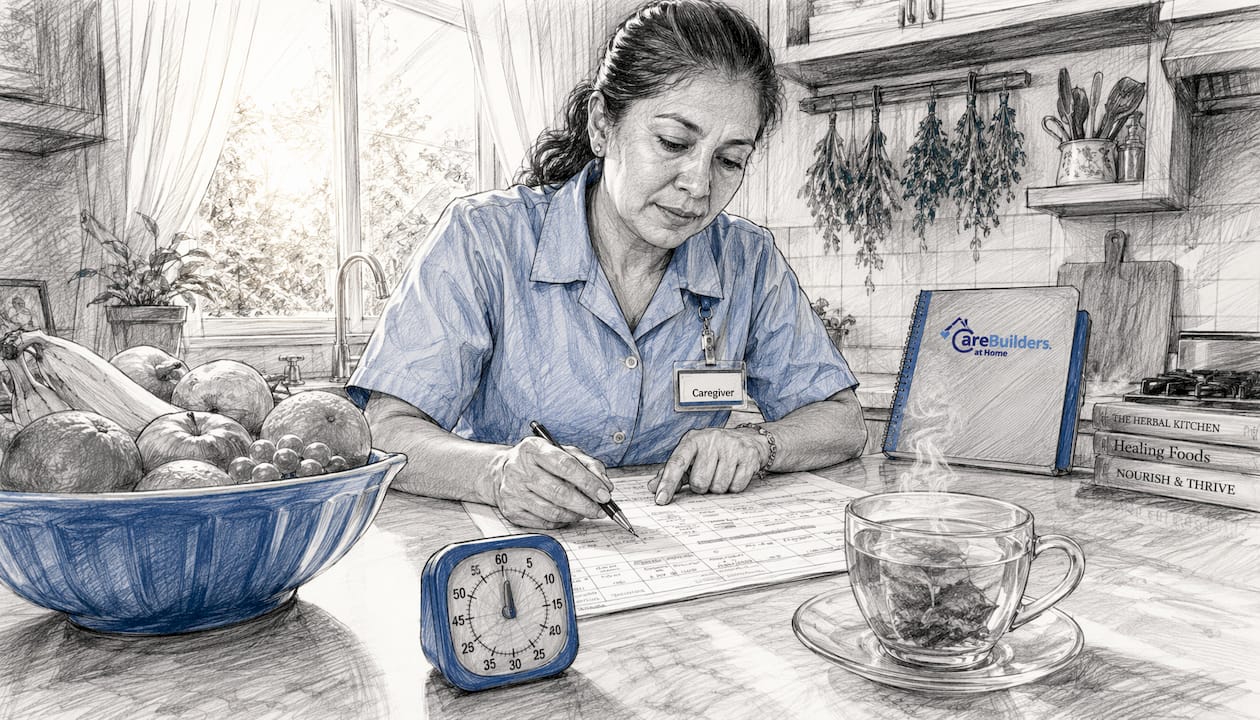
Task-content flexibility means the caregiver adjusts what they do during a visit based on what the client actually needs that day, not just what the care plan says in the abstract. A client who normally manages their own breakfast may need full assistance after a restless night. A caregiver who can read that and respond without waiting for a formal plan update is practicing responsive caregiving.
Relational and continuity adjustments are subtler but arguably more important. Consistent staffing is widely cited as a top-three quality element in home care because regular workers detect subtle changes and respond faster than rotating rosters. When a client sees the same caregiver three times a week, that caregiver knows what “normal” looks like, and deviation from normal becomes a signal rather than noise.
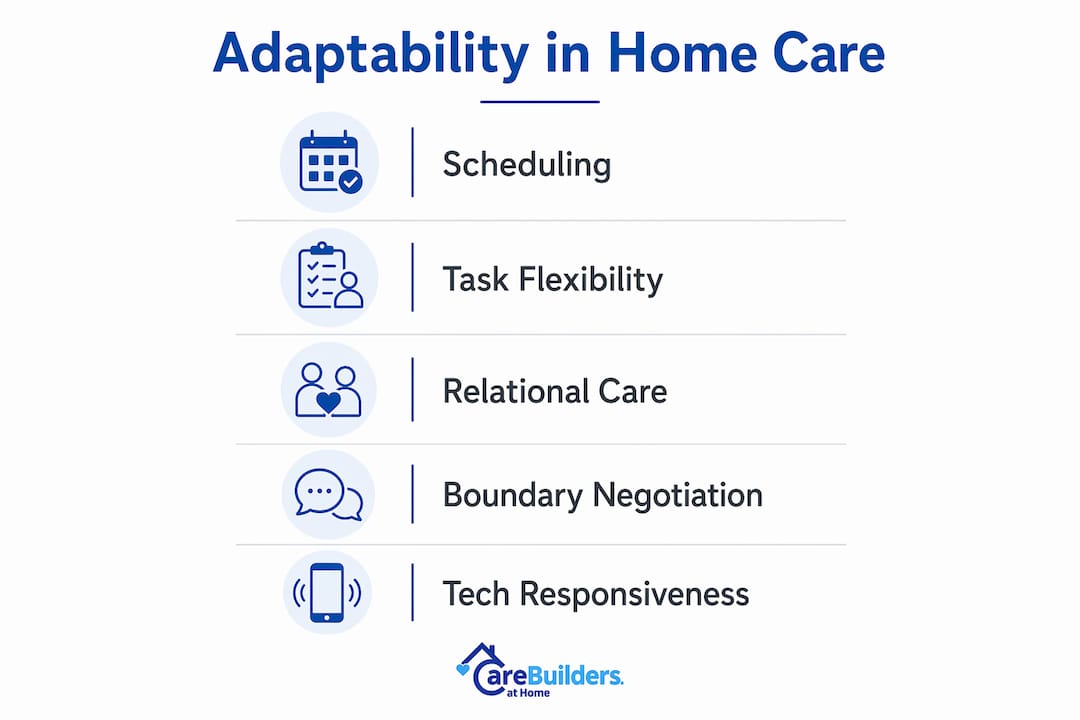
Boundary negotiation is an everyday skill in adaptive care. Research on person-centered home care documents the emotional labor involved when workers bend rules to achieve person-centered outcomes. Effective adaptive systems train workers to set appropriate limits while still allowing context-sensitive help, knowing when to extend a visit versus when to escalate to a supervisor or nurse.
Technology-enabled responsiveness is the newest and fastest-growing form. Remote monitoring tools, virtual caregiver check-ins, and fall detection sensors give caregivers and families real-time situational awareness that was simply not possible a decade ago. This is especially valuable overnight or between scheduled visits.
Pro Tip: When you tour a home care agency, ask specifically: “What happens if my parent needs a longer visit than scheduled?” The answer tells you more about their adaptive capacity than any brochure.
What barriers limit adaptability in U.S. home care?
Understanding what gets in the way of flexible care helps you distinguish problems a good agency can solve from structural issues that require policy change.
The biggest structural constraint is the Time-and-Task funding model. Most Medicaid-funded home care in the United States pays agencies for measured contact time tied to specific tasks: 30 minutes for bathing, 15 minutes for medication reminders. This model limits flexibility by paying for presence rather than outcomes. A caregiver who spends 10 extra minutes talking a distressed client through a difficult moment is providing genuine care, but under time-and-task contracting, that time is invisible and often uncompensated.
Operational barriers compound the structural ones:
- Staffing churn: High turnover in home care means clients frequently see unfamiliar faces, destroying the relational continuity that makes adaptive responses possible.
- Route and travel scheduling: Agencies that pack caregiver schedules with back-to-back visits leave no buffer for a visit that legitimately runs long.
- Rigid care plans: Plans written at intake and rarely updated fail to reflect how a client’s needs evolve week to week.
- Undocumented adaptations: Research in applied resilience engineering identifies a persistent gap between “work-as-imagined” (what the care plan says) and “work-as-done” (what caregivers actually do to meet client needs). These adaptations are often invisible to supervisors and payers.
Regulatory and safety tensions add another layer. Checklists and standardized protocols exist for good reasons, but when they crowd out clinical judgment, they can reduce the very adaptive capacity that keeps clients safe.
The honest reality: Families and local care managers can influence staffing continuity, care plan language, and communication routines. Changing the funding model requires policy advocacy at the state Medicaid or managed care level, and that is a longer road.
Practical strategies to increase adaptability in home care
Whether you are a family member choosing a provider or a care manager supervising a team, there are concrete steps you can take right now.
For families: a checklist of questions to ask any provider
- How do you handle it when a client’s needs change between scheduled visits?
- Will my parent see the same caregiver consistently, or does the roster rotate?
- How are care plans updated when a client’s condition changes?
- What technology do you use to monitor clients between visits?
- How do caregivers communicate concerns to supervisors and family members?
- What training do your caregivers receive beyond basic certification?
Red flags include vague answers about staffing, no clear escalation process, and care plans that are described as “set at intake.” A good resource for structuring what you want in writing is a personalized elder care plan that specifies outcomes, not just tasks.
Pro Tip: Keep a simple daily log using a tool like Care Chronicle to track your parent’s mood, appetite, and sleep. Patterns you notice at home are exactly the kind of information that helps a caregiver adapt their approach, and having it written down makes the conversation with the agency far more productive.
For providers and frontline managers
Continuity of staff is the single highest-leverage change most agencies can make. Supportive leadership that explicitly authorizes discretionary judgment, allows caregivers to reschedule or extend visits when needed, and creates mutual trust is the environment where adaptive behaviors become safe and sustainable.
Outcome-based care plans replace task lists with goals: “Mrs. R. will be able to prepare her own breakfast three times a week” rather than “assist with breakfast daily.” That shift gives caregivers permission to step back when a client is having a good day and step in more fully when they are not.
Brief team huddles, even five minutes at shift change, create shared sensemaking. When caregivers talk through what they noticed and what they adjusted, those adaptations become visible, teachable, and documentable rather than invisible workarounds.
Pro Tip: If you are a care manager, create a simple “adaptation log” where caregivers note any deviation from the care plan and why. Reviewing these weekly turns tacit adaptive work into organizational learning, and it gives you the data to justify flexible scheduling to payers.
How do you measure adaptability and its effect on care quality?
Adaptability is measurable using a mix of process indicators and outcome indicators. You do not need sophisticated software; a simple tracking log and a monthly family check-in are enough to start.
| Metric | Type | What it measures | How to collect |
|---|---|---|---|
| Continuity of staff | Process | Observed frequency of repeat visits by the same caregiver | Agency scheduling records |
| Schedule adherence with flexibility | Process | Timeliness of visits completed near scheduled time, considering legitimate adjustments | Caregiver visit logs |
| Response time to family concerns | Process | Interval from concern raised to documented response | Communication log |
| Avoidable hospital transfers | Outcome | Occurrences of ER visits or hospitalizations over a period | Family/medical records |
| Client satisfaction | Outcome | Periodic rating on comfort, trust, and routine | Family or client self-report |
| ADL independence | Outcome | Functional status in activities of daily living as observed by caregiver | Caregiver observation checklist |
Collecting these does not require a clinical team. A caregiver can note visit duration and any plan deviations in a simple log. A family member can complete a five-question monthly check-in. The virtual caregiver technology some agencies use generates automatic visit records that make process metrics nearly effortless to track.
Expect meaningful signals in process metrics within four to six weeks of a change. Outcome metrics like hospital transfers take longer, typically three to six months, to show a clear trend in a small-sample home care situation. A single data point is not a signal; a direction over time is.
How do payment models shape flexibility in home care?
The way care is funded determines, more than almost anything else, how much flexibility a provider can actually offer. Two contrasting models define the current U.S. landscape.
| Feature | Time-and-task model | Outcome-based model |
|---|---|---|
| What is paid for | Contact hours tied to specific tasks | Achievement of client-defined goals |
| Staff incentive | Complete the task list efficiently | Respond to what the client needs today |
| Care plan flexibility | Low; deviations require authorization | Higher; caregivers have discretion within goals |
| Adaptive capacity | Constrained by billing codes | Supported by goal-oriented deployment |
| Client outcome focus | Task completion | Functional independence and wellbeing |
Most Medicaid waiver programs and many managed care plans in the United States still operate primarily on a time-and-task basis, though outcome-based contracting is growing. Families navigating this system can take several practical steps:
- Read the service contract carefully. Look for language that ties payment to specific tasks and ask whether the agency can document goal-based outcomes alongside task completion.
- Request outcome-focused language in the care plan. Even within a time-and-task contract, a well-written care plan can describe goals and give caregivers more discretion.
- Raise concerns with your local Medicaid waiver office or managed care plan. Many states have waiver programs with more flexibility than standard Medicaid, and care managers within managed care plans sometimes have authority to authorize additional hours when outcomes data supports the request.
Local context matters as much as national policy. An agency that knows your community’s resources, your family’s situation, and your parent’s home environment will find more room to adapt within any funding model than one that treats every client identically.
How CareBuilders at Home of Plano & Allen puts adaptability into practice
Consider a situation that plays out regularly in Collin County: an 82-year-old veteran with moderate dementia living alone in Plano. His daughter works full-time in Allen and cannot be present for every visit. His needs shift week to week: some mornings he is oriented and wants to make his own coffee; others he is confused and needs full assistance with every step of his morning routine.
CareBuilders at Home of Plano & Allen addresses this through three interlocking adaptive strategies. First, the agency assigns a consistent caregiver who learns the client’s baseline over weeks, not days, making deviations from normal immediately recognizable. Second, virtual monitoring technology provides passive, continuous awareness of activity patterns between visits, so the caregiver and family receive alerts when something changes rather than discovering it at the next scheduled visit. Third, as a VA-approved provider, the agency helps the family access veteran benefits that fund additional hours, giving the care plan room to flex when a difficult week requires more support.
The specialized services the agency offers, including dementia-specific caregiver training, mean that adaptive responses to behavioral changes are grounded in clinical understanding, not guesswork.
Three questions to ask any provider to probe for similar capabilities:
- How does your technology alert the care team and family when a client’s routine changes unexpectedly?
- How do you train caregivers to recognize and respond to dementia-related behavioral shifts?
- If a client’s needs increase suddenly, how quickly can you adjust the care plan and add hours?
What are the limits of adaptability, and what is coming next?
Adaptability is not unlimited, and understanding its boundaries protects both clients and caregivers.
Common tradeoffs to watch for:
- Caregiver burnout: Caregivers who are constantly asked to go beyond their scheduled tasks without recognition or support will burn out, increasing turnover and destroying the continuity that makes adaptability possible.
- Boundary erosion: Person-centered relationships can blur into “fictive kin” dynamics where caregivers take on emotional labor far beyond their role, raising both worker wellbeing and liability concerns.
- Inconsistent documentation: When adaptations are not recorded, they cannot be reviewed, improved, or defended if a safety question arises.
- Funding sustainability: Agencies that routinely extend visits without compensation eventually face financial pressure that forces them to cut the very flexibility that made them effective.
On the horizon, three trends are reshaping what adaptive care can look like. Remote monitoring and AI-aided triage tools are making it possible to detect subtle changes in activity, sleep, and movement patterns that no scheduled visit would catch. Outcome-based contracting is slowly expanding in state Medicaid waiver programs, creating financial room for the kind of flexible deployment that time-and-task models prevent. Workforce development programs that explicitly teach risk sensemaking, boundary negotiation, and clinical observation are beginning to appear in caregiver training curricula.
The guardrails that make these advances safe are supervision, documentation, and role clarity. Adaptability without accountability is not resilience; it is drift.
Key Takeaways
Adaptability in home care is not a soft preference; it is the mechanism through which safe, person-centered care actually reaches the people who need it most.
| Point | Details |
|---|---|
| Consistent staffing enables adaptation | The same caregiver over time detects subtle changes faster than a rotating roster ever can. |
| Time-and-task funding constrains flexibility | Outcome-based contracts give caregivers the discretion to respond to what a client needs today. |
| Measure both process and outcomes | Track continuity of staff, response time, and avoidable hospital transfers to see whether adaptability is working. |
| Families are active participants | Clients and families who join in risk assessment and goal-setting make on-the-spot adaptations safer and more effective. |
| CareBuilders at Home of Plano & Allen | Combines consistent staffing, virtual monitoring, and VA-approved services to deliver adaptive care in Collin County. |
Why adaptability should reshape how we design home care
The conventional wisdom in home care still treats standardization as the path to quality. Uniform task lists, timed visits, and compliance checklists feel measurable and defensible. But the Safety-II framework, and the growing body of resilience research behind it, makes a compelling case that this logic is backwards. Quality in home care emerges from the relationship between a caregiver and a client, not from the faithful execution of a predetermined script.
Families, clinicians, and payers each hold a piece of this. Families who document changes and communicate them clearly give caregivers the information they need to adapt well. Clinicians and supervisors who authorize discretionary judgment and create space for honest reporting turn individual adaptations into organizational learning. Payers who shift even partially toward outcome-based contracting remove the financial penalty for doing the right thing. None of these changes requires a policy revolution. Most of them start with a conversation, a question asked at the right moment, or a care plan written with goals instead of tasks.
CareBuilders at Home of Plano & Allen: adaptive care you can count on
Families in Plano, Allen, Richardson, Wylie, and surrounding Collin County areas who want care that genuinely responds to their loved one’s changing needs have a concrete option. CareBuilders at Home of Plano & Allen pairs highly trained, consistent caregivers with virtual monitoring technology and specialized dementia support to deliver care that adjusts as your family member’s needs evolve. As a VA-approved provider, the agency also helps veteran families access benefits that fund the additional hours a flexible care plan sometimes requires.
The starting point is understanding exactly what personal assistance services can include for your specific situation. Reach out to CareBuilders at Home of Plano & Allen to schedule a care assessment and see how an adaptive, outcome-focused plan can be built around your loved one’s real life.
Authoritative sources and further reading
“Adaptability depends on two-way participation; clients and families who participate in risk assessment and goal-setting materially improve the safety and acceptability of on-the-spot adaptations.” — Adaptive Capacity Within the Homecare Setting, PubMed/Journal of Patient Safety
- Adaptive Capacity Within the Homecare Setting — Examines how shared risk perception between clients, caregivers, and families enables safer adaptive responses in home care.
- Exploring Norwegian homecare healthcare professionals’ perceptions of risk and the link to high-quality care (BMJ Open) — Qualitative study showing how clinical gaze and team sensemaking support adaptive decision-making, and how rigid checklists can interfere.
- Exploring homecare leaders’ risk perception and the link to resilience and adaptive capacity (BMC Health Services Research) — Documents how supportive leadership authorizes discretionary judgment and creates the conditions for sustainable adaptive practice.
- Context-sensitive strategies for homecare adaptive capacity (BMC Health Services Research) — Shows that local context, family support, and community resources differentiate effective adaptive providers from those applying national guidelines uniformly.
- Understanding the relationship between resilience and care quality in home care support — Applies resilience engineering concepts (work-as-imagined vs. work-as-done) to home care and explains how time-and-task funding constrains adaptive work.
- Person-Centered Home Care: Exploring Worker-Client Relationships Using an Intersectional and Critical Disability Framework — Qualitative research on the emotional labor of rule-bending, boundary negotiation, and “fictive kin” relationships in person-centered care.
- Home care work and quality: consistency and relationships (SPRU/University of York) — Identifies consistent staffing as a top-three quality element in home care and its role in enabling adaptive responses.
- Home care program flexibility as a relational phenomenon (ScienceDirect) — Frames flexibility as a relational, not merely operational, phenomenon requiring shared sensemaking across the care team.
- MedlinePlus: Home Care Services — Plain-language overview of home care service types and what families can expect from providers.
Recommended
- Personal Care – CareBuilders at Home | Senior and Veteran Care in Plano, Allen & Richardson TX
- How Memory Care at Home Works: A Family Guide – CareBuilders at Home | Senior and Veteran Care in Plano, Allen & Richardson TX
- Alzheimer’s In-Home Care Types: A Family Guide – CareBuilders at Home | Senior and Veteran Care in Plano, Allen & Richardson TX
- Companion Services – CareBuilders at Home | Senior and Veteran Care in Plano, Allen & Richardson TX