


Dementia Behavior Changes: A Caregiver’s Guide to Why and What Helps
Dementia most often causes agitation, wandering, repetitive questioning, apathy, disinhibition, sleep and appetite changes, and sometimes hallucinations or delusions. These are not character flaws or willful defiance. They are the brain’s way of signaling pain, confusion, fear, or an unmet need it can no longer put into words.
If you’re in the middle of a difficult moment right now, here’s your first move: check for safety, then check for a medical cause, then de-escalate calmly.
- Safety first: Clear the immediate area of anything that could cause a fall or injury.
- Rule out red flags: Fever, sudden confusion, unusual urinary symptoms, or a fall in the past 24 to 48 hours point to a medical problem, not just dementia progression.
- De-escalate gently: Lower your voice, slow your movements, and avoid arguing or correcting.
Behavior is communication. Your loved one’s brain is trying to tell you something it can no longer say directly, and once you start reading it that way, the guilt and confusion caregivers often carry starts to lift.
Key Takeaways
Dementia causes behavioral changes through brain damage interacting with unmet needs, and nonpharmacological strategies plus prompt medical screening manage most symptoms safely at home.
| Point | Details |
|---|---|
| Common behaviors | Agitation, wandering, sundowning, apathy, disinhibition, and hallucinations affect most people with dementia at some stage. |
| Rule out medical causes first | Sudden changes over 24 to 48 hours often signal delirium, infection, or medication effects, not disease progression. |
| Try nonpharmacological strategies first | Routines, environment changes, and the DICE framework are the recommended first-line response before medication. |
| Medications need strict limits | Trial any behavioral medication for at least four weeks, then reassess and discontinue if it isn’t working. |
| Specialized in-home support helps | CareBuilders at Home of Plano & Allen pairs dementia-trained caregivers with 24/7 monitoring to manage wandering and nighttime agitation safely. |
Table of Contents
- What Behavioral Changes Does Dementia Cause?
- Why Does Dementia Cause These Behavioral Changes?
- How Do You Rule Out Medical Causes Behind a Sudden Change?
- What Should You Do for Each Specific Behavior?
- What Non-Drug Strategies Actually Reduce These Behaviors?
- When Should You Consider Medication for Behavioral Symptoms?
- How Do You Keep the Home Safe and Prevent Wandering?
- How Do You Take Care of Yourself as a Caregiver?
- When Should You Bring in Professional Help or Consider Long-Term Care?
- How Does Specialized In-Home Dementia Care Address These Behaviors?
- A Few Words From Someone Who Understands How Hard This Is
- How Can In-Home Dementia Care Support Your Family Right Now?
- Frequently Asked Questions
- Sources
What Behavioral Changes Does Dementia Cause?
Dementia behavior changes fall into five recognizable categories, and knowing them helps you track patterns instead of feeling ambushed by each new episode. Clinicians group these under the umbrella term BPSD, or behavioral and psychological symptoms of dementia. Up to 97% of people with dementia living in the community will develop at least one BPSD symptom at some point, so if you’re seeing this in someone you love, you are far from alone.
The five domains caregivers should recognize:
- Cognitive/perceptual: delusions (false beliefs, like accusing a caregiver of theft) and hallucinations (seeing or hearing things that aren’t there).
- Motor: wandering, pacing, repetitive movements, or restlessness.
- Verbal: repetitive questioning, shouting, or verbal aggression.
- Emotional: apathy, depression, anxiety, and sudden mood shifts.
- Vegetative: sleep disturbances, appetite changes, and disrupted daily rhythms.
Within those domains, a handful of specific behaviors show up again and again:
- Agitation and aggression: restlessness, irritability, or physical/verbal outbursts, often triggered by frustration or overstimulation.
- Wandering: purposeful-looking movement that can lead someone out of a safe area, frequently tied to a forgotten task or old routine.
- Sundowning: worsening confusion and agitation in the late afternoon or evening.
- Repetitive questioning: asking the same question minutes apart, driven by short-term memory loss rather than a desire to annoy.
- Apathy: loss of interest in previously enjoyed activities, the most common behavioral symptom in many studies.
- Depression: persistent low mood, withdrawal, or hopelessness.
- Delusions and hallucinations: false beliefs or sensory experiences that feel completely real to the person.
- Disinhibition: saying or doing socially inappropriate things without the usual filter.
- Sleep and appetite changes: reversed day/night cycles, reduced hunger cues, or sudden preference for sweet foods.
Certain symptoms cluster with certain diagnoses. Visual hallucinations are especially common early in Lewy body dementia, while disinhibition and apathy dominate the picture in frontotemporal dementia, according to the Lewy Body Dementia Association. That’s a meaningful clue for your care team when a diagnosis still feels uncertain.
There’s a direct line between the behavior you’re seeing and the part of the brain losing function. Apathy and poor impulse control often trace back to frontal lobe atrophy, the region responsible for planning and self-control. That single fact reframes a lot of painful moments: the “personality change” families grieve is frequently a measurable loss of brain tissue, not a choice.
Why Does Dementia Cause These Behavioral Changes?
Two forces are almost always working together: physical damage to the brain, and everything happening around the person in that moment. Understanding both helps you respond instead of just reacting.
On the biological side, dementia damages specific networks. Frontal lobe shrinkage impairs judgment and impulse control, which shows up as disinhibition or poor planning. Damage to the temporal lobes and the anterior cingulate, a region tied to attention and emotional regulation, contributes to apathy and blunted emotional responses. The insula, which helps process internal body signals like pain and hunger, also degrades, which is part of why people with dementia often can’t tell you they’re uncomfortable, hungry, or in pain. They still feel it. They just can’t translate it into words anymore.
That’s where the biopsychosocial model comes in, and it’s the single most useful mental shift a caregiver can make. A behavior is rarely just “the disease.” It’s the disease acting on:
- Biology: the specific brain regions affected and how far the disease has progressed.
- Personality history: how this person always handled stress, before dementia.
- Environment: noise, lighting, unfamiliar faces, or a disrupted routine.
- Unmet needs: pain, hunger, thirst, a full bladder, boredom, or loneliness.
A caregiving resource from the National Institute on Aging makes a point worth repeating to yourself on the hard days: the disease causes the behavior, not the person. Mirroring their distress with your own frustration tends to escalate things, while staying calm and curious about the underlying trigger often defuses them.
Different dementia types also bias toward different behavior patterns. Frontotemporal dementia tends to produce early disinhibition and social missteps because it targets the frontal and temporal lobes directly. Lewy body dementia frequently causes vivid, detailed visual hallucinations tied to how the disease affects visual processing regions. Alzheimer’s disease, the most common form, tends to produce a slower buildup of repetitive questioning, apathy, and eventually agitation as memory and reasoning decline together.
How Do You Rule Out Medical Causes Behind a Sudden Change?
Timeline is everything here. A behavior that builds gradually over months usually reflects disease progression. A behavior that appears over 24 to 48 hours almost always signals something else, and that something else is often treatable.
Sudden changes point toward delirium, a medical emergency with an acute onset and a fluctuating course, commonly triggered by infection, dehydration, or a new medication. This distinction matters enough to build into your routine.
Your rapid assessment checklist:
- Check for fever, unusual sweating, or flushed skin.
- Look for signs of a urinary tract infection: strong odor, cloudy urine, or new incontinence.
- Ask about recent bowel movements. Constipation is an underrated agitation trigger.
- Review any medication changes in the past one to two weeks, including over-the-counter additions.
- Check for signs of dehydration: dry mouth, sunken eyes, dark urine.
- Look for unreported falls, bruising, or signs of pain.
- Note breathing changes, coughing, or congestion.
Because people with advanced dementia often can’t verbally report pain, caregivers and clinicians increasingly rely on observational tools. The PAINAD scale (Pain Assessment in Advanced Dementia) rates breathing, negative vocalizations, facial expression, body language, and consolability to flag pain in nonverbal patients. FLACC (Face, Legs, Activity, Cry, Consolability) works similarly and is used to catch pain signals through observed behavior rather than a self-report. Both give caregivers a structured way to say “something’s wrong” instead of just a gut feeling.
Keep a simple log: date, time, what happened before the behavior, and what happened during it. A pattern often only becomes visible after three to four weeks of consistent notes, and that log becomes invaluable at the next doctor’s visit. If a change is sudden, severe, or paired with any red flag above, call your loved one’s clinician the same day rather than waiting for a scheduled appointment.
What Should You Do for Each Specific Behavior?
Every behavior has its own logic once you know what to look for. Here’s a practical playbook for the ones caregivers deal with most often.
Agitation and aggression
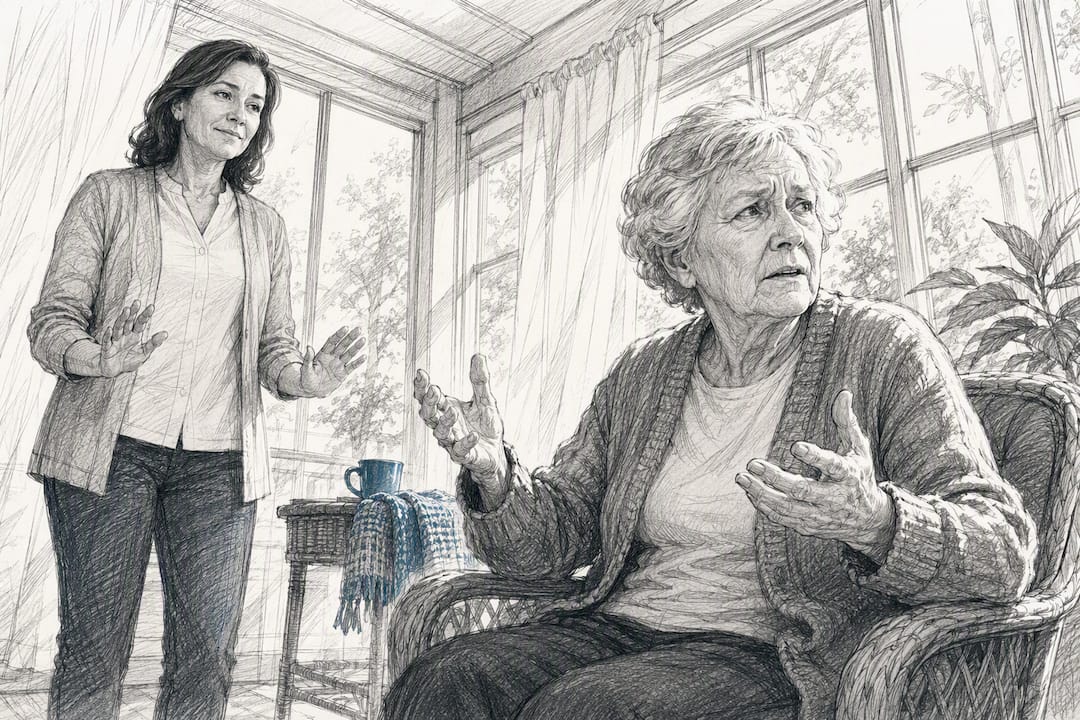
This looks like pacing, clenched fists, raised voice, or, at its worst, hitting or grabbing. Triggers are usually overstimulation, fatigue, pain, or a task that feels too demanding. Give physical space first. Lower your voice instead of raising it. Try a script like, “You seem upset. I’m here with you, let’s sit down for a minute.” Avoid arguing about facts or demanding they “calm down,” which almost always backfires. Once things settle, look for the trigger: was it too loud, too late in the day, or did the task ask too much of them?
Wandering
Wandering often has a hidden purpose: looking for a bathroom, a former job, or a childhood home. Don’t block the path aggressively or physically restrain unless there’s immediate danger. Redirect instead: walk alongside them for a minute, then gently guide toward a different destination. Follow up by asking whether the wandering happens at a consistent time of day, which often points to an unmet need like hunger or restlessness.

Sundowning
Confusion and agitation that worsen in the late afternoon or evening are common enough that most caregivers eventually see it. Draw blinds before it gets dark to reduce shadows, turn on lights early, and keep evening routines calm and predictable. Avoid scheduling appointments, visitors, or errands in the late afternoon. Sundowning triggers frequently include pain, sleep disruption, and overstimulation, so a quiet, dim, low-demand evening routine is often the single best prevention tool you have.
Hallucinations and delusions
Seeing people who aren’t there or believing a caregiver is a stranger is distressing for everyone in the room. Don’t argue about what’s real. Validate the emotion instead: “That sounds scary, I’m right here with you.” Check the environment for misleading shadows, reflections, or television noise that could be feeding the hallucination. If hallucinations are new, vivid, and paired with stiffness or slowed movement, mention Lewy body dementia to your clinician specifically.
Repetitive questioning
Answering the same question for the twentieth time in an hour tests anyone’s patience. Resist the urge to say “I already told you.” Instead, answer briefly and redirect to an activity: “We’re going at 3:00. Want to help me fold this laundry while we wait?” A visible clock, calendar, or written note can sometimes reduce the need to ask at all.
Apathy and withdrawal
Apathy can look like depression but often isn’t sad, it’s just flat. Don’t mistake it for laziness. Offer small, structured invitations rather than open-ended ones: “Let’s go sit outside for five minutes” works better than “Do you want to do something?”
Disinhibition
Inappropriate comments or actions stem from frontal lobe damage, not rudeness. Redirect calmly and privately rather than scolding in front of others, which can trigger shame or defensiveness that makes things worse.
Sleep and appetite changes
Reversed sleep cycles and reduced appetite are common as the disease progresses. Keep consistent wake and meal times, limit daytime napping, and offer smaller, more frequent meals if appetite has dropped.
Do this in every interaction: validate the feeling, redirect to an activity, and keep your own tone calm.
Avoid this in every interaction: correcting facts, arguing, raising your voice, or asking “why” questions the person can’t answer.
Pro Tip: Keep a small sensory kit nearby, a favorite song playlist, a soft blanket, or a familiar object, and use it the moment agitation starts. Redirecting through the senses often works faster than words when reasoning has stopped being effective.

What Non-Drug Strategies Actually Reduce These Behaviors?
Medication is rarely the first answer, and for good reason: nonpharmacological approaches are the recommended first-line treatment for behavioral symptoms in dementia. Clinicians and caregivers who work through problems systematically tend to see better results than those reacting case by case.
One structured approach worth adopting is the DICE framework: Describe, Investigate, Create, Evaluate.
- Describe the behavior in specific terms: what happened, when, where, who was present.
- Investigate possible causes: pain, medication timing, hunger, noise, unfamiliar faces.
- Create a plan targeting the most likely cause, rather than the behavior itself.
- Evaluate whether the plan worked, and adjust.
Here’s DICE applied to repetitive questioning about “going home.” Describe: happens most around 4 PM, especially when the TV is on. Investigate: could be sundowning combined with boredom. Create: turn off the TV by 3:30, start a folding or sorting task, dim harsh lighting. Evaluate after one week: did the questioning frequency drop?
Your environment and routine do more heavy lifting than most families realize.
- Keep wake, meal, and bedtimes consistent, even on weekends.
- Reduce background noise and clutter, especially during high-stress transition times like mornings.
- Use warm, adequate lighting throughout the day and dim it gradually in the evening.
- Build sleep hygiene habits: limit caffeine after noon, keep the bedroom cool and dark, avoid screens before bed.
- Offer small snacks on a schedule rather than waiting for hunger cues that may no longer register clearly.
- Use visual or auditory cues, like a labeled calendar or a favorite radio station, to anchor time and place.
Meaningful activity is one of the most underused tools in a caregiver’s kit. Simple folding tasks, light gardening, sorting objects by color, listening to familiar music, or handling a textured sensory box can meet the same psychological needs that agitation and wandering are often trying to fill: purpose, movement, and stimulation. Match the activity to current ability, not past ability. A former accountant might now find satisfaction in sorting playing cards by suit rather than balancing a checkbook, and that’s a success, not a step down.
A sample routine that many families find workable: consistent wake time, breakfast, a mid-morning activity like a short walk or music, lunch, quiet rest time in early afternoon, a low-stimulation activity before the sundowning window starts, an early calm dinner, and a wind-down routine that starts well before bedtime.
Try one change at a time and give it a week before judging it. If agitation, aggression, or wandering persists despite consistent environmental and routine adjustments, that’s your signal to escalate to your loved one’s physician or a dementia care specialist.
When Should You Consider Medication for Behavioral Symptoms?
Medications belong in the conversation only after nonpharmacological strategies have had a fair trial, and even then, expectations should stay realistic. Antipsychotics and other behavioral medications tend to show modest benefit at best, and they carry real risks, including increased fall risk, sedation, and, for antipsychotics specifically, elevated cardiovascular risk in older adults with dementia.
If your clinician does recommend a medication, bring this rule with you: a proper trial runs at least four weeks at the appropriate dose, followed by a clear reassessment. If there’s no meaningful benefit by then, the medication should be tapered off rather than continued indefinitely “just in case.”
Common medication classes and what to watch for:
- Antipsychotics: sedation, increased fall risk, stiffness.
- Antidepressants: modest benefit for mood symptoms, generally lower risk profile.
- Benzodiazepines: short-term use only; linked to falls, confusion, and dependency with prolonged use.
Push for shared decision-making. Ask your prescriber directly what specific behavior the medication targets, how you’ll measure success, and when you’ll revisit the decision. Keep tracking behavior frequency and side effects in the same log you started during the assessment phase. That record turns a vague “it seems better” into something a clinician can actually act on.
How Do You Keep the Home Safe and Prevent Wandering?
A safer home reduces both risk and your own anxiety, and most of the changes cost little.
Home safety checklist:
- Install door alarms or chimes that alert you when an exterior door opens.
- Have your loved one wear an ID bracelet with a phone number, in case they wander beyond your reach.
- Clear walking paths of rugs, cords, and clutter that raise fall risk.
- Store car keys out of sight and out of habitual reach.
- Secure medications, cleaning supplies, and sharp tools in a separate, locked space.
Monitoring technology fills the gaps you physically can’t cover around the clock. In-home camera or sensor systems offer peace of mind but raise privacy considerations worth discussing as a family. GPS-enabled wearables help locate someone quickly if they do leave unnoticed, though reliability depends on signal strength and battery life. A 24/7 medical alert service adds a layer of coverage overnight or when you step away, which matters most during the exact hours when sundowning and wandering risk peak.
If a wandering episode happens, act fast:
- Search the immediate home and yard first; most people are found within a short distance.
- Call 911 immediately if they’re not found within a few minutes, don’t wait it out.
- Give responders a recent photo, a description of clothing, and any known habits or former routines that might explain a direction of travel.
- Notify close neighbors, since a familiar face is often the one who spots them first.
Pro Tip: Keep a printed photo, a written physical description, and a simple neighborhood map in an accessible folder, on the fridge, in your car, wherever you’ll actually grab it under stress. In an emergency, you won’t want to be searching your phone for a decent picture.
How Do You Take Care of Yourself as a Caregiver?
Caring for someone with these behavioral changes takes a toll that’s easy to minimize until it catches up with you. Watch for the warning signs: chronic exhaustion, irritability that feels out of character, skipping your own medical appointments, or a growing sense of resentment you didn’t expect to feel. None of that makes you a bad caregiver. It makes you human, and it’s your cue to bring in more support, not push harder alone.
Support comes in several forms, and using more than one usually works better than relying on any single option:
- Respite care: short-term relief, whether a few hours a week or a longer stretch, gives you room to rest without guilt.
- Counseling or therapy: processing grief and frustration with a professional helps more than most caregivers expect.
- Peer support groups: connecting with others managing the same behaviors reduces the isolation that caregiving breeds.
- Case management: a coordinator who helps navigate appointments, benefits, and care transitions.
- Veteran benefit navigation: if your loved one served, VA-connected benefits can offset the cost of in-home support.
Build small non-negotiables into your week: protected sleep, a standing break, your own medical checkups. Keep documenting behaviors and questions before appointments so visits are efficient instead of rushed, and so nothing important gets forgotten in the moment.
When Should You Bring in Professional Help or Consider Long-Term Care?
Certain signals mean it’s time to expand your support team, not push through alone: wandering that’s become dangerous, aggression you can no longer safely manage, a need for supervision around the clock, your own health declining, unexplained weight loss or dehydration, or repeated hospital visits.
Short-term in-home help, like respite visits or targeted behavior-management support, can bridge a rough patch without uprooting your loved one’s routine. Long-term placement becomes the better conversation when safety needs exceed what any home setup can reasonably provide, even with help.
If you’re evaluating in-home caregivers or agencies, ask directly: What dementia-specific training do caregivers receive? What monitoring is available overnight? What’s the emergency protocol if a behavior escalates? Can you provide references from families managing similar behaviors?
How Does Specialized In-Home Dementia Care Address These Behaviors?
Here’s a real-world look, drawn from an anonymized case, at how the right support structure changes outcomes for families managing these exact behavior patterns.
A family working with CareBuilders at Home of Plano & Allen came to us managing nighttime wandering and worsening sundowning agitation, the two behaviors that most often push families toward crisis decisions. The plan paired a dementia-trained caregiver with 24/7 virtual monitoring and fall-detection technology, giving the family real-time alerts the moment their loved one left the bed overnight rather than discovering it after the fact.
Services that map directly onto the strategies covered throughout this guide include:
- Dementia-trained caregivers skilled in de-escalation and person-centered communication.
- 24/7 virtual monitoring paired with fall detection for overnight and unsupervised hours.
- Behavior logs shared with families and available for physician visits.
- Veteran benefit navigation for eligible families seeking to offset care costs.
A Few Words From Someone Who Understands How Hard This Is
Watching someone you love say or do things that feel unrecognizable is one of the loneliest parts of caregiving. It’s easy to internalize these moments as personal, as if patience alone should be enough to fix them. It rarely is, because the behavior isn’t coming from a place reason can reach.
What actually helps is treating each outburst, each wandering episode, each repeated question as information rather than an attack. Use the checklists here. Try the DICE framework on the behavior that wears you down most. And when things escalate past what feels manageable, reach out for help sooner than your instincts tell you to. Asking early isn’t giving up. It’s what gives both of you a better chance at calmer days ahead.
How Can In-Home Dementia Care Support Your Family Right Now?
Families managing wandering, sundowning, and aggression on their own often burn out long before residential care ever enters the conversation, and that’s exactly the gap CareBuilders at Home of Plano & Allen was built to close. Instead of a family absorbing every overnight wake-up and every agitated evening alone, a dementia-trained caregiver handles de-escalation in real time, while 24/7 virtual monitoring with fall detection catches the moments no one can watch for around the clock.
Every recommendation in this guide, consistent routines, calm redirection, safety planning, behavior logging, maps directly onto what our caregivers are trained to do every shift. Veteran families also gain direct navigation support for VA-connected benefits, which often makes specialized dementia care more financially reachable than families expect.
If you’re weighing whether to bring in professional support, start with our guide on choosing a dementia-trained in-home caregiver, or reach out directly through CareBuilders at Home of Plano & Allen to set up a consultation and talk through what your household needs most right now.
Frequently Asked Questions
What behavioral changes does dementia cause most often?
Dementia most commonly causes agitation, wandering, repetitive questioning, apathy, disinhibition, sleep and appetite disruption, and, in some types, hallucinations or delusions. Which symptoms appear and how severely varies by the type of dementia and the stage of the disease.
Is aggression in dementia intentional?
No. Aggression almost always stems from frustration, fear, pain, or overstimulation that the person can’t express verbally. Responding calmly and looking for the underlying trigger works far better than treating it as defiance.
How do behavioral changes typically progress through dementia stages?
Early stages often bring subtle apathy, mild repetitive questioning, and mood changes. Middle stages tend to add agitation, sundowning, and wandering as memory and reasoning decline further. Later stages can bring disinhibition, psychosis, and significant sleep disruption, though the exact pattern varies by dementia type and individual.
When should I call a doctor about a new behavior?
Call promptly if a change appears suddenly, over 24 to 48 hours, or comes with fever, pain signs, confusion that fluctuates through the day, or a recent fall. These point toward a treatable medical cause rather than dementia progression itself.
Do behavioral changes get worse over time?
Behavioral symptoms often shift rather than simply worsening in a straight line. Some, like repetitive questioning, may fade as verbal ability declines, while others, like agitation or disinhibition, can intensify as judgment and impulse control deteriorate further.
Can environment alone reduce agitation without medication?
Often, yes. Reducing noise and clutter, keeping consistent routines, and addressing unmet needs like pain or hunger resolves a meaningful share of agitation episodes without any medication involved. Medication is typically reserved for symptoms that don’t respond to these approaches after a genuine trial period.
This article is general information, not a substitute for advice from a qualified doctor. Consult a qualified healthcare professional about your own circumstances before acting on anything here.
Sources
For deeper reading beyond this guide, these sources cover the clinical and caregiving ground in more depth:
- Behavioral and Psychological Symptoms in Dementia – StatPearls – NCBI Bookshelf
- Alzheimer’s Caregiving: Managing Personality and Behavior Changes | National Institute on Aging
- Behavior & Personality Changes | Memory and Aging Center
Recommended
- Guide – CareBuilders at Home | Senior and Veteran Care in Plano, Allen & Richardson TX
- How to Choose a Dementia-Trained In-Home Caregiver – CareBuilders at Home | Senior and Veteran Care in Plano, Allen & Richardson TX
- What Late-Stage Alzheimer’s Care Involves: A Family Guide – CareBuilders at Home | Senior and Veteran Care in Plano, Allen & Richardson TX
- How Memory Care at Home Works: A Family Guide – CareBuilders at Home | Senior and Veteran Care in Plano, Allen & Richardson TX