


Hire a Licensed VA Aware In Home Agency for Paid Family Care in Texas
The most reliable path to paid in-home caregiving in Texas is hiring through a licensed HHSC HCSSA agency, not managing a caregiver yourself. Start by contacting an agency directly; if your loved one is a veteran, also call their VA primary care team or social worker to ask about Homemaker and Home Health Aide services or Veteran-Directed Care. CareBuilders at Home of Plano & Allen is one such VA-approved agency serving Collin County families who want licensed staffing, monitoring, and dementia-trained caregivers in one place.
TL;DR:
- Hiring through a licensed HHSC HCSSA agency reduces risks related to background checks, supervision, and backup staffing compared to managing a caregiver privately.
- Verify an agency’s license number and ask about caregiver training, supervision, and updated care plans to ensure consistent, quality support.
- Cost varies regionally with added charges for holidays and overnight shifts; Medicare rarely covers non-medical caregiving, so private pay and VA programs are primary options.
- VA benefits like Homemaker & Home Health Aide and Veteran-Directed Care depend on clinical eligibility, not income, requiring VA referrals for support.
- Agencies that prioritize reliable backup staffing and active supervision are key to smooth, ongoing care, beyond initial caregiver personality assessments.
Table of Contents
- Why an Agency Is Usually the Safer Choice for Paid Caregiving in Texas
- How Do You Hire a Paid Caregiver in Texas Step by Step?
- What Questions Should You Ask When Screening a Caregiver?
- What Does Paid In-Home Care Cost in Texas, and Who Pays for It?
- How CareBuilders at Home of Plano & Allen Matches These Priorities
- Who Qualifies for Paid In-Home Caregiving Services in Texas?
- How Do You Apply for Medicaid Support Through the Texas CDS Option?
- What Alternatives to Guardianship Exist for Texas Families?
- Are There Tax Benefits to Hiring a Caregiver for a Family Member?
- What Training Do Texas Caregivers Need, and Where Do Families Verify It?
- What This Guide Gets Right That Most Advice Misses
- Ready to Talk to a Licensed, VA-Aware Agency in Collin County?
- Sources
Why an Agency Is Usually the Safer Choice for Paid Caregiving in Texas
When you’re arranging a paid family caregiver in Texas, you’re really choosing between two paths: hire a licensed agency, or hire an individual caregiver directly and manage everything yourself. For most families, the agency route carries far less risk.
Texas regulates any organization providing personal assistance services as a Home and Community Support Services Agency, or HCSSA, through the Texas Health and Human Services Commission. That license sets requirements for staffing, supervision, and operational safety, and it’s the first thing you should confirm before signing anything. Ask for the license number and verify it, not just a promise that “we’re licensed.”
A licensed agency typically handles:
- Background checks and employment verification on every caregiver sent to your home
- Payroll, tax withholding, and liability insurance, so you’re not the employer of record
- Scheduled supervision and a documented, written care plan
- Backup staffing when your regular caregiver is sick or unavailable
Hiring privately can look cheaper on paper, but you become the household employer. That means payroll taxes, potential workers’ compensation exposure, and no guaranteed replacement if your caregiver quits with no notice, according to the American Caregiver Association. You’re buying more than labor with an agency. You’re buying a managed system that keeps functioning when one person can’t show up.
How Do You Hire a Paid Caregiver in Texas Step by Step?
Hiring the right caregiver isn’t a single decision. It’s a sequence of smaller ones, and skipping a step is usually where families run into trouble later.
- Assess needs first. Write down what help is actually required: bathing, dressing, mobility, medication reminders, cognitive supervision, and the hours or days you need covered. Don’t call an agency until you’ve done this; vague requests get vague answers.
- Request core documents. Ask for the agency’s HHSC license, proof of liability insurance, and whether caregivers are W-2 employees or independent contractors. W-2 status usually means tighter supervision and accountability.
- Ask how they screen and train caregivers. Get specifics on background-check policy, dementia or fall-prevention training, and how supervisors check in.
- Pin down costs in writing. Confirm the hourly rate, minimum shift length, weekend or overnight differentials, and the cancellation policy before you commit.
- Schedule a trial shift. A short intro period lets you and your loved one evaluate the caregiver before locking into a longer schedule.
- Sign a written service agreement. It should spell out the care plan, review intervals, and how you’ll communicate with the agency between visits.
Pro Tip: Ask the agency how often the written care plan gets reviewed and updated. A plan that’s set once and never revisited usually means supervision is thin, no matter how good the intake conversation sounded.
For a broader walkthrough of setting up in-home support, see this guide on arranging in-home care for an elderly parent.
What Questions Should You Ask When Screening a Caregiver?
Paperwork tells you whether an agency is legitimate. Conversation tells you whether a specific caregiver is right for your family. Both matter and skipping either one is how families end up disappointed three weeks in.
Before you agree to anything, verify:
- Government-issued ID and a summary of the caregiver’s background check
- At least two client or employer references you can actually call
- Certifications relevant to your situation, including dementia-specific training and CPR
- A valid driver’s license and current auto insurance, if transportation is part of the job
In the interview itself, ask the caregiver to walk you through a typical shift from start to finish. Ask about their direct experience with dementia care or veteran clients, and how they’ve handled a real emergency in the past, not a hypothetical one. Ask what happens if they’re sick on a scheduled day; understanding the importance of respite care and caregiver wellbeing can clarify how backup support is structured. That last question tells you a lot about whether backup coverage actually exists.
Watch for red flags: vague or shifting answers about supervision, references that don’t check out, or an agency pushing cash payment instead of a written agreement. High caregiver turnover, or an inability to explain who covers a shift when someone calls out, both suggest weak internal management rather than a caregiver problem. If you’re vetting specifically for dementia experience, this breakdown of choosing a dementia-trained caregiver covers the specific competencies to probe for.
What Does Paid In-Home Care Cost in Texas, and Who Pays for It?
Private-pay rates for non-medical in-home care in Texas vary by region, the level of care needed, and whether you’re booking daytime hours or overnight and weekend shifts. Most agencies apply differentials for holidays and overnight coverage, and many enforce a minimum shift length, so ask about both before comparing quotes across agencies.
Medicare’s role here is limited. It generally doesn’t cover non-medical personal care like bathing or companionship, and home health aide coverage only applies under specific skilled-care conditions tied to a doctor’s order, not ongoing custodial support. Families are often surprised by this gap, since Medicare covers so much else related to senior health.
For veterans, three programs are worth checking:
- Homemaker & Home Health Aide (H/HHA): Veterans enrolled in VA healthcare may qualify for trained aide support at home if they meet clinical eligibility criteria set by their VA medical team.
- Veteran-Directed Care: This program lets eligible veterans direct a flexible budget and hire their own support workers, though availability depends on the local VA medical center and aging network.
- Aid & Attendance: An added pension benefit for veterans who need help with daily activities, applied for through the VA.
Start by calling your veteran’s VA primary care provider or social worker directly; they initiate referrals for H/HHA and can point you toward Veteran-Directed Care where it’s offered locally. Ask any agency you’re considering whether they’re VA-approved and have experience navigating VA paperwork. It saves weeks of back-and-forth. Local Area Agencies on Aging are also worth a call to confirm what’s actually available in your county.
How CareBuilders at Home of Plano & Allen Matches These Priorities
Everything covered so far, licensure, supervision, VA navigation, and backup reliability, maps directly onto what CareBuilders at Home of Plano & Allen was built to deliver. The agency is a VA-approved provider, which means it can help veteran families navigate Homemaker & Home Health Aide referrals and Aid & Attendance paperwork instead of leaving them to figure it out alone.
Its caregivers receive specialized training in dementia and Alzheimer’s care, a need that generic home care listings often gloss over but that families managing memory loss know is central to safety and daily quality of life. On top of hands-on care, CareBuilders at Home layers in virtual monitoring and fall detection technology, giving families a second layer of safety awareness between in-person visits.
Support runs 24/7, and the agency serves Plano, Allen, Richardson, Wylie, and the surrounding Collin County area. When you call, ask directly how they structure caregiver supervision, what their backup coverage looks like if your regular caregiver is out, and how they handle VA paperwork specifically. Those three questions will tell you quickly whether an agency’s claims match its actual operations.
Who Qualifies for Paid In-Home Caregiving Services in Texas?
Eligibility for agency-provided paid caregiving in Texas isn’t tied to income limits or family relationship rules the way public-assistance programs are. It’s based on care need, not household finances. Any Texas family can hire a licensed HCSSA agency privately regardless of income, since it’s a direct-pay consumer service, not a means-tested benefit.
What actually determines whether care is appropriate is a functional assessment: how much help someone needs with bathing, dressing, mobility, medication reminders, or supervision due to memory loss. Agencies typically conduct this assessment during the initial consultation, and it shapes the written care plan more than any paperwork about income or family ties.
For veterans, eligibility works differently and depends on VA enrollment status and a clinical determination by their VA care team. Homemaker & Home Health Aide services require the veteran to be enrolled in VA healthcare and to meet the clinical criteria their provider sets, not a family relationship test. Veteran-Directed Care similarly hinges on a VA needs assessment rather than income.
If you’re exploring VA-backed routes for a veteran family member, the eligibility conversation should start with their VA primary care provider or social worker, since they control the referral and clinical sign-off. Private-pay families skip that step entirely and can begin with an agency consultation directly. Either way, the deciding factor is documented care need, assessed by a professional, not a income bracket or a specific family title on paper.
How Do You Apply for Medicaid Support Through the Texas CDS Option?
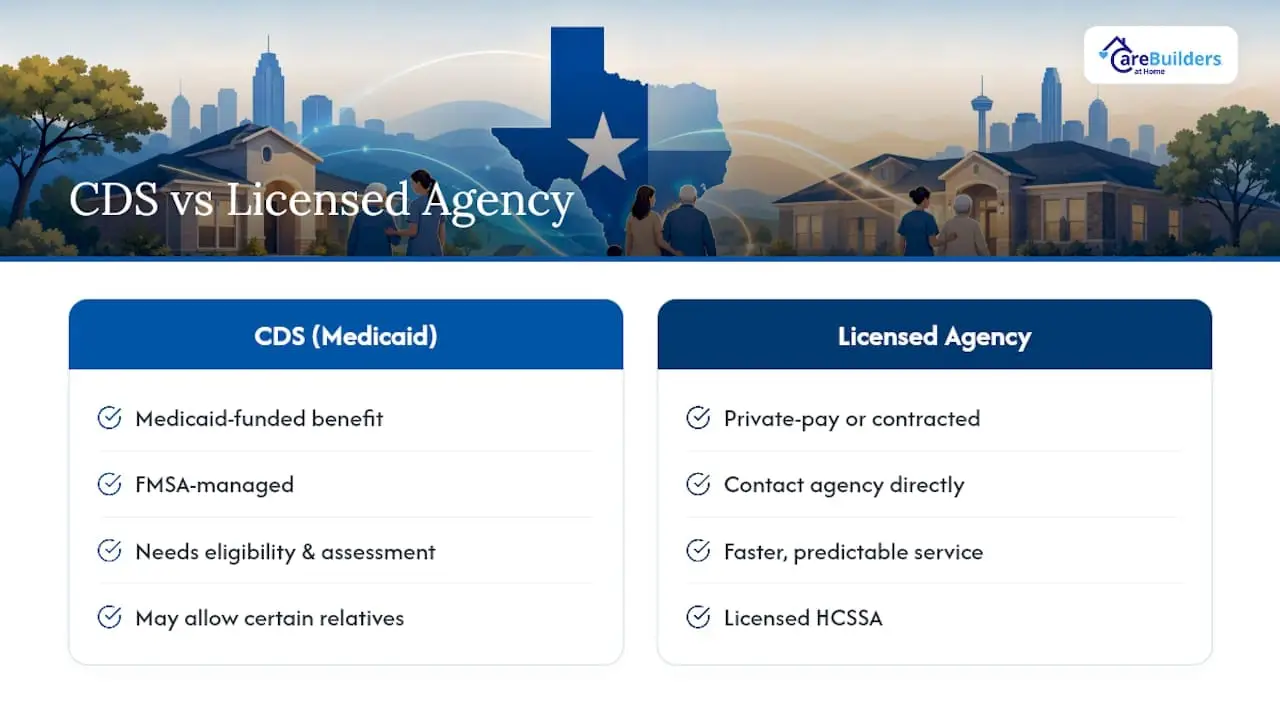
Texas does offer a Medicaid-funded path called Consumer Directed Services, or CDS, which operates under STAR+PLUS and other Medicaid waiver programs. It allows an approved individual to direct their own care budget and choose their support workers, including certain relatives in specific circumstances.
That said, CDS sits outside the agency-hire model this guide focuses on. It’s a Medicaid benefit administered through a Financial Management Services Agency (FMSA) rather than a licensed HCSSA you contact directly for private-pay staffing. Applying starts with a Medicaid eligibility determination through the Texas Health and Human Services Commission, followed by an assessment to confirm the applicant qualifies for a waiver program that offers the CDS option.
Families exploring CDS should request a needs assessment through their Medicaid managed care organization or a local Aging and Disability Resource Center, since eligibility depends on both the underlying waiver’s income and functional criteria, not a simple checklist. Processing timelines and available waiver slots vary by region and can involve a waiting period, so starting the application early matters if this route interests you.
For families who want caregiving support now rather than navigating a Medicaid waiver timeline, a licensed agency remains the faster, more predictable option. It’s worth pursuing both in parallel if your loved one may eventually qualify for CDS. Private-pay agency care can bridge the gap while a Medicaid application is pending, and many families ultimately use a combination of funding sources rather than relying on one program alone.
What Alternatives to Guardianship Exist for Texas Families?
Guardianship is often the first solution families consider when a loved one can no longer manage their own affairs, but Texas law and advocacy groups increasingly point families toward less restrictive alternatives first. Guardianship removes legal rights from the individual, and courts are required to consider alternatives before granting it.
Options families should discuss with an elder law attorney include a Durable Power of Attorney for financial decisions, a Medical Power of Attorney for healthcare decisions, and a Declaration of Guardian that lets someone name a preferred guardian in advance, before incapacity becomes an issue. Supported Decision-Making Agreements are another option gaining traction in Texas, allowing an adult with a disability to keep legal decision-making authority while a trusted supporter helps them understand choices and communicate decisions.
None of these legal tools replace hands-on caregiving, but they shape who has authority to arrange and pay for that care. A family member holding a valid Medical or Financial Power of Attorney can sign a service agreement with a home care agency on a loved one’s behalf, without needing full guardianship. That distinction matters practically: many families pursue a Power of Attorney specifically so they can hire and manage in-home caregivers without a lengthy guardianship court process.
If capacity is already in question, consult an elder law attorney before assuming guardianship is the only path forward. The right legal tool depends heavily on the individual’s specific cognitive and functional status.
Are There Tax Benefits to Hiring a Caregiver for a Family Member?
Hiring paid caregiving support can carry real tax implications, both for the family paying for care and, in some structures, for a family member providing it. The details depend heavily on individual circumstances, so this is an area where a tax professional’s input is worth the cost.
The Child and Dependent Care Credit typically applies to care for children, but a version of dependent care tax treatment can extend to a qualifying relative if strict IRS tests around income, disability, and dependency are met. Separately, medical expense deductions may apply if a portion of caregiving costs qualifies as medical care under IRS rules, though the deduction only kicks in above a percentage-of-income threshold, and non-medical companion care generally doesn’t qualify on its own.
If you hire a caregiver privately and directly, rather than through an agency, you may become a household employer for tax purposes. That status can trigger obligations to withhold and pay Social Security and Medicare taxes once wages cross a set annual threshold, according to the American Caregiver Association. This is one of the most overlooked costs of the private-hire route, and it’s a major reason agency staffing appeals to families who want to avoid becoming an employer on paper.
None of this constitutes tax advice specific to your household. A CPA familiar with dependent care and household employment rules can tell you exactly what applies to your family’s income and care arrangement.
What Training Do Texas Caregivers Need, and Where Do Families Verify It?
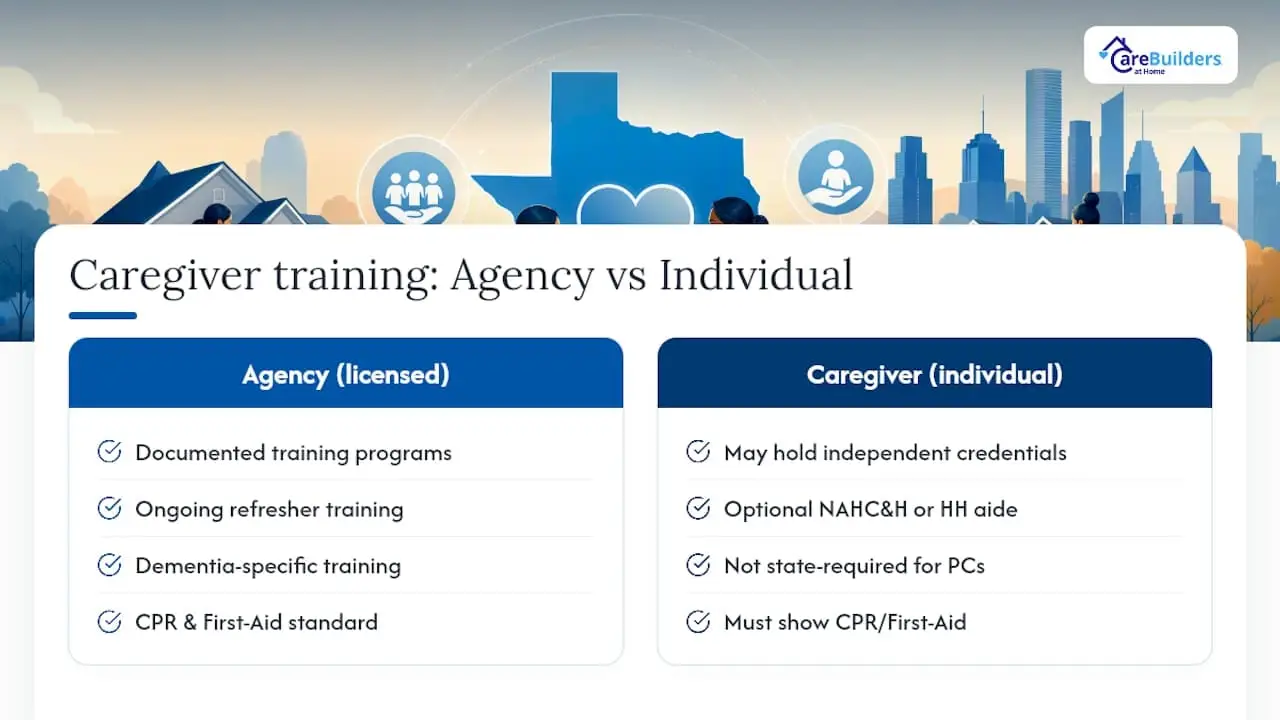
Caregiver training standards in Texas start at the agency level, since HCSSA rules require licensed agencies to maintain documented training and supervision programs for their staff. That’s different from a certification an individual caregiver holds independently, and families should understand both layers.
At minimum, ask any agency what training their caregivers complete before their first shift and on an ongoing basis. Dementia-specific training matters enormously if memory loss is part of the picture, since general caregiving skills don’t automatically translate to safely managing wandering, sundowning, or agitation. CPR and first-aid certification should be standard, and agencies handling transportation should confirm caregivers hold a valid license and current auto insurance.
Beyond agency-provided training, some caregivers pursue independent credentials through organizations like the National Association for Home Care & Hospice or state-recognized home health aide certification programs, though non-medical personal care attendants in Texas aren’t required to hold a state license the way nurses or medical aides are. That’s exactly why agency oversight matters so much: it’s the mechanism that verifies ongoing competency when no individual licensing board is doing that job.
Families should ask, directly, how often supervisors observe caregivers in the home and how training gaps get addressed once identified. An agency that can answer specifically, with names of training programs and review schedules, is telling you something different than one that answers in generalities.
What This Guide Gets Right That Most Advice Misses
Most caregiving guides treat the caregiver interview as the whole decision. It isn’t. The caregiver in front of you is only as reliable as the system behind them, and that system is what determines whether care continues smoothly when someone gets sick, quits, or needs a schedule change on short notice.
The conventional advice, “trust your gut about the person,” undersells how much agency management actually predicts outcomes. Two caregivers with identical skills can produce wildly different family experiences depending on whether their agency has real backup staffing, active supervision, and a training program that goes beyond a single orientation day. That’s the piece families should investigate first, before they fall in love with a particular caregiver’s personality.
If there’s one thing to prioritize above all else, it’s asking every agency the same blunt question: what happens on the day your assigned caregiver can’t show up? The answer separates agencies that manage risk from ones that simply staff shifts. Texas’s HCSSA licensure sets a floor for safety, but it doesn’t guarantee depth of supervision or genuine VA program fluency. Those differences show up only when you ask directly and compare answers side by side.
— cbahplano
Ready to Talk to a Licensed, VA-Aware Agency in Collin County?
CareBuilders at Home of Plano & Allen gives you one point of contact for everything this guide just walked through: licensed HCSSA staffing, VA benefit navigation, dementia-trained caregivers, and monitoring technology, instead of piecing those pieces together yourself across multiple agencies and paperwork trails.
Before your first call, gather a short summary of your loved one’s care needs, any VA enrollment or insurance details, your preferred schedule, and current medications or recent hospital discharge information if relevant. On the consult itself, expect a full needs assessment, guidance on VA referral options if applicable, and a written care plan with a clear estimate, along with an explanation of how monitoring and staffing actually work day to day.
Start by reviewing the personal care services CareBuilders at Home of Plano & Allen provides, or, if you’re arranging care for a veteran, go straight to the veteran home care guide to see how VA benefit navigation fits into the process. Either page gives you a direct way to request a consult and get a real estimate for your family’s situation.
Sources
- How to become a licensed HCSSA provider — Texas Health and Human Services
- Homemaker and Home Health Aide care — U.S. Department of Veterans Affairs
- How to hire a caregiver — American Caregiver Association
- Veteran-Directed Home and Community-Based Services — Administration for Community Living