


Get VA Home Care Approved: 5 Documents U.S. Families Must Bring
Most enrolled veterans who need help with daily tasks like bathing, dressing, or managing medications qualify for VA-funded home care. Eligibility hinges on two things: being enrolled in VA health care and meeting a clinical need threshold. If your loved one relies on a pension route like Aid & Attendance instead, different rules apply. Your best first move is calling your VA social worker or asking your local VA medical center about the Veteran Decision Aid.
Table of Contents
- What Determines VA Home Care Eligibility?
- Which VA Home Care Programs Fit Your Situation?
- How Do You Apply for VA Home Care Eligibility?
- What Will VA Home Care Cost Your Family?
- What Should You Bring to Your VA Home Care Assessment?
- What Families Get Wrong About VA Home Care
- How CareBuilders at Home Helps You Navigate VA Benefits
- Where to Verify VA Home Care Rules
- Sources
- FAQ
What Determines VA Home Care Eligibility?
VA health care enrollment is the foundation for most in-home programs run by the Veterans Health Administration. Without it, a veteran generally cannot access services like Homemaker & Home Health Aide care or Home Based Primary Care, no matter how urgent the need looks on paper. Enrollment priority groups can also affect how quickly someone gets seen, though clinical urgency usually takes precedence once a veteran is in the system.
Once enrollment is confirmed, VA clinical teams look for specific signs that a veteran needs help staying safe at home. VHA Notice 2024-01 spells out the indicators reviewers use for Purchased Home and Community Based Services:
- Needing assistance with two or more activities of daily living, such as bathing, dressing, or transferring from a bed to a chair
- Showing significant cognitive impairment that affects safety or independence
- Meeting the clinical bar for nursing-home level of care, even if the family wants to keep the veteran at home
Here’s the part many families miss: these services are also location-dependent. Home and community-based care falls under the VA Standard Medical Benefits Package, but a veteran only qualifies for a specific program if it’s actually offered at their assigned VA medical center. A program that exists on paper nationally might not be running at every facility.
Which VA Home Care Programs Fit Your Situation?
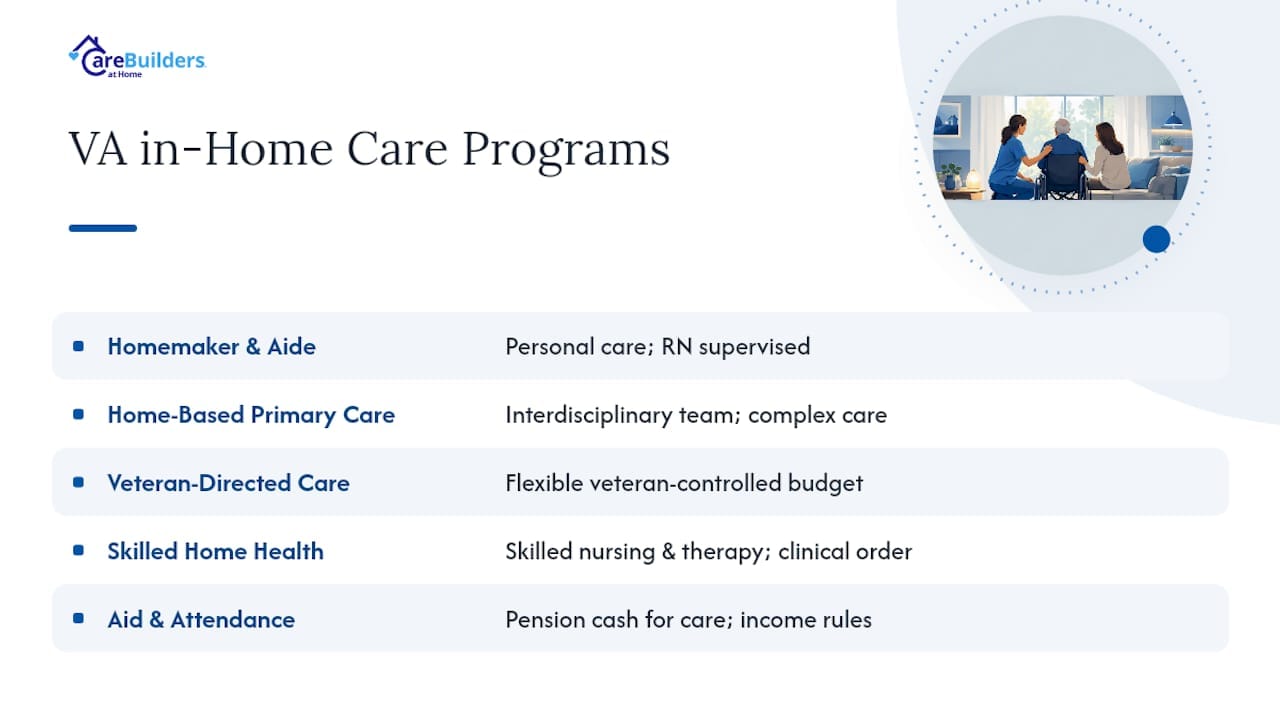
VA in-home assistance isn’t one program. It’s a cluster of services, each built for a different level of need, and picking the wrong one wastes time you may not have.
Homemaker & Home Health Aide Care covers help with bathing, meal prep, light housekeeping, and mobility. Aides are supervised by a registered nurse who assesses the veteran’s needs and adjusts the care plan, and eligibility ties directly to the clinical indicators above along with community care program rules.
Home Based Primary Care sends an interdisciplinary team, doctors, nurses, social workers, sometimes a pharmacist, directly into the home for veterans managing complex chronic conditions. This isn’t for someone who just needs occasional help; it’s built for veterans whose medical situation would otherwise mean frequent hospital trips. Enrollment and documented clinical need are both required.
Veteran-Directed Care hands the veteran (or their representative) a flexible budget to hire aides, arrange transportation, or buy equipment directly, rather than working through a VA-contracted agency.
Skilled Home Health Care is different from aide services. It covers nursing tasks and therapy, wound care, injections, physical therapy, and requires a clinical order, not just a personal care need.
Aid & Attendance, run through the Veterans Benefits Administration rather than VHA, is a pension supplement. It pays cash the household can use for care, but it runs on separate wartime service and income rules.
Pro Tip: Don’t assume a service-connected disability rating automatically unlocks home care. Clinical need and enrollment status matter more than disability percentage when it comes to qualifying for VA in-home assistance.
Homemaker & Home Health Aide is the most frequently purchased non-institutional personal care service the VA offers, part of a broader push to help veterans avoid nursing home placement, according to VA policy research.
How Do You Apply for VA Home Care Eligibility?
Getting an assessment started is more straightforward than the acronyms suggest. Here’s the sequence that actually moves things forward:
- Call your VA medical center and ask for a social worker or case manager. This is the person who initiates the clinical evaluation and matches you to the right program.
- Complete the Veteran Decision Aid if your social worker provides one. It’s a tool VA clinical teams use to help sort out which home and community-based service actually fits the situation.
- Fill out VA Form 10-10EC (Application for Extended Care Benefits) if requested. Not every program requires it, but your caseworker will tell you if it applies.
- Expect a clinical assessment, often led by a registered nurse, who documents ADL deficits, cognitive status, and caregiver burden. This paperwork is what actually justifies the approval, so specifics matter more than general descriptions.
- Follow up if you need services urgently. Timelines vary by facility and caseload, and a documented safety risk, a fall, a missed medication, a wandering incident, can prompt faster review.
If the process stalls, ask your social worker directly what’s holding up the file. Vague answers like “it’s in review” aren’t good enough when a veteran’s safety is on the line.
What Will VA Home Care Cost Your Family?
Costs depend heavily on service-connected status and financial information the VA collects during enrollment. Veterans with a higher service-connected disability rating often pay reduced or no copays for extended care services, while others may see charges based on income.
- Copays for home and community-based services can vary depending on service-connected status and financial disclosures
- Aid & Attendance pension income can be applied toward the cost of in-home care, but it follows separate wartime service and income eligibility tests
- Medicare and Medicaid may cover certain skilled services alongside VA benefits, depending on the veteran’s overall coverage
- Veteran-Directed Care gives families a set budget to manage directly, which can simplify cost planning
Ask your VA social worker for a written copay estimate before services start. Verbal estimates change, and having it in writing prevents billing surprises later.
What Should You Bring to Your VA Home Care Assessment?
Walking into your first conversation with documentation already in hand can shave weeks off the process. Gather these before you call:
- Proof of VA health care enrollment and DD214 or service records
- Recent clinical notes from a primary care doctor, especially anything documenting memory changes or physical decline
- A current medication list
- Specific examples of ADL struggles, missed doses, falls, trouble cooking safely, not general statements like “mom needs help”
- A completed Veteran Decision Aid or Caregiver Self-Assessment, if your facility uses one
Pro Tip: Write down three specific incidents from the last month where your veteran needed hands-on help. Concrete examples move faster through clinical review than general concerns, and they help the reviewing nurse document the case accurately.
When you meet with your caseworker, ask directly about program availability at your facility, how often aides visit, what RN supervision looks like, and your expected copay before you agree to anything.
What Families Get Wrong About VA Home Care
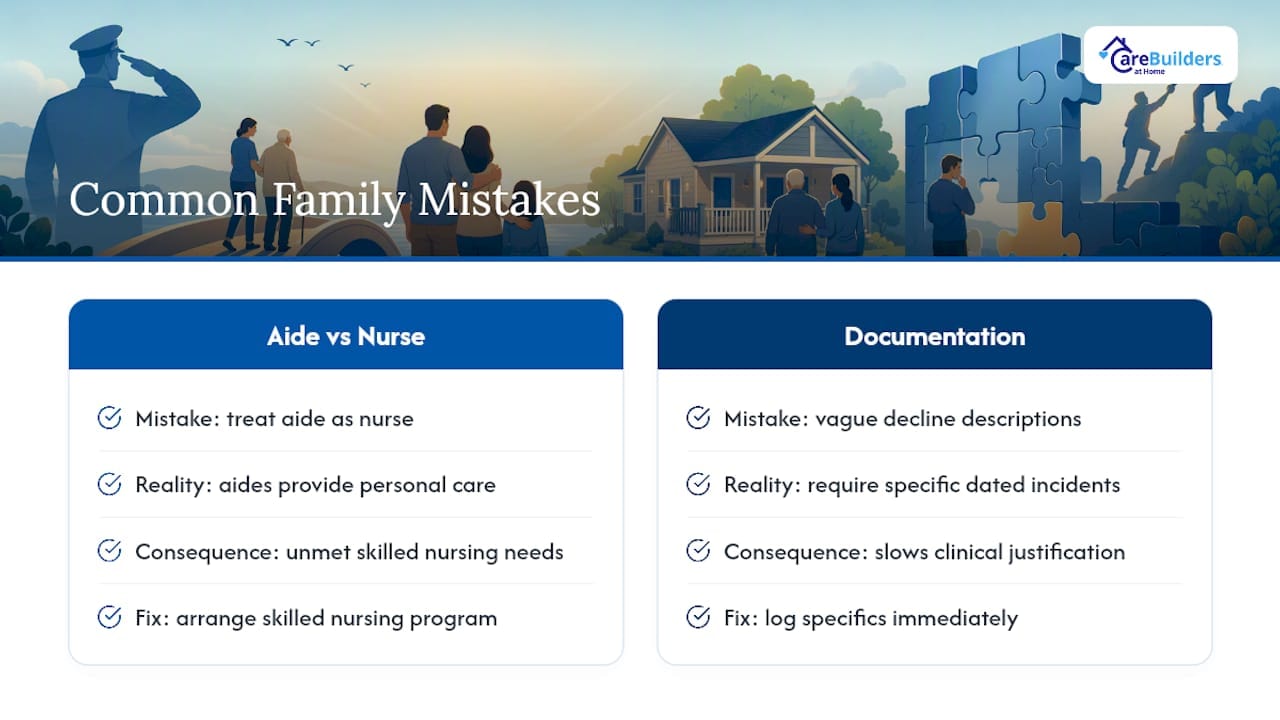
The biggest misconception we see is treating a home health aide as a nurse. Aides handle personal care, bathing, dressing, meal prep, but they are supervised by a registered nurse rather than delivering nursing care themselves. Skilled nursing needs, wound care, medication management, injections, require a different program entirely.
The second problem is documentation. Families often describe a loved one’s decline in general terms (“she’s just not herself anymore”) instead of specific, dated incidents. Vague records slow down clinical justification. The fix is simple: log specifics as they happen, not from memory weeks later.
— cbahplano
How CareBuilders at Home Helps You Navigate VA Benefits
Figuring out VA eligibility while also managing a loved one’s daily care is a lot to carry at once. CareBuilders at Home is a VA-approved provider offering assistance to families in the region to understand applicable VA programs while providing day-to-day support for veterans.
If you’re waiting on a VA assessment or just found out your loved one qualifies, our Veterans Care Services team can walk you through what happens next, including how our personal care services work alongside VA benefits. Reach out for a consultation and let us help you sort out the next step instead of guessing at it.
Where to Verify VA Home Care Rules
For eligibility rules and clinical indicators, review VHA Notice 2024-01. For enrollment and forms, start at the official VA website. If you’re documenting sleep-related caregiving concerns, this resource on sleep support may help.
This article is general information, not a substitute for advice from a qualified doctor. Consult a qualified healthcare professional about your own circumstances before acting on anything here.
Sources
- VHA Notice 2024-01, Purchased Home and Community Based Services
- Policy brief: Home and Community Based Services (VA research)
FAQ
Does a Service-Connected Disability Guarantee VA Home Care?
No. A service-connected rating can affect copay amounts, but eligibility depends on VA health care enrollment plus a documented clinical need, such as help with two or more activities of daily living, per VHA policy.
What’s the Difference Between VA Home Care and Aid & Attendance?
VA home care programs like Homemaker & Home Health Aide are services scheduled through your local VA medical center. Aid & Attendance is a separate pension benefit that pays money toward care and follows its own wartime service and income rules.
How Long Does VA Home Care Approval Take?
Timelines vary by facility and by how quickly clinical documentation comes together. Bringing complete records, including a Veteran Decision Aid and specific examples of daily struggles, to your first meeting with a VA social worker tends to speed the process.
Can a Spouse Get VA-Funded Home Care Support?
VA spousal home care support typically comes through helping the veteran access services, or through separate caregiver support programs rather than direct home care for the spouse. A VA social worker can clarify what applies to your household’s specific situation.
Does CareBuilders at Home Work With VA Benefits?
Yes. CareBuilders at Home of Plano & Allen is a VA-approved provider that helps veterans and families in Collin County navigate benefit paperwork alongside arranging in-home care. Current service details are available on the Veterans Care Services page.