


Caregivers: Room by Room Home Safety for Seniors and When to Call an OT
Start by removing trip hazards, securing rugs and cords, installing grab bars and better lighting, confirming that smoke and carbon monoxide alarms work, locking up medications, and setting the water heater to 120°F or below. If mobility or memory has started to slip, add one more step: arrange an occupational therapy home safety assessment or bring in an in-home caregiver before a fall or a missed dose turns into a crisis.
Table of Contents
- Room-by-room home safety checklist for every part of the house
- Why falls happen and how to lower the risk
- Fire and carbon monoxide safety built for aging in place
- Medication storage, poisoning prevention, and burn safety
- Home modifications, assistive technology, and funding help
- Getting a professional home safety assessment
- Hydration and nutrition safety at home
- Using walkers, canes, and wheelchairs safely indoors
- What home safety misses without the right support
- How CareBuilders at Home supports a safer home
- FAQ
- Sources
Room-by-room home safety checklist for every part of the house
Walking through each room with fresh eyes helps you catch hazards that feel invisible after years of living with them. Think of it as a slow lap through the house, checking floors, lighting, and reach before checking anything else.
- Entry and stairs: Add sturdy handrails on both sides, use non-slip treads, and consider a ramp or no-step entry if knees or balance are a concern.
- Living areas: Clear walking paths of furniture and cords, tape down or remove loose rugs, and add lamps so no room depends on a single overhead light.
- Kitchen: Move everyday dishes and food to waist-to-shoulder height, install an auto shutoff or timer on the stove if forgetfulness is a factor, and keep a working fire extinguisher nearby.
- Bathroom: Install grab bars near the toilet and inside the shower, add a non-slip mat, and consider a shower seat or transfer bench along with a raised toilet seat.
- Bedroom: Keep a night-light burning, place the phone, glasses, and keys within arm’s reach of the bed, and adjust the bed height so feet touch the floor easily when sitting up.
- Outdoors: Repair cracked walkways, keep steps even and well lit with motion-activated fixtures, and clear leaves, ice, or debris promptly.
None of these fixes require a contractor. Most take an afternoon and a trip to a hardware store, and together they remove the hazards that cause the most harm.
Why falls happen and how to lower the risk
More than a quarter of older adults report falling every year, and the CDC’s STEADI program points to home hazards, weak muscles, poor vision, and certain medications as the usual culprits. The good news is that each of those risk factors responds to a specific, fixable action.
- Fix the home first: Add brighter lighting, secure handrails, and declutter walkways since these changes carry the biggest return for the least effort.
- Build strength and balance: Programs like Tai Chi have become a go-to recommendation in fall-prevention guidance because they train the reflexes that stop a stumble from becoming a fall.
- Check vision yearly: An outdated prescription changes how stairs and curbs look underfoot.
- Review medications with a pharmacist: Sedatives, blood pressure drugs, and certain combinations can affect balance in ways a family member might not expect.
Pro Tip: If you’ve noticed unsteadiness, a near-fall, or new hesitation on stairs, ask a doctor for a fall-risk screen rather than waiting for an actual fall to prompt the conversation.
Fire and carbon monoxide safety built for aging in place
Older adults face a higher risk of dying in a home fire than younger adults, which makes alarm placement and escape planning worth getting right the first time.
A significant portion of older adults fall every year, and fire deaths follow a similar pattern of disproportionate risk, according to the U.S. Fire Administration’s Fire Safe Seniors guidance. That guidance recommends alarms on every level of the home and just outside each sleeping area, with replacement after 10 years regardless of how well they seem to work.
- Test alarms monthly and swap batteries at least once a year.
- For hearing loss, add low-frequency alarms, strobe lights, or bed shakers rather than relying on a standard alarm tone alone.
- Keep stovetops attended, avoid loose sleeves while cooking, and never allow smoking near an oxygen tank.
- Map two exits from every room and walk through the escape plan twice a year so it becomes automatic.
Medication storage, poisoning prevention, and burn safety
A missed pill or an accidental swallow is rarely dramatic in the moment, which is exactly why it’s easy to overlook until it becomes an emergency.
- Lock medications and hazardous cleaning products, especially where memory loss is part of the picture.
- Post the Poison Control number, 1-800-222-1222, near every phone in the house, a step the National Institute on Aging recommends for households supporting someone with Alzheimer’s or related dementia.
- Set the water heater to 120°F or lower to prevent scald injuries, which the same NIA guidance lists alongside medication security as a core safety step.
- Use a weekly pill organizer or an automatic dispenser, or arrange supervised administration if dosing has become confusing.
- Secure or remove items that pose outsized risk for someone with cognitive decline, including matches, power tools, and firearms.
Home modifications, assistive technology, and funding help
Not every fix needs to be expensive. A grab bar costs little and prevents a specific fall; a wheelchair ramp costs more but opens the whole house to someone who can no longer manage steps. Prioritize based on what the person actually struggles with today, not what might become a problem years from now.
- Minor modifications: Grab bars, raised toilet seats, and brighter bulbs address immediate hazards cheaply.
- Major modifications: Ramps, walk-in showers, and widened doorways support long-term independence for someone using a walker or wheelchair.
- Assistive technology: Fall detectors, remote monitoring sensors, and voice-activated lighting or thermostats reduce the need for constant in-person supervision.
- Community support: Programs highlighted in the Administration for Community Living’s home modification action guide, including Rebuilding Together and HARP, pair volunteers or subsidized contractors with low-income and rural households to cover repairs and accessibility upgrades.
Start with a written list of hazards, then call a local Area Agency on Aging or a nonprofit builder to ask what’s available before assuming a project is out of reach financially.
Getting a professional home safety assessment
An occupational therapist brings a trained eye to hazards families often stop noticing, from a rug worn thin by years of foot traffic to a recliner that’s become too low to rise from safely. The assessment usually covers mobility, daily activities like bathing and dressing, and cognitive safety concerns, ending in a written, personalized plan.
- Ask the primary care physician for an OT referral, and mention any recent falls or near-falls directly.
- Request a pharmacist medication review at the same visit if multiple prescriptions are involved.
- Ask whether a physical therapist should also be involved for strength or gait training.
- Check Medicare, Medicare Advantage, or VA benefits for coverage details and any prior authorization steps, since combining Medicare with home care services often requires a bit of coordination between providers.
- Compare the OT’s suggested repairs against nonprofit modification programs before hiring a contractor for anything beyond small fixes.
Hydration and nutrition safety at home
Dehydration sneaks up on older adults faster than most families expect, partly because the sense of thirst dulls with age and partly because some medications increase fluid loss. A senior who seems unusually tired, confused, or dizzy may be dehydrated rather than simply having an off day, and dehydration itself raises fall risk by affecting balance and alertness.
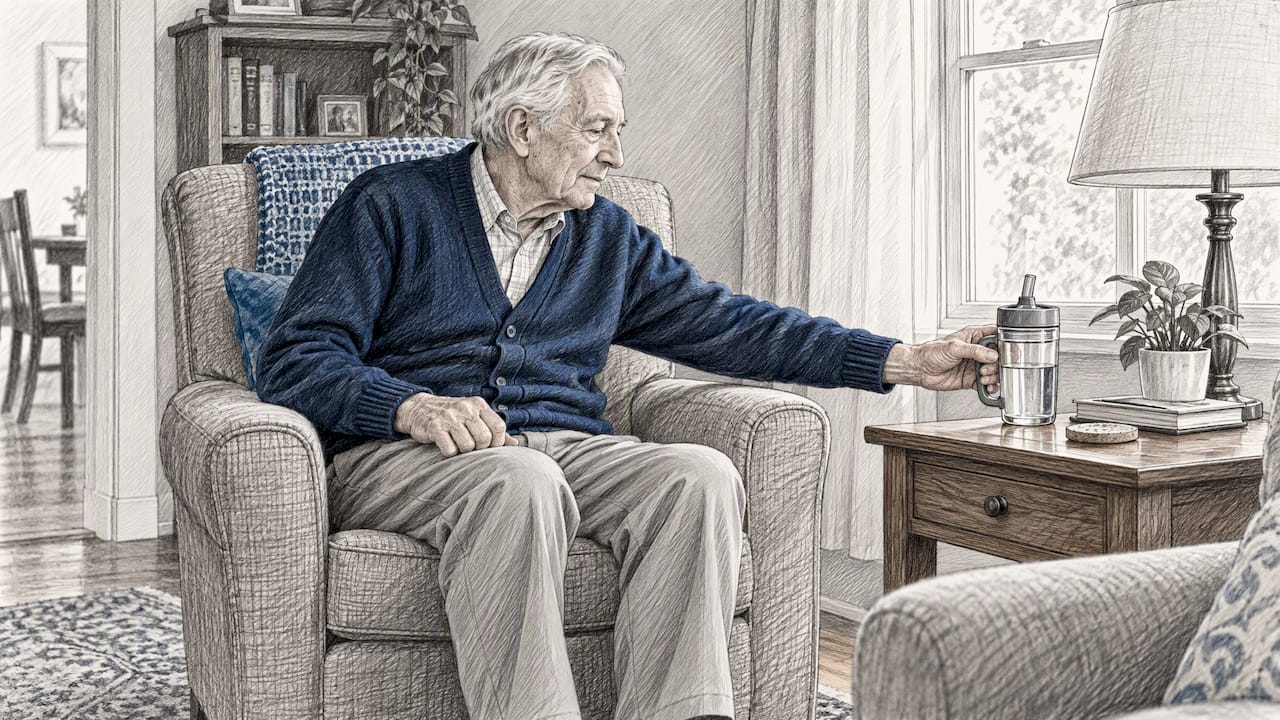
Keep water visible and within easy reach in every room where the person spends time, not just the kitchen. A refillable cup on a side table gets used far more often than one left in a cabinet. Watch for reduced appetite, which can signal anything from medication side effects to depression to difficulty chewing or swallowing, and loop in a physician if meals have noticeably shrunk.
In the kitchen, check expiration dates regularly since cognitive changes can make it harder to track food freshness, and label leftovers with dates to prevent accidental spoilage from going unnoticed. Soft, easy-to-chew options reduce choking risk for anyone with dental issues or swallowing difficulty. A simple daily or weekly meal plan posted on the refrigerator also helps someone with early memory loss make consistent, safer food choices without needing constant reminders.
Using walkers, canes, and wheelchairs safely indoors
A mobility device only helps if the home is arranged to work with it. A walker that catches on a thick rug or a wheelchair that can’t turn in a narrow hallway creates new hazards instead of solving old ones.
Clear a path at least 36 inches wide through main walkways, and remove any furniture that narrows a doorway or hallway. Rubber tips on canes and walkers should be checked regularly for wear since a worn tip loses grip exactly when it’s needed most. For wheelchair users, check that thresholds between rooms are flush or have a small ramp, since even a half-inch lip can cause a tip.
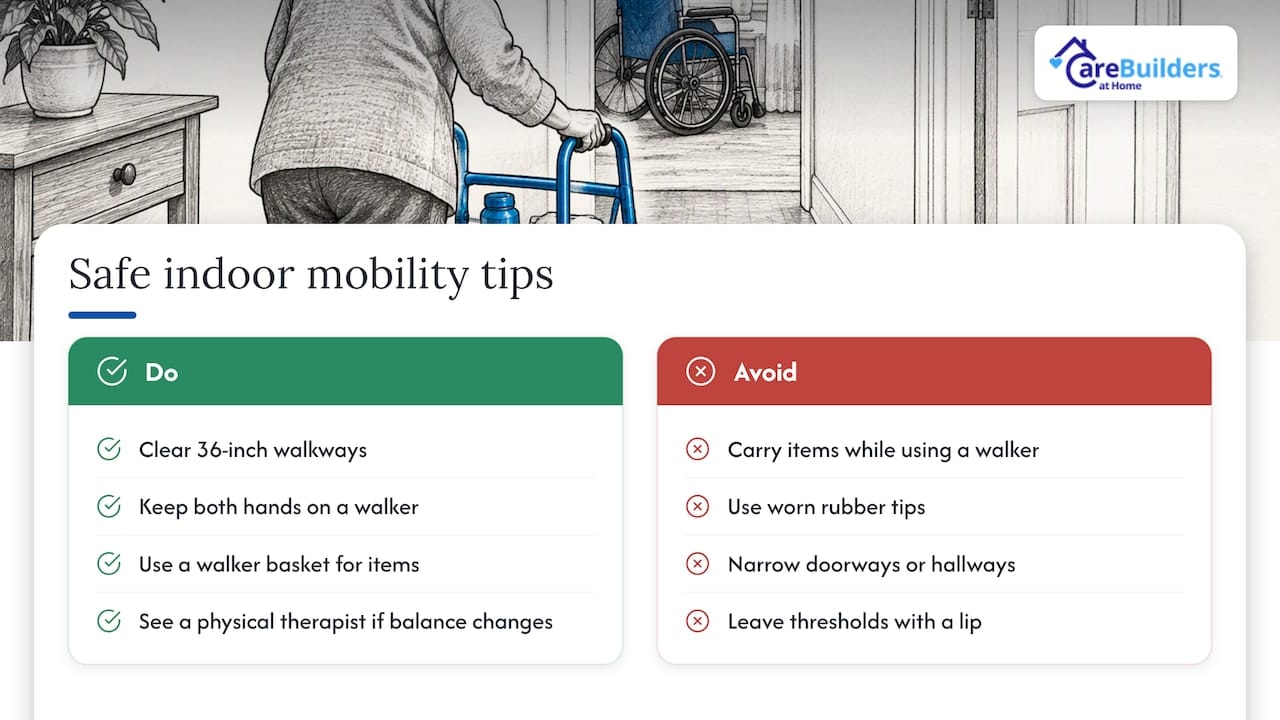
Encourage the person to keep both hands on a walker rather than carrying items, and consider a walker basket or bag for carrying small objects like a phone or glasses. Canes should be sized so the handle sits at wrist height when the arm hangs naturally, since an improperly sized cane does little to prevent a stumble. If balance issues are new or worsening, a physical therapist can confirm whether the current device still matches the person’s needs or whether it’s time to step up to something sturdier.
What home safety misses without the right support
A checklist fixes the house, but it doesn’t answer who notices when something changes. Grab bars don’t call for help after a fall, and a locked medicine cabinet doesn’t remind anyone to take the dose inside it. That’s the gap most families underestimate: home safety and daily supervision are two different jobs, and most people only plan for the first one.
At CareBuilders at Home, we see this gap close when a trained caregiver is part of the plan, offering medication reminders, overnight supervision, and support that adapts as needs change, often paired with virtual monitoring and fall detection for an extra layer of awareness between visits.
— cbahplano
How CareBuilders at Home supports a safer home
A safer house is the foundation, but ongoing support is what keeps it that way day to day. Personal Care Services bring trained caregivers into the home for bathing, mobility assistance, and medication reminders, while Specialized Dementia Care adds behavior-focused supervision for families managing memory loss. The Virtual Caregiver Platform & Wellness Program and 24/7 Medical Alert Monitoring extend that awareness around the clock, and veterans can ask about Veterans Care Services for help navigating VA benefits alongside care. If you’d rather start with information, request the free home care navigation guide or call to set up a consultation and talk through what your family actually needs first.
FAQ
How can I make my house safer for the elderly?
Start with the highest-impact, lowest-cost fixes: remove trip hazards, add grab bars and brighter lighting, confirm smoke and carbon monoxide alarms work, and secure medications. From there, a room-by-room walk-through and an occupational therapy assessment catch anything specific to that person’s mobility or memory.
Does Medicare cover a home safety evaluation?
Coverage depends on the specific plan and the medical necessity documented by a physician, so it’s worth asking directly about combining Medicare coverage with home care services before assuming an evaluation is or isn’t included. An occupational therapy referral from a primary care doctor is usually the first step toward getting coverage questions answered.
What are the needs of the elderly at home?
Common needs include fall prevention, fire and poisoning safety, medication management, reliable hydration and nutrition, mobility support, and a way to get help quickly in an emergency. Cognitive safety measures, like secured hazardous items and clear routines, become additional needs for anyone experiencing memory decline.
What is the most requested support service for older adults?
Families most often start by looking for in-home personal care and supervision, since it addresses daily safety needs that a home modification alone can’t cover. Services like personal care and medication reminders tend to be the first call once a family realizes checklist fixes aren’t enough on their own.
How do I know if a senior needs a professional safety assessment?
Recent falls, near-falls, new confusion, or difficulty managing medications are strong signs it’s time to ask a physician for an occupational therapy referral. An OT assessment looks at mobility, daily activities, and cognitive safety together, producing a specific plan rather than a generic checklist.
Sources
- Preventing falls | CDC STEADI patient resources
- Home safety and Alzheimer’s disease | National Institute on Aging
- Fire Safe Seniors implementation guide | U.S. Fire Administration (USFA)
- Action guide: Partnering to expand access to home modifications, repairs, and weatherization