


Get Homemaker Services for U.S. Seniors in Days: IHSS, VA & What They Cover
Homemaker services are non-medical in-home supports, light housekeeping, meal prep, errands, and companionship, that help a senior stay safely and comfortably at home. If a parent or spouse is struggling with everyday tasks but doesn’t need medical care, the next step is simple: call a licensed home care agency or your local Area Agency on Aging for a free needs assessment.
Table of Contents
- What Do Homemaker Services for Seniors Actually Include?
- Who Pays for Homemaker Services, and What Does Medicare Cover?
- How Do You Choose a Reliable Homemaker Provider?
- What Does the Research Say About Homemaker Services?
- What Happens After You Decide to Hire Help?
- A Publisher’s Note on Knowing When Homemaker Help Is Enough
- How CareBuilders at Home of Plano & Allen Can Help
- Where to Go Next for Official Programs and Research
- Sources
- FAQ
What Do Homemaker Services for Seniors Actually Include?
Homemaker services cover what caregivers often call IADLs, instrumental activities of daily living. These are the practical tasks that keep a household running: cooking, cleaning, laundry, transportation, and light organization. They’re different from personal care, which covers ADLs, activities of daily living like bathing, dressing, and toileting. A senior might need only homemaker support for years before personal care becomes necessary, or need both at once.
Most agencies build a schedule around what the household actually needs, not a fixed package. A senior who lives alone but drives fine might need three two-hour visits a week for cleaning and meal prep. Someone recovering from a hospital stay might need daily visits, or even live-in support, for a few weeks.
Typical tasks include:
- Light housekeeping: vacuuming, dishes, laundry, and tidying common areas
- Meal prep for seniors: planning, cooking, and storing meals that meet dietary needs
- Errands for seniors: grocery shopping, pharmacy pickups, and post office runs
- Transportation to medical appointments or social activities
- Medication reminders (not administration, which falls under personal care)
- Companionship: conversation, shared activities, and simple check-ins that reduce isolation
Companion services and homemaking often overlap in practice. A single caregiver visit might include folding laundry and playing cards, which is part of why families researching companion services find the line between “chore help” and “friendly visit” gets blurry fast. That’s by design. The tasks matter, but so does who’s doing them.
Who Pays for Homemaker Services, and What Does Medicare Cover?
Most families pay privately for homemaker services, and hourly rates vary by region, provider, and the number of hours booked per week. Before assuming private pay is the only route, it’s worth checking three other doors first.
Medicare’s coverage is narrow. Medicare generally does not pay for standalone homemaker or housekeeping help. It covers home health services, like skilled nursing or physical therapy, only when a doctor certifies they’re medically necessary, and even then, homemaker tasks are usually bundled in as incidental, not the primary service. Families searching “does Medicare cover homemaker services for seniors” are often disappointed to learn the answer is no for pure chore assistance.
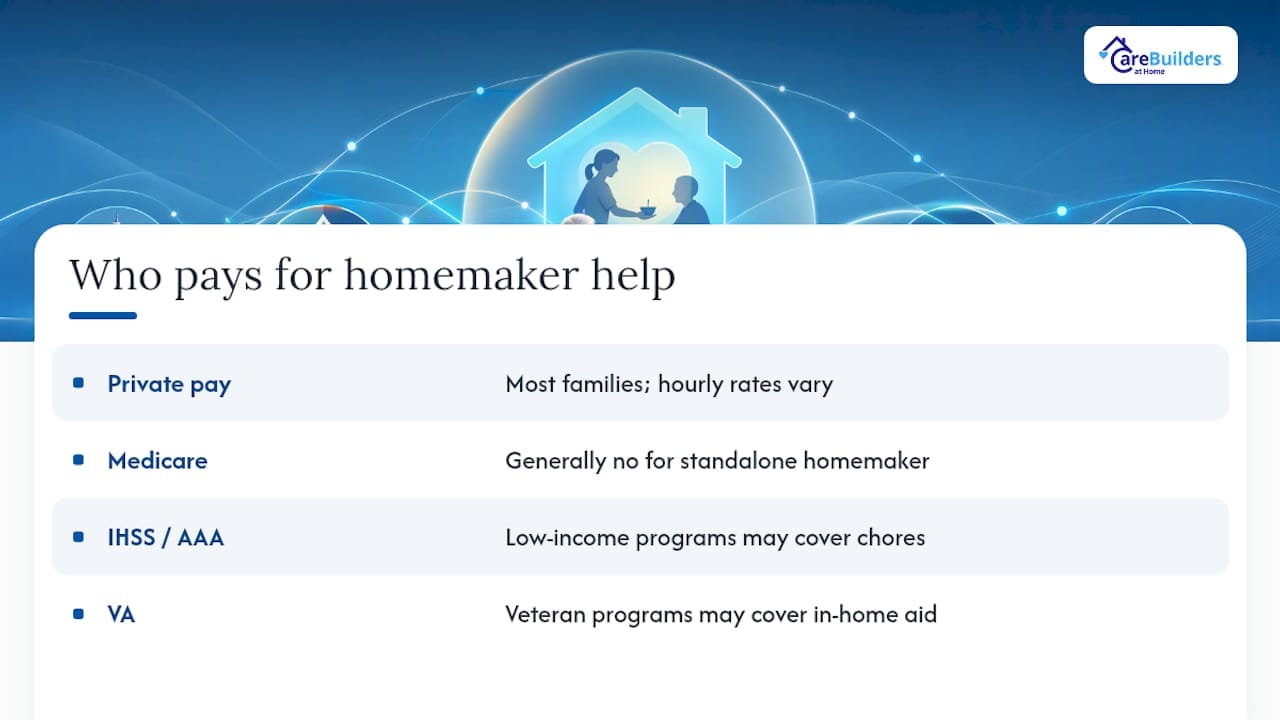
IHSS and your local Area Agency on Aging are the real starting points for lower-income households. California’s In-Home Supportive Services program provides in-home assistance to eligible aged, blind, and disabled residents, and it’s often the first call a Santa Clara County family should make. Illinois runs a comparable model through its own aging network, where community homemaker programs cover cleaning, meal planning, laundry, and errands, sometimes allowing a qualified family member to serve as the paid aide.
Veterans have an additional path. VA programs, including veteran-directed care options, can help cover in-home support, and VA-approved providers can walk families through the application and eligibility maze rather than leaving them to figure it out alone.
A practical budgeting approach many families use: blend private-pay hours for flexibility with IHSS or VA-covered hours for baseline coverage, rather than relying on one funding source alone.
How Do You Choose a Reliable Homemaker Provider?
Every provider will tell you they’re trustworthy. Your job is to verify it, not take their word for it.
- Confirm background checks and supervision. Ask to see the agency’s written background-check policy. Reputable programs run criminal background checks on every caregiver and maintain a clear supervisory chain, because these roles involve unsupervised access to someone’s home and belongings.
- Check training and certifications. Ask what training caregivers complete before their first visit, and whether there’s specialized training for conditions like dementia.
- Ask about backup coverage. What happens if your regular caregiver is sick? A provider without a backup system will leave you scrambling on short notice.
- Review the cancellation and scheduling policy in writing. Verbal promises about flexibility mean nothing if the contract says otherwise.
- Ask how visits get documented. Reliable agencies keep visit notes and share updates with family, not just verbal recaps.
- Request references. A provider confident in their caregivers will connect you with existing client families.
Red flags to walk away from: vague answers about who supervises caregivers, no willingness to share a written background-check policy, unclear or shifting billing practices, and high caregiver turnover that nobody wants to discuss directly.
Trust signals worth seeking out: a written, individualized care plan; a caregiver-matching process instead of “whoever’s available”; VA approval if the client is a veteran; and monitoring technology, like fall detection, layered on top of in-person visits.
Pro Tip: Ask a provider how they’d handle a caregiver calling in sick on a Friday afternoon. The answer tells you more about their operation than any brochure will.
What Does the Research Say About Homemaker Services?
The strongest evidence points in one clear direction: homemaker services work best as part of a bigger package, not as a standalone fix. A synthesis of systematic reviews from the McMasterForum found that multi-component interventions, homemaking paired with case management, falls prevention, and assistive technology, outperform single-component services. Evidence on harder outcomes like mortality and hospital readmission stays mixed, which is an honest limitation worth knowing before anyone oversells what homemaking alone can do.
Where the evidence is more consistent is quality of life. Research summarized by MDPI links homemaker services to:
- Reduced fall risk through a cleaner, better-organized home environment
- Improved nutrition from consistent, planned meals
- Lower social isolation through regular companionship
A small exploratory study on perceived well-being found that seniors receiving homemaking visits reported real gains in emotional well-being, with participants specifically citing the social contact as valuable, not just the chores getting done. The practical takeaway: pairing homemaker support with a falls-prevention plan and, where possible, monitoring technology gets you closer to the outcomes families actually want, rather than treating a clean kitchen as the finish line.
What Happens After You Decide to Hire Help?
Once a family decides to move forward, the process usually follows a predictable arc, and knowing it in advance keeps expectations realistic.
- Initial intake call. An agency representative asks about the senior’s daily routine, current challenges, and family goals. This usually happens within a day or two of first contact.
- In-home assessment. A coordinator visits to evaluate home safety, IADL and ADL needs, and specific goals, whether that’s more social contact, meal consistency, or simply lightening a family caregiver’s load.
- Care plan development. A written plan outlines tasks, frequency, and goals. Good agencies revisit this every few months, or sooner if health status changes.
- Caregiver matching. The agency pairs a caregiver based on personality fit and skill needs, with a backup caregiver identified in case of illness or scheduling conflicts.
- Ongoing monitoring. Visit notes, family check-ins, and, in some cases, virtual monitoring tools track how things are going over time.
Most families can expect the full path from first phone call to a caregiver’s first visit to take a few days to a couple of weeks, depending on availability and urgency. For a closer look at what to prepare before that first assessment, these essential steps walk through what agencies typically ask for.
A Publisher’s Note on Knowing When Homemaker Help Is Enough
We’ve spent years helping families sort out exactly this question, and the honest answer is: homemaker services are enough when the need is practical, cleaning, meals, errands, company. Once medication management, wound care, or mobility risks enter the picture, it’s time to talk with a home health provider or your doctor. A good care plan bends as needs change instead of locking a family into the wrong level of support.
— cbahplano
How CareBuilders at Home of Plano & Allen Can Help
Managed, monitored options exist for families who want more than a rotating cast of unfamiliar helpers. Our companion and homemaker services pair trained caregivers with a written care plan and a matching process, so the person showing up at the door is someone your family actually knows and trusts. Caregivers may receive dementia-specific training for households navigating memory changes; some providers assist veteran families with navigating benefits. Families who want an added layer of reassurance can add virtual monitoring and 24/7 alerting on top of in-person visits. Free consultations may assist families considering homemaker help alongside other funding options. Reach out to get started.
Where to Go Next for Official Programs and Research
- Eldercare Locator: the national hub for finding your local Area Agency on Aging
- IHSS Program: California’s in-home support program for eligible seniors
- City of San Jose senior services: local referral point for Santa Clara County residents
- MDPI homemaker services study: research behind the well-being and fall-risk claims in this guide
- McMasterForum synthesis: the systematic-review evidence on multi-component care
Sources
- Using non-medical home services to support older adults — McMasterForum
- In-Home Supportive Services (IHSS) Program — California Department of Social Services
- In-home service / Homemaker — Illinois Department on Aging
FAQ
Does Medicare Cover Homemaker Services for Seniors?
No. Medicare generally does not pay for standalone homemaker or housekeeping help; it only covers home health tasks when a doctor certifies them as medically necessary, and homemaking is bundled in as incidental at most.
How Much Does IHSS Pay Family Caregivers Per Month?
IHSS payment amounts depend on the recipient’s approved hours and California’s program rate, which varies by county; contact the IHSS program directly for current figures in Santa Clara County.
How Much Does Medicare Pay for Home Care Per Hour?
Medicare doesn’t pay an hourly rate for non-medical home care since it isn’t a covered benefit; it only reimburses skilled home health services under specific medical criteria, billed under its own payment structure rather than a flat hourly fee.
What’s the Difference Between Homemaker and Personal Care Services?
Homemaker services cover IADLs like cleaning, meals, and errands, while personal care covers ADLs like bathing, dressing, and mobility assistance.
How Do I Find Affordable Homemaker Help Near Me?
Start with your local Area Agency on Aging or the Eldercare Locator, then compare that against private-pay agencies to see which funding mix fits your budget.