


Long-Distance Elderly Parent Care Tips for Adult Children
The most effective long-distance care plan comes down to three moves: assign one family member as the primary point person, build a shared digital hub for documents and schedules, and agree in writing on which events require an in-person visit. You can start all three today.
Three actions to take right now:
- Schedule a family meeting (video call works) to assign roles and decide who pays, who talks to doctors, and who coordinates locally
- Create a shared folder (Google Drive, Dropbox, or a HIPAA-aware platform) for medical records, legal documents, and a running medication list
- Confirm that your parent has signed a health care proxy, HIPAA authorization, and durable power of attorney — before any crisis forces the issue
The National Institute on Aging confirms that long-distance caregivers can coordinate care effectively by assisting with finances, arranging in-home help, creating shared calendars, and using telehealth. Practical frameworks to support families managing this from hundreds of miles away are available through various caregiver support organizations. The hard part is not knowing what to do — it is doing it before a fall or a hospitalization forces your hand.
Key Takeaways
Long-distance care works when one person owns the plan, legal documents are in place before a crisis, and a trusted local team handles what you cannot do from afar.
| Point | Details |
|---|---|
| Assign one lead immediately | Name a single primary point person and share that contact with every provider and caregiver. |
| Build the shared hub first | Create a secure folder with legal, medical, and financial documents before any health event forces the issue. |
| Vet local help carefully | Check licenses, references, background, and dementia training before any caregiver enters your parent’s home. |
| Define travel trigger points | Write down which events require an in-person visit so travel decisions are planned, not reactive. |
| CareBuilders at Home of Plano & Allen | A VA-approved local provider in Collin County offering in-home care plus virtual monitoring that integrates with your family’s shared digital plan. |
Table of Contents
- What are the best long-distance elderly parent care tips for organizing your family?
- How do you stay connected and informed without micromanaging from afar?
- What documents do you need to collect before a health crisis hits?
- How do you find and vet local caregivers and care managers?
- What home safety changes make the biggest difference right away?
- How do you manage costs and identify financial support?
- How do you make the most of a short visit and prepare for emergencies?
- How do you protect the local caregiver and yourself from burnout?
- What does a shared digital ecosystem actually look like in practice?
- What local providers wish long-distance families would do first
- CareBuilders at Home of Plano & Allen supports families managing care from a distance
- Sources
What are the best long-distance elderly parent care tips for organizing your family?
Clear role assignments prevent the two most common breakdowns in remote caregiving: nobody acts because everyone assumes someone else will, and siblings argue over money because no one documented who agreed to what. A systematic review published in PMC/NIH found that long-distance caregivers provide substantial financial and care coordination support yet report elevated stress and information gaps tied directly to geographic separation. Written role assignments close that gap faster than any app.
A one-page family meeting agenda
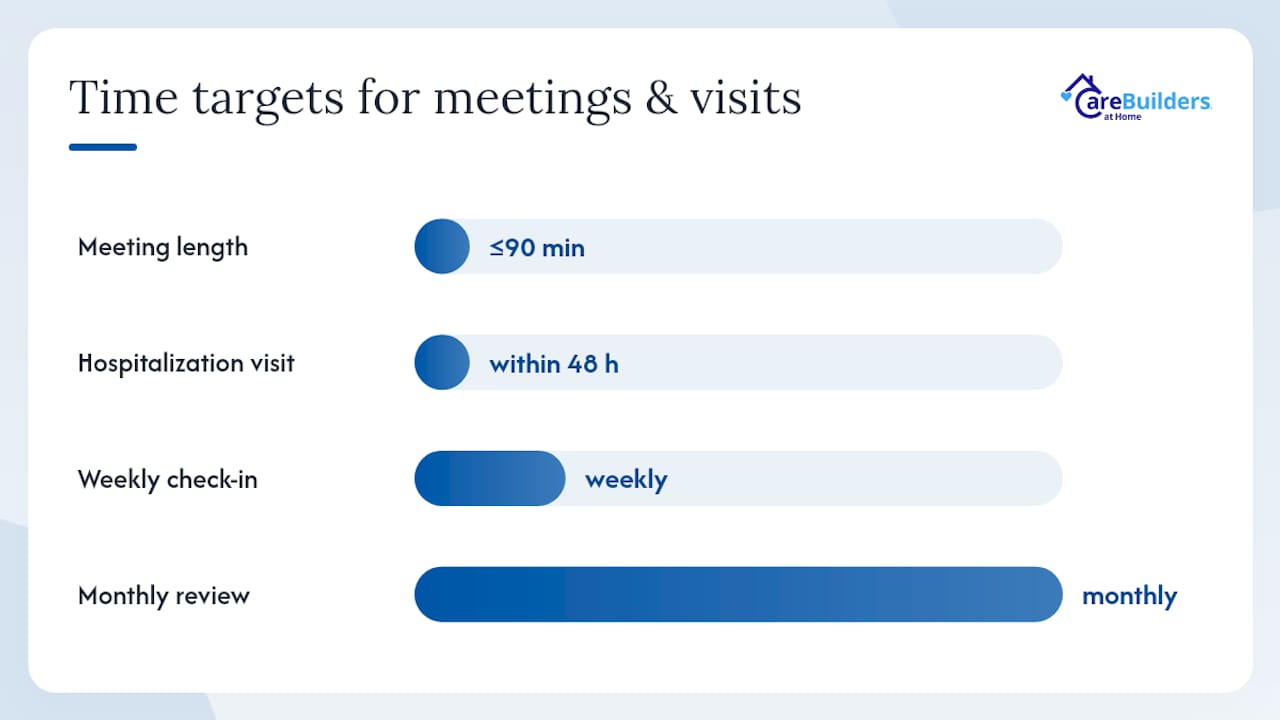
Run this meeting by video call. Keep it under 90 minutes and record it or take shared notes.
- Roles to assign: primary point person (single contact for all providers), finance lead (pays bills, tracks expenses), medical communicator (attends or dials into appointments), local liaison (lives closest, handles day-to-day), and a named backup for each role
- Payment responsibility: decide who pays what and document it in the shared hub — even if one sibling contributes more time and another more money, write it down
- Communication rhythm: agree on a weekly check-in call and a monthly review of the care plan
- Document ownership: name one person to keep the shared folder current and set a monthly reminder to update it.
Expert guidance from the Institute for Family Studies recommends defining travel trigger points in advance — deciding which events require in-person presence versus what can be handled remotely. This single step reduces reactive, expensive travel and prevents the guilt-driven scramble that exhausts remote caregivers.
Pro Tip: Write your trigger points into the shared document. Examples: “Any hospitalization requires a visit within 48 hours. A single fall with no injury = phone assessment. Two falls in one month = in-person visit.” Specific language prevents arguments later.
How do you stay connected and informed without micromanaging from afar?
Reliable communication is less about frequency and more about structure. A predictable rhythm lets your parent feel supported without feeling surveilled, and it lets you spot changes in health or mood without needing to call three times a day.
Tool categories worth setting up
- Shared calendar: Google Calendar or Apple Calendar for medical appointments, medication refills, and caregiver schedules
- Secure document vault: a HIPAA-aware platform or an encrypted cloud folder for medical records and legal documents
- Messaging with attachments: a group thread (iMessage, WhatsApp, or a family app like Carely) for photos, updates, and quick questions
- Telehealth access: confirm your parent’s primary care provider offers video visits and that you are listed as an authorized participant
- Medication reminders: a pill organizer with a built-in alarm, or an app like Medisafe, to reduce missed doses
- Virtual monitoring and alerts: passive sensor systems or a virtual caregiver platform that sends alerts to family members without requiring the parent to push a button
Sample weekly communication schedule
Surveys cited by USA Today find that long-distance caregivers report higher emotional distress than local caregivers, and that technology can meaningfully reduce both logistical and emotional strain. Researcher Francesca Falzarano of USC notes that long-distance caregivers are often overlooked by the healthcare system, making proactive planning and supportive technology especially critical for this group.
A note on privacy and consent: Before adding anyone to a telehealth visit, your parent must sign a HIPAA authorization naming you as an authorized recipient of their health information. Without it, providers are legally barred from speaking with you directly.
What documents do you need to collect before a health crisis hits?
Getting legal authority after a crisis is far harder than getting it before one. Guidance from Helping Elders is direct: secure a health care proxy, HIPAA authorization, and durable financial power of attorney now, not when your parent is in the ICU and a hospital administrator is asking for paperwork you do not have.
Essential document checklist
- Advance directive (living will)
- Health care proxy (medical power of attorney)
- HIPAA authorization naming family contacts
- Durable financial power of attorney
- Insurance cards (Medicare, Medicaid, supplemental, dental, vision)
- Current medication list (see format below)
- Primary care physician and specialist contact list
- Recent lab results and imaging reports
- Long-term care insurance policy, if applicable
Medication list format to copy
- Drug name (brand and generic)
- Dose (e.g., 10 mg)
- Frequency (e.g., once daily with food)
- Prescribing doctor and their phone number
- Pharmacy name, address, and phone
- Reason for the medication (one phrase)
- Known allergies or interactions
Store one copy in the shared digital vault and one in a labeled physical binder kept in a consistent location at your parent’s home. Give the local caregiver and the local liaison the physical binder’s location. Review and update the medication list at every doctor visit.
How do you find and vet local caregivers and care managers?
Hiring local help is the single highest-leverage move a remote caregiver can make. A trusted person on the ground changes everything: you get real-time information, your parent gets consistent support, and you stop making decisions based on incomplete phone calls.
Vetting checklist for agencies and solo caregivers
- Verify state licensure (home health aide or personal care aide certification, depending on your state)
- Confirm background check and criminal history screening
- Ask for three professional references and call all three
- Verify liability insurance and bonding
- Confirm dementia or Alzheimer’s training if your parent has a diagnosis — ask for the specific training program name
- Ask about caregiver-to-client ratios and backup coverage when the primary caregiver is sick
Key interview questions to ask
- How do you document and report changes in a client’s condition?
- Who do I contact if there is an incident after hours?
- What is your protocol if a client refuses care?
- How do you handle medication reminders (noting that non-medical aides do not administer medications)?
- Can you provide weekly written updates to a remote family member?
When to bring in a geriatric care manager: A geriatric care manager (also called an aging life care professional) is a licensed social worker or nurse who assesses your parent’s needs, coordinates providers, and serves as your eyes and ears locally. They are worth the cost when care needs are complex, when family conflict is high, or when you cannot visit frequently. Find one through the Aging Life Care Association.
Caring Village’s complete guide recommends building a local support network and creating a single source of truth for documents and schedules — the local caregiver should have access to both.
Red flags that warrant an immediate on-site check or replacement: unexplained bruises or injuries, missed medications with no explanation, a caregiver who is evasive or unavailable when you call, sudden changes in your parent’s mood or behavior, or reports from neighbors that something seems off.
Pro Tip: Set up a biweekly 10-minute call between the local caregiver and the primary point person. Use a simple template: What went well? What changed? What does the parent need this week? Written notes from these calls go into the shared hub.
What home safety changes make the biggest difference right away?
Falls are the leading cause of injury among older adults in the United States. Most of the highest-impact safety changes cost under $50 and take an afternoon to install.
Basic home safety checklist for your next visit
- Grab bars in the shower and next to the toilet (professionally installed, not suction-cup)
- Non-slip bath mat and non-slip strips on any slippery floor surfaces
- Remove or secure loose rugs throughout the home
- Improve lighting in hallways, stairs, and the bathroom — add nightlights
- Confirm working smoke detectors and carbon monoxide detectors on every floor
- Post emergency contacts (911, primary doctor, local liaison, poison control) on the refrigerator
- Clear pathways of clutter, cords, and furniture that creates obstacles
Low-cost modifications with the highest safety return: a bed rail for easier transitions, a shower chair, a medication organizer with daily compartments, and a key lockbox outside the door so emergency responders can enter without breaking a window.
Monitoring options compared
| Option | What it monitors | Best for |
|---|---|---|
| Daily check-in calls | Mood, cognition, basic needs | Low-cost baseline; works for early-stage needs |
| Medical alert pendant | Fall detection, manual SOS | Active seniors who will wear the device |
| In-home passive sensors | Movement patterns, door activity, sleep | Seniors who resist wearables; detects gradual decline |
| Virtual monitoring platform | Continuous activity, alerts to family and caregivers | Families wanting real-time oversight without cameras |

CareBuilders at Home of Plano & Allen uses in-home monitoring technology that combines passive sensors with 24/7 alert routing to both caregivers and family members — a practical option for families in Plano, Allen, Richardson, Wylie, and surrounding Collin County.
How do you manage costs and identify financial support?
Long-distance caregiving carries real financial weight: travel, in-home care fees, monitoring subscriptions, and often a share of your parent’s living expenses. Getting ahead of the numbers prevents the resentment that builds when costs are invisible or unevenly shared.
Who typically pays: Most families use a combination of the parent’s own savings and income, contributions from adult children, and public benefits. Document every contribution in the shared hub — even informal ones — to prevent disputes.
Rough cost shapes for common services:
- Companion visits and homemaker help: lower cost tier; often a few hours per week
- Private-duty personal care aides: mid-range; cost rises with hours and specialized training (dementia, overnight)
- Monitoring subscriptions and medical alert devices: low to mid-range monthly fees
- Geriatric care manager assessments: higher hourly rate, but often a one-time or periodic cost
Benefits and programs to check immediately:
- VA Aid & Attendance: a pension supplement for veterans and surviving spouses who need help with daily activities — check eligibility through VA benefits resources
- Medicare: covers skilled nursing, home health (after a qualifying hospital stay), and some durable medical equipment — it does not cover ongoing personal care or companion services
- Medicaid: covers long-term care for those who meet income and asset thresholds; eligibility rules vary by state
- Area Agency on Aging: the Eldercare Locator connects families to local services funded under the Older Americans Act, including meal delivery, transportation, and caregiver respite programs
Research published in PMC/NIH confirms that long-distance caregivers provide substantial financial support in addition to care coordination, making a clear cost-sharing agreement among family members especially important.
Watch for financial abuse. Sudden changes in your parent’s bank account, new “friends” who ask for money, or a caregiver who handles cash without receipts are all warning signs. Review bank statements monthly and consider setting up account alerts.
How do you make the most of a short visit and prepare for emergencies?
Every in-person visit should accomplish specific tasks, not just provide comfort. MedlinePlus Magazine recommends planning visits around priorities and also making time for non-care activities — your parent needs you as a family member, not only as a care coordinator.
Visit priority checklist
- Walk through every room and complete the home safety checklist
- Review and update the medication list; check expiration dates and pill counts
- Attend at least one medical appointment in person or dial in remotely
- Confirm all legal documents are current and accessible
- Meet the local caregiver face to face; review the care plan together
- Handle any home maintenance issues the local liaison flagged
- Spend at least one meal or activity with your parent that has nothing to do with care
Emergency escalation plan
Share this with every local helper and post it in the shared hub:
- Step 1: Local liaison calls 911 and stays with your parent
- Step 2: Local liaison calls the primary point person immediately
- Step 3: Primary point person notifies the medical communicator and other family
- Step 4: Medical communicator contacts the primary care physician and relevant specialists
- Step 5: Physical document binder location is shared with emergency responders on arrival
Indicators that warrant an immediate visit or a care-level change: a fall with injury, unexplained weight loss over two to three weeks, two or more missed medication doses in a week, a new confusion or disorientation that is out of character, or a caregiver reporting they cannot manage the current level of need.
How do you protect the local caregiver and yourself from burnout?
The person carrying the most physical weight in a long-distance arrangement is almost always the local caregiver — whether that is a paid aide, a nearby sibling, or a neighbor. Caregiver burnout is not a character flaw; it is a predictable outcome of sustained, unsupported caregiving without adequate rest or recognition.
Signs of burnout in the local caregiver: increasing irritability or withdrawal, missed shifts or late arrivals, declining quality of care notes, physical complaints (exhaustion, illness), or statements like “I can’t keep doing this.”
Signs of burnout in the remote lead: persistent anxiety between check-ins, difficulty concentrating at work, resentment toward siblings who contribute less, and a sense of helplessness that no amount of phone calls resolves. Caregiver isolation compounds this — remote caregivers often feel disconnected from both the care situation and their own support networks.
Delegation and respite template
Assign specific tasks to specific people on a rotating schedule:
- Local liaison: daily check-in, grocery pickup (Monday/Thursday)
- Paid aide: personal care, medication reminders (weekday mornings)
- Backup family member: covers local liaison every third weekend
- Remote lead: weekly video call, monthly care plan review, benefit tracking
Respite options the remote lead can fund or coordinate: adult day services (typically lower cost, structured daytime programming), short-term in-home respite through a local agency, and volunteer visitor programs through the Area Agency on Aging.
Pro Tip: Schedule respite before the local caregiver asks for it. A standing “no-care weekend” once a month, covered by a paid aide or a backup family member, prevents the crisis resignation that leaves your parent without support.
What does a shared digital ecosystem actually look like in practice?
A shared digital ecosystem is not a single app. It is a set of connected tools, each serving a specific function, that any authorized family member or caregiver can access from anywhere.
Secure document vault folder structure
/Legal— advance directive, health care proxy, POA, HIPAA authorization/Medical— current medication list, insurance cards, doctor contacts, recent labs/Financial— benefit documents, insurance policies, account alert setup/Caregiver— care plan, caregiver contact list, incident notes/Emergency— escalation plan, lockbox code, hospital preference
Access: primary point person (full), medical communicator (medical folder), local caregiver (caregiver and emergency folders), finance lead (financial folder).
Calendar and task board categories
- Medical appointments (with telehealth dial-in link)
- Medication refill dates
- Caregiver schedule and shift changes
- Home maintenance tasks
- Family check-in calls
Tool recommendations by function:
- Document vault: Google Drive (encrypted), Dropbox, or a dedicated family caregiving app
- Calendar: Google Calendar or Apple Calendar (shared)
- Messaging: a group thread or a family app with photo sharing
- Medication reminders: Medisafe or a smart pill dispenser
- Monitoring and alerts: Sensi.AI-enabled monitoring or a virtual caregiver platform
CareBuilders at Home of Plano & Allen integrates directly into this kind of ecosystem. Their caregivers document visits and observations in a format the remote lead can review, and their virtual caregiver platform routes alerts to family members in real time. For families in Collin County, this means a local human presence plus digital oversight — without requiring the remote lead to build the monitoring infrastructure from scratch.
Pro Tip: Give providers limited, auditable access rather than blanket permissions. A caregiver needs the care plan and emergency contacts — not the financial folder. Review access permissions every six months.
What local providers wish long-distance families would do first
The single most common gap we see in long-distance caregiving arrangements is not the technology or the care plan. It is the absence of one named contact. When a family has five people involved and no designated lead, every provider call becomes a negotiation. Medications get missed because three people thought someone else called the pharmacy. A fall goes unreported for two days because no one was sure who to tell.
The one request that changes everything: name a single point of contact and share that name with every provider, every caregiver, and every neighbor involved in your parent’s care. That person does not have to do everything. They just have to be the one who knows everything and routes it correctly. When that structure is in place, the rest of the plan — the documents, the monitoring, the visits — actually works.
CareBuilders at Home of Plano & Allen supports families managing care from a distance
Coordinating care from another city is genuinely hard, and the families who do it best are the ones with a trusted local partner handling the day-to-day. CareBuilders at Home of Plano & Allen provides personal care, companion care, overnight care, dementia-specialized support, and 24/7 virtual monitoring for seniors and veterans in Plano, Allen, Richardson, Wylie, and surrounding Collin County. Caregivers document every visit, and the virtual monitoring platform sends real-time alerts to family members — so you stay informed without needing to call constantly.
For veterans, CareBuilders at Home of Plano & Allen is a VA-approved provider, which means eligible families can use VA Aid & Attendance benefits to offset care costs. If you are not sure whether your parent qualifies, a quick consultation can clarify that.
The next step is straightforward: arrange in-home care with a local team that becomes part of your shared digital ecosystem from day one.
Sources
These organizations offer free, authoritative resources you can use right now — worksheets, legal checklists, local service finders, and caregiver support guides.
- What Is Long-Distance Caregiving? | National Institute on Aging
- Long-distance caregivers: systematic review (PMC/NIH)
- Long-distance caregiving: How tech eases financial, emotional burdens (USA Today)
- Helping from miles away: Strategies for long-distance caregiving (MedlinePlus Magazine)
- Long-Distance Caregiving Tips: The Complete Guide – Caring Village
- Long-Distance Caregiving Tips for Adult Children | Senior Resource Center (Helping Elders)
- Eldercare (Administration for Community Living)
- The Sandwich Generation on Wheels: Tips for Long-Distance Family Caregivers | Institute for Family Studies
This article is general information, not a substitute for advice from a qualified doctor. Consult a qualified healthcare professional about your own circumstances before acting on anything here.
Recommended
- Arrange in-home care for an elderly parent: essential steps
- Mastering Remote Senior Care Check-Ins: Hybrid AI + Human Support
- Overnight Caregivers and Senior Safety: A Family Guide – CareBuilders at Home | Senior and Veteran Care in Plano, Allen & Richardson TX
- What Late-Stage Alzheimer’s Care Involves: A Family Guide – CareBuilders at Home | Senior and Veteran Care in Plano, Allen & Richardson TX