


U.S. Caregiver Checks: What Families Can Run and When to Hire an Agency
A caregiver background check verifies a candidate’s criminal history, sex offender status, abuse and neglect record, and identity before that person enters your loved one’s home. Your first move is simple: get written consent from the candidate, then order a multi-jurisdictional check through a reputable vendor, or contact a licensed home care agency that already runs these screenings as a condition of employment.
TL;DR:
- Private families often lack access to fingerprint-based FBI checks and state abuse registries, which licensed agencies can routinely perform.
- The cost of comprehensive checks ranges from $100 to $150 or more and can take several days to process, especially with fingerprinting and registry verifications.
- Legal compliance requires obtaining written consent, providing a disclosure, and issuing a pre-adverse notice if the candidate is disqualified based on findings.
- Immediate disqualifiers include violent crimes, sexual offenses, substantiated abuse, and active federal exclusion orders, while older or dismissed charges require careful judgment.
- Regular re screening, ideally annually or after role changes, is essential because a clean record at hiring does not guarantee ongoing safety.
Table of Contents
- What Does a Caregiver Background Check Include?
- What Legal Steps Are Required Before You Screen Anyone?
- How Do You Run a Caregiver Background Check Step by Step?
- Which Findings Should Stop the Hiring Process?
- How Often Should You Rescreen a Caregiver?
- What Should Your Screening Checklist Include?
- How Does CareBuilders at Home Screen Its Caregivers?
- What This Guide Gets Right That Most Advice Misses
- Ready for Caregivers Who Are Already Fully Screened?
- Sources
What Does a Caregiver Background Check Include?
A thorough caregiver background check is layered, because no single search catches everything. County, state, and federal criminal record searches form the backbone. County searches find local convictions that a nationwide database sometimes misses; federal searches catch crimes prosecuted in federal court, like Medicare fraud. Fingerprint-based FBI checks are the gold standard because they confirm identity biologically, cutting down on false negatives that happen with name-based searches when someone has a common name or has changed it.
Beyond criminal history, a comprehensive check for anyone entering a vulnerable adult’s home should include:
- Sex offender registry searches across all states the candidate has lived in
- State abuse and neglect registry checks, which flag substantiated findings that never resulted in a criminal charge
- OIG’s List of Excluded Individuals/Entities (LEIE) and SAM exclusion checks, which catch people barred from federally funded healthcare work
- Identity verification and Social Security number trace, confirming the person is who they claim to be
- Employment and education verification, motor vehicle records if driving is part of the job, and drug testing where relevant
Costs scale with depth. A basic instant-database check runs $20 to $50 and returns in minutes. Standard criminal packages land between $50 and $100 with a one- to two-day turnaround. Comprehensive packages that include fingerprinting and registry checks often cost $100 to $150 or more and can take several days to a week, since fingerprint results depend on state and FBI processing queues.
What Legal Steps Are Required Before You Screen Anyone?
The Fair Credit Reporting Act (FCRA) governs how you use consumer reports for hiring, and it applies to private families acting as employers, not just corporations. Before you order a report, you must give the candidate written disclosure that a background check will be performed, and get their signed authorization. If the results lead you to reject a candidate, FCRA rules require a pre-adverse action notice, a copy of the report, a summary of their rights, and a waiting period before final adverse action.
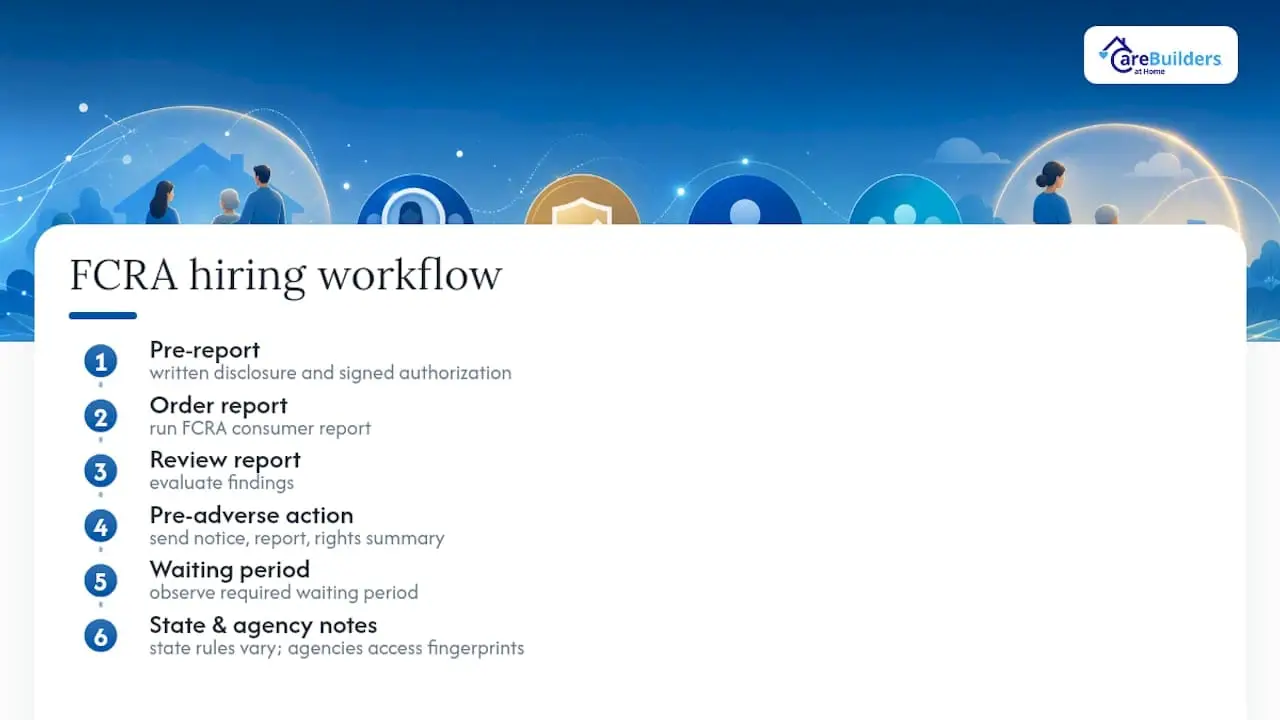
State requirements add another layer. Wisconsin’s Department of Quality Assurance mandates specific caregiver background check procedures for licensed providers, while California’s Health and Safety Code sets its own rules for home care organizations. These vary enough that a check compliant in one state may not satisfy another state’s licensing board.
Here’s the catch most families miss: licensed agencies typically have access to state fingerprint systems and abuse registries that private households simply cannot query on their own. The National Background Check Program, funded through CMS state grants, restricts certain fingerprint-based and registry searches to licensed entities. If you’re hiring privately, ask candidates whether they’ve already passed a state-mandated agency screening. That history gives you a proxy for checks you cannot run yourself.
Common vendor mistakes: skipping the written disclosure step, running a check before authorization is signed, or failing to issue a pre-adverse notice before withdrawing an offer. Any of these can expose you to legal liability, regardless of what the report found.
How Do You Run a Caregiver Background Check Step by Step?
Start by defining the role, because the checks you need depend on what the caregiver will actually do. A live-in aide managing medications needs a different screening depth than someone providing a few hours of companionship. Driving duties mean you need a motor vehicle record. Medication management raises the stakes on any prior substance-related offenses.
- Define the role and risk level. Will this person drive your parent, manage medications, or live in the home overnight?
- Get written consent. Provide a clear FCRA disclosure stating you’ll obtain a consumer report for employment purposes, and get a signed authorization before you order anything.
- Choose your path. Decide between a DIY consumer-report service, a specialized caregiver screening vendor, or a licensed home care agency that has already vetted its staff.
- Order the searches. Request criminal history, registry checks, identity verification, and any role-specific searches like MVR or drug testing.
- Review results and follow FCRA procedures. If findings might disqualify the candidate, send a pre-adverse action notice, wait the required period, then proceed to adverse action if warranted.
- Document everything. Keep signed consent forms, the report, and your decision notes in a secure file.
Pro Tip: Don’t rely on the criminal report alone. Call every reference listed, and ask specifically about reliability under stress, not just general character. A candidate who sounds great on paper can still have a spotty attendance history that only a former employer will mention.
Which Findings Should Stop the Hiring Process?
Some findings are unambiguous. Violent crimes, sexual offenses, substantiated findings on an abuse or neglect registry, an active OIG exclusion, or theft and fraud convictions involving vulnerable adults are clear disqualifiers for anyone entering a senior’s home. There’s no context that makes these acceptable for direct patient access roles.
Other findings need judgment. A 15-year-old misdemeanor, a dismissed charge, or a single non-conviction arrest shouldn’t automatically end a candidacy. The Equal Employment Opportunity Commission has cautioned employers against blanket exclusions that ignore how much time has passed, the nature of the offense, and its relevance to caregiving duties.
What deserves more attention than most families give it: inconsistencies. If a candidate’s resume says they worked somewhere for three years but the report shows a six-month gap, or a reference’s story doesn’t match the candidate’s own account, that mismatch is often more revealing than a clean criminal record. Investigate the discrepancy directly rather than dismissing it.
- Automatic disqualifiers: violent crime, sexual offense convictions, substantiated abuse findings, OIG/LEIE exclusion, financial crimes against vulnerable adults
- Requires context: old convictions, dismissed charges, arrests without conviction
- Always investigate: gaps or contradictions between the report, resume, and reference answers
Whatever standard you apply to one candidate, apply to all of them, and write down why you made each decision. That consistency protects you if a hiring decision is ever questioned later.
How Often Should You Rescreen a Caregiver?
Licensed agencies typically rescreen at hire and then again on a schedule set by state rules, often annually or every two to four years depending on the state’s licensing requirements. That cadence exists because a clean record at hire doesn’t guarantee a clean record five years later.
Families hiring privately should adopt a similar habit: recheck annually, and always recheck if the caregiver’s role changes (say, from companion care to medication management) or if something raises a concern.
- Set a recurring annual recheck as your baseline, even for long-tenured caregivers
- Rescreen immediately after any role change or unresolved concern
- Consider low-cost periodic database checks between full rescreens
- Remember that fingerprint-based and certain state registry checks generally stay limited to licensed agencies, which is one more reason families lean on agency-vetted candidates for anything beyond companion care
What Should Your Screening Checklist Include?
A workable consent form needs five elements: a clear disclosure that a background check will occur, a statement of purpose (employment as an in-home caregiver), an authorization line for signature, a date field, and a note on how you’ll store the records securely.
- Confirm identity with a government-issued ID and Social Security number trace.
- Run criminal and registry checks covering county, state, sex offender, and abuse/neglect databases.
- Verify employment and education history against the candidate’s resume.
- Check motor vehicle records if driving is part of the job.
- Confirm any required license or certification is current and unrestricted.
Five reference questions worth asking every time: How did the caregiver handle a stressful or unexpected situation? Did they ever miss shifts without notice? How did they communicate about changes in the client’s condition? Would you rehire them? Is there anything you’d want us to know before we do?
Pro Tip: Tell candidates plainly, before you screen them, exactly what you’re checking and why: “We run a background check on every caregiver we consider, covering criminal history and abuse registries, because we take my father’s safety seriously.” Transparency up front tends to reduce friction later.
How Does CareBuilders at Home Screen Its Caregivers?
CareBuilders at Home of Plano & Allen builds every hire around the screening depth this guide describes, layered specifically for dementia and veteran care, where the stakes are higher and the margin for error is smaller. As a VA-approved provider, the agency also helps veteran families navigate benefits while pairing trained caregivers with virtual monitoring and fall detection technology for round-the-clock safety.
Choosing a licensed provider shifts the fingerprint-based checks, registry access, and ongoing rescreening burden off your shoulders and onto a team that already has the infrastructure to do it right.
Families in Plano, Allen, Richardson, and Wylie get the benefit of that infrastructure without having to become screening experts themselves.
What This Guide Gets Right That Most Advice Misses
Most caregiver background check advice treats the report as the finish line. It isn’t. The research behind this guide points to a more honest conclusion: a “clean” report tells you what didn’t happen, not whether this specific person will handle your parent’s medication schedule responsibly at 2 a.m. on a hard night.
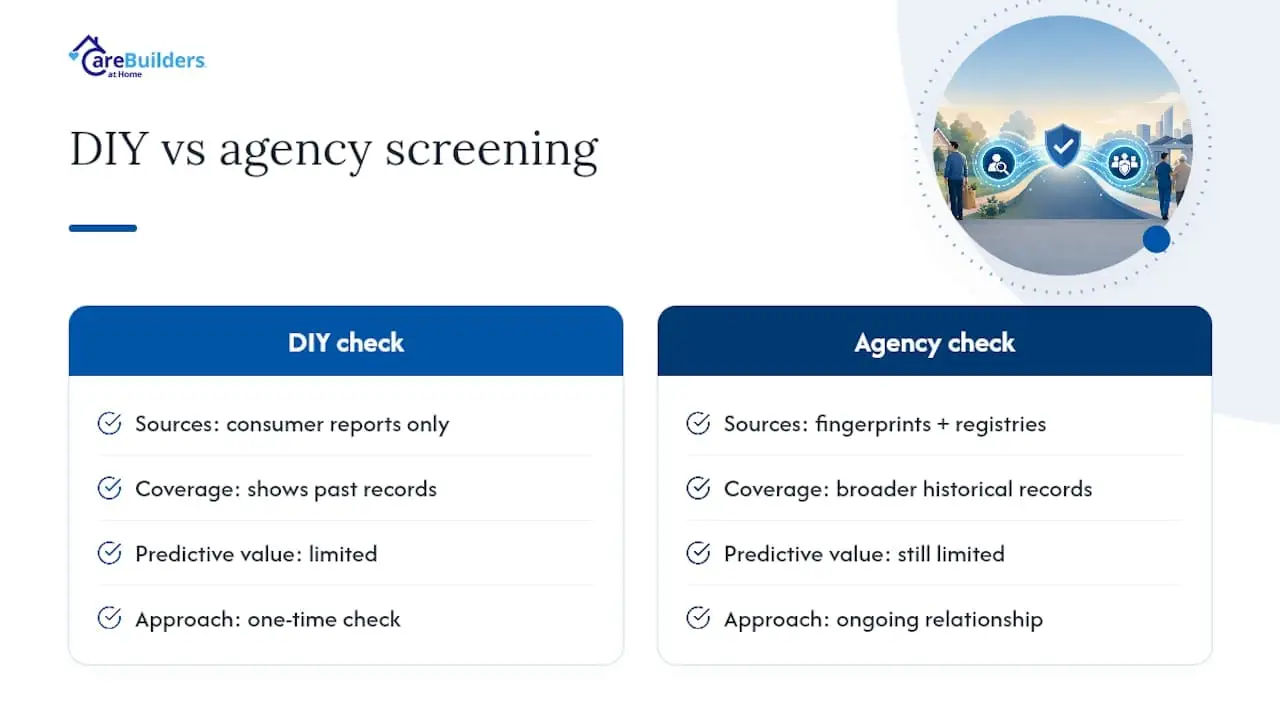
Where conventional advice falls short is in treating DIY screening as equivalent to agency screening. It rarely is. Private households cannot access the same fingerprint systems or state abuse registries that licensed agencies use as a baseline, which means a family running only a consumer-report check is working with a narrower picture than they realize.
If you take one thing from this guide, prioritize the follow-up over the paperwork. Call references. Ask about gaps. Notice when a story doesn’t add up. The report is your floor, not your ceiling, and the families who do best are the ones who treat screening as an ongoing relationship with a provider, not a one-time box to check.
— cbahplano
Ready for Caregivers Who Are Already Fully Screened?
CareBuilders at Home of Plano & Allen exists for families who want the screening depth this guide describes without becoming background check experts themselves. Every caregiver on staff goes through the fingerprint-based and registry checks that private households often cannot run alone, plus ongoing monitoring that continues well past the hiring date. That means you get dementia-trained, VA-familiar caregivers for personal care and companion support without spending weeks chasing consent forms and vendor reports yourself. If you’re ready to move from research to action, start with our guide on how to arrange in-home care for an elderly parent and let our team walk you through next steps for your family in Plano, Allen, Richardson, or Wylie.
Sources
- Caregiver background check best practices — GoodHire
- Background checks and the National Background Check Program — CMS