


Choose Flexible In-Home Assistance for Seniors: A Practical Guide

The single best first step when you need to choose flexible in-home assistance is to write down the specific problem you are solving before you contact a single provider. Are you managing fall risk, missed medications, overnight wandering, or caregiver exhaustion? That answer shapes everything else. Providers like CareBuilders at Home of Plano & Allen, along with public programs such as Medicare and VA benefits, each cover different problems and different schedules, so clarity upfront prevents choices driven by sales pressure rather than real need.
Quick-start steps:
- Write the specific problem in one sentence (fall risk, medication gaps, overnight coverage, family burnout).
- Estimate a minimum safe plan (fewest hours that keep your loved one safe) and an ideal plan (full support you would want).
- Request written minimum-shift policies and backup staffing procedures from every provider you consider.
- Compare at least three providers on identical criteria: schedule fit, caregiver continuity, responsiveness, training, and total estimated monthly cost.
What flexibility means in practice:
- Schedule swaps with less than 24 hours’ notice
- Short-notice shift coverage with a named backup caregiver
- Formal care plan reassessments triggered by condition changes, not just annual reviews
- Split or short visits billed transparently (e.g., two 45-minute visits vs. one 90-minute block)
Table of Contents
- What types of in-home assistance can actually flex with your schedule?
- Agency, private hire, or registry: which gives you the flexibility you need?
- What does genuinely flexible care look like in practice?
- How to compare providers and make a confident choice
- What does in-home care actually cost, and what will insurance cover?
- How to run a low-risk trial and know if it’s working
- How CareBuilders at Home of Plano & Allen approaches flexible care
- Red flags that a provider’s flexibility is not real
- Key Takeaways
- Why flexibility in care planning matters more than families expect
- CareBuilders at Home of Plano & Allen is ready to build your flexible care plan
- Useful sources to verify coverage and local rates
What types of in-home assistance can actually flex with your schedule?
Flexible home care is built around the idea that services, timing, and frequency should adapt to the individual’s routine rather than the provider’s convenience. Knowing the service types helps you recognize what each provider is actually offering.
- Companion care: Nonmedical visits focused on conversation, errands, and social engagement. Highly flexible because no clinical credential is required, making short or split visits easier to schedule.
- Personal care (ADLs): Bathing, dressing, grooming, and mobility support. Requires a trained personal care aide or certified nursing assistant (CNA); visit timing often ties to morning or evening routines, so true flexibility means the provider can accommodate both.
- Home health aide (HHA): A step above personal care, often including basic health monitoring. Regulated by state and, when Medicare-certified, by federal standards.
- Skilled nursing (RN/LPN): Wound care, injections, medication management. Typically prescribed and time-sensitive, which limits schedule flexibility but can be layered with nonmedical companion visits on the same day.
- Overnight or live-in care: Covers nighttime wandering, fall risk, and caregiver respite. Live-in arrangements usually require a rest period for the caregiver, which affects how “on-call” they can be.
- Respite care: Short-term relief for family caregivers, ranging from a few hours to several weeks. Medicaid covers respite in most states; Medicare covers it only under hospice.
- Short-visit or hourly care: Visits as brief as one to two hours for medication reminders or meal prep. The most flexible format, though minimum billing increments vary widely by provider.
- Virtual check-ins and hybrid monitoring: Remote video or sensor-based check-ins that supplement in-person visits. Useful for families who need reassurance between scheduled visits without adding full hours.
Caregiver credentials vary significantly by role and state. Companion aides typically require no clinical certification; CNAs and HHAs complete state-approved training programs; RNs and LPNs hold state licenses. Matching the credential to the task protects your loved one and keeps costs proportionate to actual need.
Agency, private hire, or registry: which gives you the flexibility you need?
The hiring route you choose shapes how much schedule control you actually have, and each comes with real trade-offs.

| Hiring Route | Schedule Flexibility | Backup Coverage | Family Burden | Relative Cost |
|---|---|---|---|---|
| Licensed agency | Moderate (minimums apply) | Agency-managed; backup caregiver on file | Low (agency handles payroll, vetting, supervision) | Higher hourly rate |
| Private/direct hire | High (you set the schedule) | Family-managed; no automatic backup | High (family handles taxes, vetting, replacement) | Lower hourly rate |
| Registry/placement | Moderate to high | Varies; registry may offer a replacement list | Medium (family manages day-to-day; registry vets) | Mid-range |
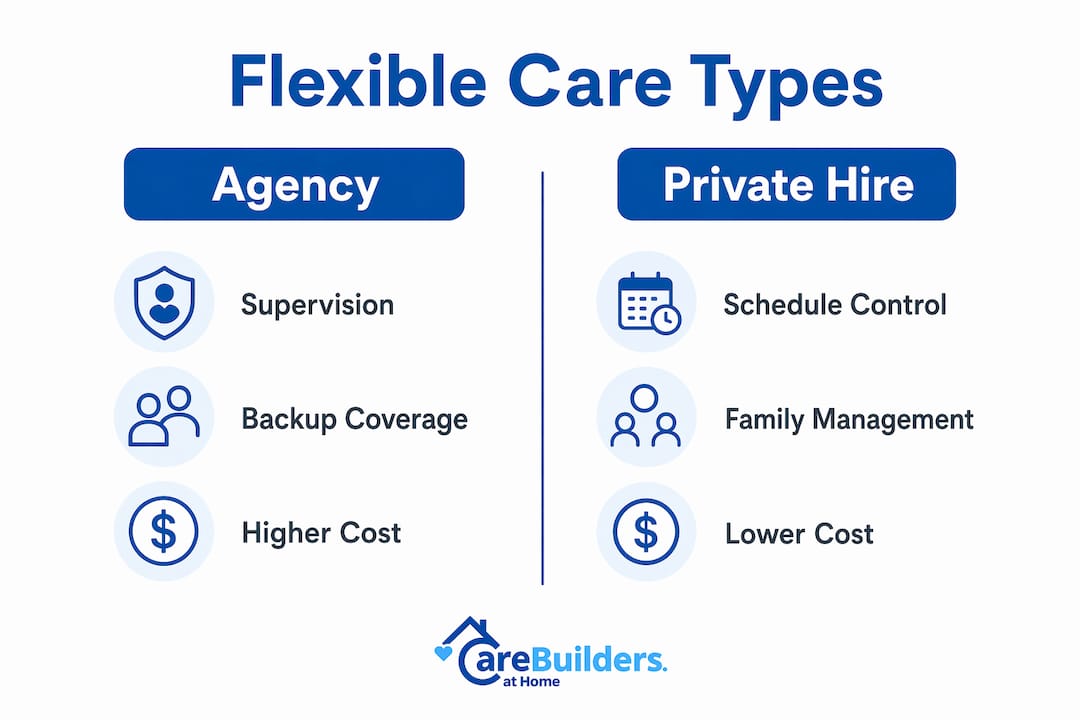
Agencies typically provide supervision, backup caregivers, and payroll handling, but they often require minimum hourly commitments per visit or per week. Private hires and registries can offer greater schedule flexibility, but vetting, payroll, and reliability responsibilities fall on the family. This trade-off is significant and worth pricing carefully.
Pro Tip: Before assuming a private hire saves money, calculate the total family time cost. Managing payroll, taxes, background checks, and last-minute replacements can easily consume 5–10 hours per month. For many families, that hidden labor often tips the math back toward an agency.
What does genuinely flexible care look like in practice?
Marketing language and operational reality are two different things. Use this checklist during provider calls to separate the two.
Questions to ask every provider:
- “What is your average time to fill a same-day shift?” (Under four hours is a reasonable benchmark; “we do our best” is not an answer.)
- “Do you allow split 45-minute visits, and how are they billed?” (Some providers bill a minimum of two or three hours regardless of visit length.)
- “How often do you formally reassess care plans, and what triggers an unscheduled reassessment?” High-quality providers document a proactive reassessment process and modify care plans as conditions change, rather than waiting for a family to call in a crisis.
- “Who is the named backup caregiver for our schedule, and can we meet them in advance?”
- “What is your cancellation policy if we need to reduce hours for a week?”
Scheduling constraints to understand:
- Fixed-time medical tasks (insulin injections, wound care) cannot flex the way companion visits can. If your loved one needs both, confirm the provider can coordinate timing without billing two separate minimums.
- Overnight and live-in arrangements require a caregiver rest period by law in most states. Clarify what “available overnight” actually means in the contract.
- A personalized elder care plan should document these constraints in writing so every caregiver who covers a shift knows the schedule requirements.
How to compare providers and make a confident choice
A repeatable selection process protects you from choosing based on whoever called back first or made the best first impression.
- Define the problem and both plans. Write the specific problem, your minimum safe plan (fewest hours that keep your loved one safe), and your ideal plan. Bring both to every provider conversation.
- Request written pricing for your exact schedule. Ask for an example invoice showing two 45-minute visits versus one 90-minute visit, plus weekend and holiday rates. Cost surprises most often come from minimum shift lengths, split-visit billing, and travel charges.
- Score three providers on identical criteria. Use the same five dimensions for each: schedule fit, caregiver continuity, backup responsiveness, training and supervision, and billing transparency.
- Interview the caregiver, not just the coordinator. Ask the assigned caregiver how they handle a missed alarm, a client who refuses care, or a family member who calls with a last-minute change.
- Set a 30-day trial with a formal review point. Agree in writing that you will evaluate the arrangement at 30 days before committing to a longer term.
Interview questions by topic:
- Scheduling: “What is your minimum shift length? How do you handle a same-day cancellation from your side?”
- Caregiver continuity: “Will the same caregiver cover our regular shifts? What is your average caregiver tenure?”
- Training and supervision: “What specialized training do your caregivers have for dementia or fall prevention? How often does a supervisor check in?”
- Billing: “Are there separate charges for travel time, split visits, or after-hours shifts?”
- Escalation: “If my loved one’s needs increase suddenly, how quickly can you adjust the care plan?”
Pro Tip: Structure the first 30 days as a deliberate test. Vary one shift time, request one short-notice change, and ask for one informal check-in from the supervisor. How the provider responds to those three small tests tells you more about their real flexibility than any intake conversation.
What does in-home care actually cost, and what will insurance cover?
Cost is where families most often get surprised, and the surprises almost always come from the details of how a provider bills.
Primary cost drivers:
- Hourly rate (varies by region, credential level, and agency vs. private hire)
- Minimum shift length (a two-hour minimum on a 45-minute task doubles the effective rate)
- Weekend and holiday premiums (often 10%–25% above the base rate)
- Overtime rules for live-in or high-hour schedules
- Travel time and split-shift billing for multiple short visits in one day
| Payment Source | What It Covers | Key Limitation |
|---|---|---|
| Medicare | Skilled home health (nursing, therapy) when medically necessary | Does not cover nonmedical personal care or companion visits |
| Medicaid HCBS waivers | Personal care, respite, companion services for eligible enrollees | Significant waitlists in many states; eligibility varies |
| VA benefits | Veteran-directed home care, respite, personal care for eligible veterans | Requires VA eligibility determination; flexible budget options available |
| Long-term care insurance | Broad coverage including personal care, respite, home health | Policy terms vary; not all cover informal/family caregivers |
| Private pay | Any service, any schedule | No coverage limits, but full cost falls on the family |
Medicare covers skilled home health services only when a physician certifies medical necessity. It does not cover nonmedical personal care, companion visits, or housekeeping, which are the services most families actually need for flexible daily support. Veterans may qualify for the Veteran-Directed Home and Community-Based Services program, which provides a flexible budget and allows veterans to hire and direct their own caregivers with counselor support.
Medicaid HCBS waivers can cover a wide range of home care services, but waitlists in many states mean families should plan for private pay as a bridge while applications process. Request written pricing with examples for your exact schedule before signing anything.
How to run a low-risk trial and know if it’s working
A structured trial protects you from committing to a provider who cannot deliver on their flexibility promises.
- Agree on written goals before day one. Examples: caregiver arrives within 10 minutes of scheduled time, all morning ADL tasks completed before 9:00 AM, medication reminder confirmed by family text.
- Set objective success metrics. Track arrival time, tasks completed per visit, incident reports, and family follow-up response time. A simple log kept by the caregiver and reviewed weekly works well.
- Run a 2–4 week pilot. Keep the schedule close to your intended ongoing plan so you are testing real conditions, not a honeymoon period.
- Hold a formal 30-day review. Sit down with the care coordinator, review the log, and ask directly: “What would need to change for this plan to work long term?”
- Test one short-notice change during the trial. Call with a same-day schedule adjustment and observe the response time and attitude. This single test reveals more about operational flexibility than any policy document.
Handling mid-trial problems: If a caregiver misses a shift without notice, ask immediately for the supervisor’s direct contact and the incident log. Request a formal reassessment within 48–72 hours if the issue involves a safety concern. If the provider cannot produce a named backup within a reasonable window, that is a signal to pause the trial and compare your other two options. For arranging in-home care step by step, a structured approach from the start reduces the chance of a mid-trial crisis.
How CareBuilders at Home of Plano & Allen approaches flexible care
CareBuilders at Home of Plano & Allen serves seniors and veterans in Plano, Allen, Richardson, Wylie, and surrounding Collin County with nonmedical in-home care built around adaptable schedules and evolving needs.
Specific features that support genuine flexibility:
- Care plan reassessment process: Care plans are reviewed and updated as a client’s condition changes, not only on a fixed annual schedule. This proactive approach means the plan adjusts before a situation becomes a crisis.
- VA-approved provider status: CareBuilders at Home of Plano & Allen is approved to work with veteran care benefits, helping eligible veterans access flexible home support through VA programs without navigating the process alone.
- Virtual check-ins and fall detection technology: Remote monitoring and virtual check-ins supplement in-person visits, giving families real-time reassurance between scheduled shifts and reducing the need to add hours simply for peace of mind.
- Specialized dementia training: Caregivers receive training specific to dementia and Alzheimer’s care, which matters because cognitive conditions change unpredictably and require caregivers who can adapt in the moment.
- Backup staffing and short-notice coverage: The agency model means a named backup is available when a regular caregiver cannot make a shift, without the family scrambling to find a replacement.
- Personal care services covering ADLs, companion visits, and hybrid monitoring are available as standalone or combined plans, so families can start with a minimum safe plan and expand as needs grow.
Red flags that a provider’s flexibility is not real
A few warning signs consistently predict poor reliability or hidden costs. Watch for these during your search.
- Vague answers on minimums. If a coordinator cannot tell you the exact minimum shift length and how split visits are billed, the invoice will surprise you.
- No written backup policy. “We always find someone” is not a policy. Ask for the written procedure and the average fill time for a same-day gap.
- Pressure to sign immediately. A provider who discourages a 30-day trial or pushes for a long-term contract before you have met the caregiver is prioritizing their schedule over yours.
- Unclear billing for short or split visits. If the provider cannot give you a sample invoice for your exact schedule, assume the worst-case billing scenario.
- Poor responsiveness during the sales process. If calls go unreturned during intake, they will go unreturned when you have an urgent scheduling need.
When to escalate to clinical care: Rapid decline in mobility, two or more falls in a month, missed medications that have caused a health event, or significant behavioral changes in a person with dementia all signal that a nonmedical care plan may no longer be sufficient. Request a formal reassessment from the provider within 48–72 hours and consult the client’s physician about whether a home health aide or skilled nursing visit should be added. The agency vs. private hire trade-offs become especially important at this stage, because an agency can typically escalate to a higher credential level faster than a family managing a private hire.
Key Takeaways
Choosing adaptable in-home care comes down to defining the specific problem first, then comparing at least three providers on identical criteria before signing anything.
| Point | Details |
|---|---|
| Define the problem first | Write the specific care need in one sentence before contacting any provider. |
| Compare three providers equally | Use the same five criteria: schedule fit, continuity, backup, training, and billing transparency. |
| Run a structured 30-day trial | Test one short-notice change during the trial; the response reveals real flexibility. |
| Check all funding sources | Medicare covers skilled care only; VA benefits and Medicaid HCBS waivers may cover nonmedical support, but waitlists apply. |
| CareBuilders at Home of Plano & Allen | Offers VA-approved, technology-supported, reassessment-driven care for seniors and veterans in Collin County. |
Why flexibility in care planning matters more than families expect
Families often come to us after a crisis, and the pattern is almost always the same: a rigid care arrangement that could not adapt when a parent’s needs shifted. The 40-70 rule exists precisely because proactive conversations, before a fall or a hospitalization forces the issue, lead to far better outcomes than reactive decisions made under pressure. What I see consistently is that families who build flexibility into the care plan from the start, including written reassessment triggers and a named backup caregiver, avoid the scramble that burns out family caregivers and puts seniors at risk. The question is not whether needs will change. They will. The question is whether the plan you put in place today can change with them, or whether you will be starting over from scratch at the worst possible moment.
CareBuilders at Home of Plano & Allen is ready to build your flexible care plan
When you are ready to move from research to action, CareBuilders at Home of Plano & Allen offers a concrete starting point: a needs assessment that maps your loved one’s current situation to a minimum safe plan and an ideal support plan, with no pressure to commit to a long-term schedule before you are confident it works.

Personal care services cover ADLs, medication reminders, and companion visits on schedules that can be adjusted as needs change. Veteran care is available for eligible veterans in Plano, Allen, Richardson, Wylie, and surrounding Collin County, with VA benefit coordination included. Virtual check-ins and fall detection technology mean families stay connected between visits without adding unnecessary hours. To arrange a written pilot plan or schedule a needs assessment, contact CareBuilders at Home of Plano & Allen directly and ask for a 30-day trial proposal.
Useful sources to verify coverage and local rates
These resources help you confirm coverage rules, caregiver credential requirements, and funding options for your specific state and situation.
- Medicare.gov: Official source for what Medicare covers under home health benefits and what it does not cover (nonmedical personal care).
- USAGov: Disability Caregiver: Explains the Veteran-Directed Home and Community-Based Services program and state consumer-directed personal assistance programs.
- KFF: Medicaid’s Home Care Support: Detailed breakdown of Medicaid HCBS waivers, self-direction options, and which states pay family caregivers.
- NCOA: How to Earn Money as a Family Caregiver: Practical guide to Medicaid HCBS waivers, long-term care insurance, and personal care agreements.
- AARP: Hiring an In-Home Caregiver: Clear overview of agency vs. private hire trade-offs, including supervision, backup, and cost differences.
- CaringInfo: Types of In-Home Caregivers: Credential and training expectations for each caregiver role, organized by state regulation.
- CareScout: How to Choose a Home Care Agency: Eight-step framework including reassessment cadence and backup staffing questions.
A practical note: Medicaid HCBS waiver waitlists and local hourly rates vary significantly by county and state. Always ask providers for written local pricing that reflects your exact schedule, and contact your state Medicaid office directly to confirm current waiver availability and eligibility rules.
Recommended
- Personal Care – CareBuilders at Home | Senior and Veteran Care in Plano, Allen & Richardson TX
- Arrange in-home care for an elderly parent: essential steps
- What Personal Assistance Services Include: A 2026 Guide – CareBuilders at Home | Senior and Veteran Care in Plano, Allen & Richardson TX
- Companion Services – CareBuilders at Home | Senior and Veteran Care in Plano, Allen & Richardson TX