


How U.S. Families Fund 24 Hour Home Care and Why $24,700 Matters
The national median cost for 24/7 non-medical in-home care runs about $34 an hour, which adds up to roughly $24,700 a month when care is staffed with rotating caregivers. Medicare almost never covers ongoing custodial care like this, so most families end up piecing together savings, Medicaid waivers, VA benefits, or long-term care insurance. If your loved one qualifies for veteran or Medicaid programs, start there before requesting quotes from local agencies.
TL;DR:
- Rotating-shift care at the median rate of $34 hourly totals approximately $24,700 monthly, with annual costs nearing $300,000 before benefits offset expenses.
- Live-in arrangements generally cost less upfront but involve complex rules about overnight sleep time and may not be cheaper when factoring in secondary caregivers.
- Costs vary significantly depending on location, medical needs, shift structure, premium pay for nights and holidays, and whether services are through an agency or private hire.
- Medicare rarely covers custodial care, making family blending of Medicaid, VA, insurance, and private pay necessary to afford ongoing 24/7 support.
- Asking for detailed staffing plans and itemized invoices is essential to avoid surprises and accurately assess true monthly costs.
Table of Contents
- Key Takeaways On 24 Hour Home Care Cost
- How Hourly Rates Turn Into Monthly Totals
- What 24-Hour Home Care Actually Covers
- What Drives Your 24/7 Home Care Price Up Or Down
- How To Pay For 24-Hour Home Care
- How To Choose A Caregiver Or Agency
- When Full 24/7 Care Isn’t The Right Or Affordable Fit
- How CareBuilders At Home Structures Round-The-Clock Support
- What The Cost Numbers Actually Tell Families
- Get Local Help Budgeting For Continuous Care
- Sources
Key Takeaways On 24 Hour Home Care Cost
You’re looking at a wide range depending on how care is staffed. Rotating shifts with multiple caregivers cost more overall but reduce burnout risk and legal gray areas. A live-in arrangement often looks cheaper on paper, but it comes with its own set of rules and hidden costs.
Quick snapshot of what families are paying:
- National median: about $34 per hour, or roughly $24,700 per month for round-the-clock rotating-shift care
- Live-in caregiver arrangements: often billed as a daily flat rate, generally lower in raw dollars but subject to overnight wage rules
- Skilled nursing visits: billed separately and at a higher rate than non-medical aide time, since they require licensed staff
- Biggest cost drivers: geography, medical complexity, and whether you hire through an agency or privately
Cost Snapshot: A family paying near the national median for full rotating-shift coverage should plan for an out-of-pocket annual cost approaching $300,000 before any benefit offsets.
Most families don’t pay this from one source. They blend savings, a benefit like VA Aid and Attendance, and sometimes a part-time Medicaid waiver to close the gap.
How Hourly Rates Turn Into Monthly Totals
The math behind 24 hour home care cost is simple once you see it laid out, but the totals surprise almost everyone the first time they run the numbers.
- Basic hourly math. At $30 an hour, 24 hours of coverage costs $720 a day, or about $21,600 a month. At $40 an hour, that same day jumps to $960, or roughly $28,800 a month. The national median of $34 an hour lands you around $816 a day and $24,700 a month, consistent with figures reported across cost-of-care surveys.
- Rotating-shift staffing. Agencies typically split 24-hour coverage across two or three caregivers working 8 or 12-hour shifts. This adds coordination overhead, but it keeps caregivers fresh and reduces the risk of a single point of failure if someone calls out sick. Expect the agency’s hourly rate to already reflect this staffing model, not to be charged on top of it.
- Live-in flat fees. Some agencies and private caregivers offer a daily flat rate for live-in care, often lower than 24 separate hourly charges because it assumes the caregiver sleeps for a portion of the night. That flat fee usually covers active care hours plus a defined sleep period. It typically does not cover room, board, or the caregiver’s meals, which the family often provides separately.
- Regional swings. A rural area with a thinner caregiver labor pool might land below the national median, while a high-cost metro area can run well above it. Ask any agency for their local rate card rather than assuming the national figure applies to your zip code.
- Watch for add-on fees. Holiday premiums, last-minute scheduling charges, mileage reimbursement, and assessment fees can all sit outside the quoted hourly rate. Request an itemized rate sheet before signing anything.
What 24-Hour Home Care Actually Covers
Not all “24-hour care” means the same thing, and the label on a quote matters as much as the number attached to it.
- Companion care covers conversation, supervision, light errands, and simply not leaving someone alone overnight.
- Personal care includes help with activities of daily living: bathing, dressing, toileting, mobility, and transfers.
- Homemaker services cover meal prep, laundry, light housekeeping, and medication reminders (not administration).
- Home health aide services blend personal care with basic health monitoring under a care plan, sometimes overseen by a nurse.
- Skilled nursing involves licensed nurses performing wound care, injections, or other clinical tasks, and it’s billed at a separate, higher rate.
Medicare’s home health coverage applies only to the skilled category, and only when a physician certifies the patient is homebound and needs intermittent, not continuous, care. Non-medical companion and personal care, the bulk of what a 24/7 arrangement actually needs, sits outside Medicare almost entirely. Combining a few weekly skilled nursing visits with daily non-medical aide coverage is common, and it raises the total bill because you’re paying two different rate tiers.
What Drives Your 24/7 Home Care Price Up Or Down
Five variables explain most of the swing between a $22,000 monthly bill and a $30,000 one.
- Geography. Local wage floors and caregiver demand set the baseline. Coastal metros and fast-growing Sun Belt cities tend to run above the national median.
- Medical complexity. A client managing insulin, a feeding tube, or advanced Parkinson’s needs a more skilled, better-trained caregiver, and that shows up in the rate.
- Shift structure. Live-in setups are governed by Department of Labor rules on sleep time for live-in domestic workers, which limit how much of the overnight period counts as unpaid sleep versus paid active work. If your loved one needs frequent overnight assistance, that sleep-time exemption often doesn’t apply, and the live-in rate you were quoted no longer holds.
- Premium pay. Nights, weekends, and holidays commonly carry a rate bump of 10 to 25 percent over standard daytime hours.
- Agency versus private hire. An agency rate includes payroll taxes, workers’ compensation, liability insurance, and backup staffing if your caregiver is sick. A private hire skips the markup but puts you on the hook for all of that yourself.
Pro Tip: Ask any live-in candidate or agency exactly how many hours per night qualify as paid active care versus unpaid sleep time. That single number can swing your monthly total by hundreds of dollars and determines whether you’ll need a second caregiver for overnight wake-ups.
How To Pay For 24-Hour Home Care
No single payer covers the full cost of round-the-clock care for most families, so the real work is stacking the right combination.
- Medicare pays for short-term, physician-ordered skilled visits when someone is homebound. It was never designed to fund ongoing custodial care, and it won’t stretch to cover a 24/7 arrangement no matter how the hours are billed.
- Medicaid Home and Community-Based Services (HCBS) waivers can fund substantial in-home support, but each state runs its own program with its own income limits and waitlists that can run months or longer. Apply early even if you’re not sure you’ll need the benefit right away.
- VA Aid and Attendance is a monthly cash benefit for eligible veterans and surviving spouses that can be applied directly toward home care costs. Processing commonly takes roughly 100 to 180 days, so file the paperwork as soon as a need becomes likely, not after the crisis hits.
- Long-term care insurance pays out once an elimination period (often 60 to 90 days of self-funded care) passes and a benefit trigger, usually needing help with a set number of daily activities, is documented.
- Private pay fills whatever gap remains. Most planners recommend layering multiple funding sources rather than betting the entire budget on one program.
The Administration for Community Living offers a useful starting point for understanding how these payers typically interact over a multi-year care plan, which matters if you’re budgeting past the first year.
How To Choose A Caregiver Or Agency
A low quote means nothing if the staffing behind it falls apart the first time someone calls in sick. Work through this checklist before signing anything.
- Verify licensing and insurance. Confirm the agency carries liability coverage and workers’ compensation, and ask how caregivers are screened, including background checks and dementia-specific training if relevant.
- Ask who covers a callout. Get a direct answer on what happens when your primary caregiver is sick or on vacation, and how quickly a qualified backup arrives.
- Clarify who pays payroll taxes. With a private hire, you’re the employer of record. With an agency, that burden shifts to them, and that’s part of what the markup covers.
- Request a written care plan. It should name specific tasks, a shift schedule, and escalation steps for a medical emergency, not vague language about “assistance as needed.”
- Ask for a sample 30-day invoice and staffing matrix. This shows primary, secondary, and emergency backup caregivers, and it often reveals overtime and premium patterns a headline hourly rate hides.
- Watch for red flags. Vague contracts, no written termination policy, and reluctance to name backup staff are all reasons to keep shopping.
When Full 24/7 Care Isn’t The Right Or Affordable Fit
Round-the-clock staffing isn’t always necessary, and it isn’t always the only safe option.
- Overnight-only supervision suits someone who is independent during the day but wanders or falls at night.
- Adult day programs and respite care give family caregivers scheduled breaks without the cost of continuous staffing.
- Assisted living trades home comfort for shared staffing costs, often landing below a private 24/7 home care budget for clients who don’t need one-on-one attention.
- Combining part-time professional care with family caregiving can cut costs, but it shifts unpaid labor, and sometimes lost income, onto family members.
How CareBuilders At Home Structures Round-The-Clock Support
Continuous care works best when staffing and technology cover the gaps a single caregiver can’t. CareBuilders at Home of Plano & Allen builds 24/7 plans around a few core pieces:
- Trained non-medical caregivers, including specialized dementia and Alzheimer’s care for clients who need more than basic supervision
- Virtual monitoring and fall detection that extends oversight between in-person shifts, which can reduce how many overnight hours require an active caregiver on site
- VA-approved status, so veteran families get direct help navigating VA benefits rather than working through the paperwork alone
For families in Plano, Allen, Richardson, and Wylie, that combination often changes the staffing math: monitoring technology can fill lower-risk overnight windows, while human caregivers focus on higher-need hours, which affects the total budget without cutting corners on safety.
What The Cost Numbers Actually Tell Families
Most articles on 24 hour home care cost hand you a national median and stop there, and that’s where the real planning mistakes start. A single hourly figure hides more than it reveals, because the gap between a rotating-shift budget and a live-in one isn’t really about the sticker price. It’s about who absorbs the risk when a caregiver is sick, when overnight needs spike, or when a state waiver waitlist runs longer than expected.
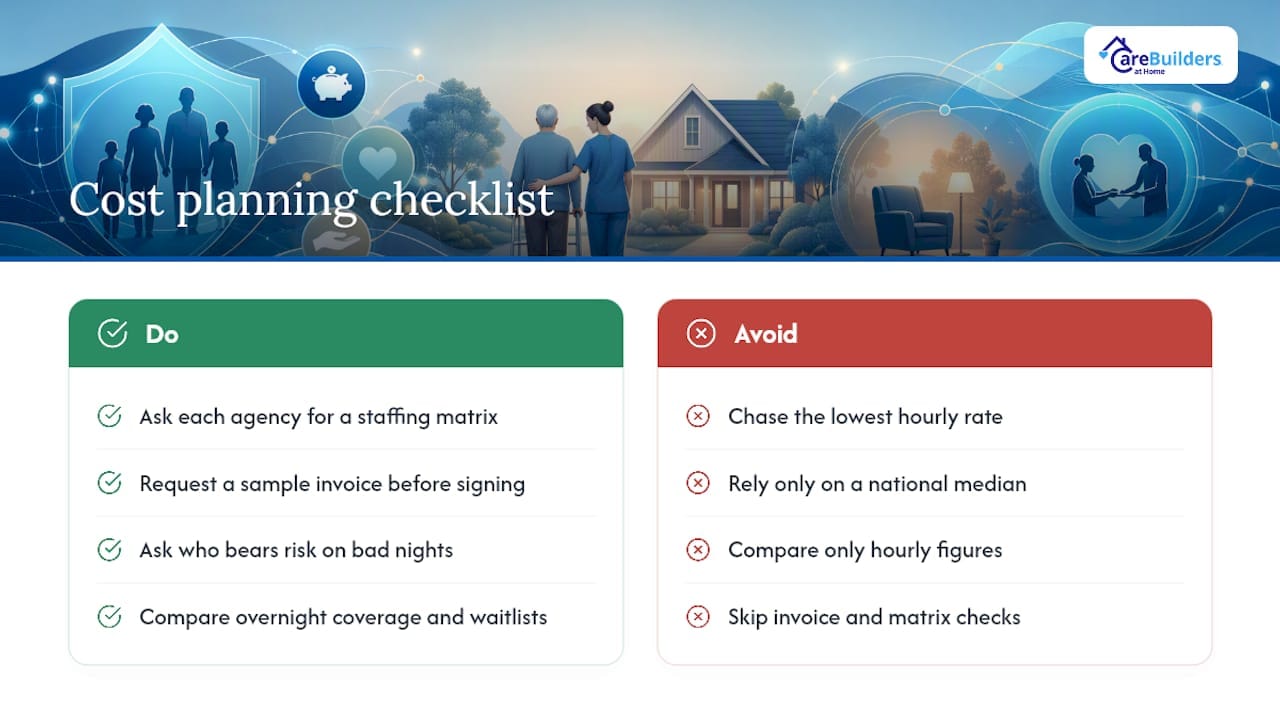
The conventional advice, “get a few quotes and compare hourly rates,” misses the bigger question: what happens on a bad night? A cheaper live-in rate that doesn’t account for active overnight wake-ups isn’t actually cheaper once you’re paying for a second caregiver to cover the gap.
The smartest move isn’t chasing the lowest number. It’s asking every agency for a staffing matrix and a sample invoice before you sign anything, because that’s where the honest cost lives. Families who skip that step are the ones who get blindsided three months in.
— cbahplano
Get Local Help Budgeting For Continuous Care
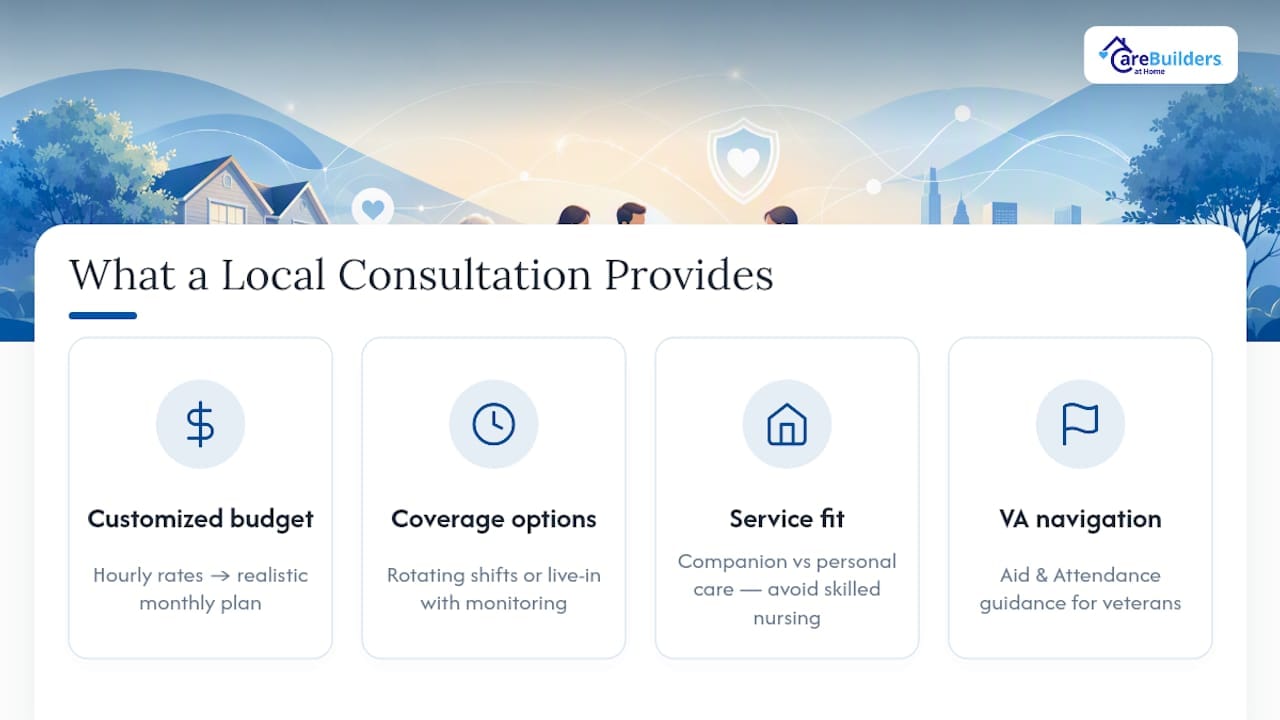
Running these numbers alone is hard, and getting them wrong costs real money over a year of care. CareBuilders at Home of Plano & Allen helps families translate a hourly rate into a realistic monthly budget based on your loved one’s actual needs, not a generic estimate.
A consultation walks through your specific situation, whether that’s rotating-shift coverage, a live-in arrangement paired with monitoring technology, or VA Aid and Attendance navigation for a veteran in the family. You’ll also get a clearer read on how companion and personal care services fit into a 24/7 plan without paying for skilled nursing rates you don’t need.
Download the Free Home Care Navigation Guide to start budgeting with real numbers, or reach out to schedule a consultation and get a local quote for your family’s situation.
Sources
- How Much Does 24/7 Home Care Cost? — A Place for Mom
- Home health services – Medicare
- Medicaid
- Fact Sheet #79B: Live-in Domestic Workers — U.S. Department of Labor